
Australia Natural Gas Market: Domestic Demand, LNG Exports & Infrastructure Investment
How rising domestic energy demand, sustained LNG export growth and ongoing infrastructure investment are shaping Australia’s natural gas market
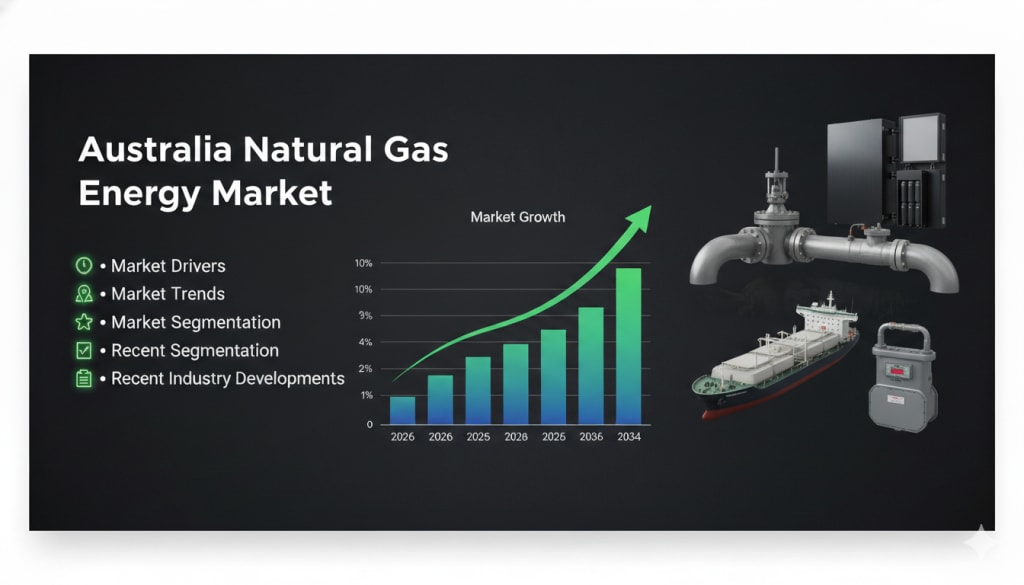
According to IMARC Group, the Australia natural gas market reached USD 34.46 Billion in 2025 and is projected to expand to USD 73.82 Billion by 2034, exhibiting a robust compound annual growth rate (CAGR) of 8.83% during 2026–2034. This strong growth reflects natural gas’s strategic role within the evolving energy framework of Australia. As the country balances decarbonization goals with energy security and industrial competitiveness, natural gas continues to function as both a critical domestic fuel source and a high-value export commodity. Sustained LNG demand, infrastructure modernization and growing industrial consumption are reinforcing the sector’s long-term outlook.
Why Should Smart Buyers and Investors Know About the Australia Natural Gas Market?
Strong Growth Outlook
With a projected CAGR of 8.83%, the sector offers significant expansion potential relative to traditional energy segments.
Critical Role in Energy Security
Natural gas ensures reliable electricity supply and industrial continuity during renewable intermittency.
Stable Export Revenue Streams
Long-term LNG contracts provide predictable income and global market positioning.
Infrastructure-Led Investment Opportunities
Pipeline networks and LNG terminals present capital-intensive, long-duration infrastructure assets.
Transitional Energy Relevance
Natural gas bridges the gap between conventional fossil fuels and renewable energy systems.
Recent Trends & Developments in the Australia Natural Gas Market
July 2025:
LNG export volumes strengthened in response to rising demand from Asian markets.
April 2025:
Pipeline capacity expansion projects advanced to enhance domestic distribution reliability.
October 2024:
Investment announcements highlighted integration of gas-fired power plants with renewable energy systems.
The Australia natural gas market reflects a strategic balance between economic growth, energy security and environmental transition. Supported by IMARC’s strong growth projections, the sector continues to benefit from expanding domestic demand, sustained LNG exports and infrastructure modernization. While renewable energy integration accelerates, natural gas remains indispensable for grid stability and industrial operations. As infrastructure investment advances and technological improvements enhance efficiency, Australia’s natural gas market will remain a pivotal component of the national energy strategy. For investors, infrastructure developers and energy stakeholders, the sector offers a forward-looking opportunity anchored in export strength, industrial resilience and transitional energy dynamics within an evolving low-carbon economy.
Australia Natural Gas Market Vision 2050
1. Cleaner Gas Technologies and Carbon Capture
By 2050, integration of carbon capture and storage (CCS) systems may reduce emissions intensity associated with natural gas extraction and use.
2. Expansion of LNG Trade Networks
Continued development of LNG export terminals may reinforce Australia’s global energy supplier status.
3. Hybrid Energy Infrastructure
Natural gas may operate alongside renewables and storage systems in hybrid energy frameworks to ensure grid reliability.
4. Digital Monitoring and Efficiency Optimization
Advanced data analytics and AI-based pipeline monitoring could enhance safety and operational efficiency.
5. Diversification of Export Markets
Australia may expand trade partnerships to mitigate geopolitical risks and ensure market stability.
What Are the Key Growth Drivers in the Australia Natural Gas Market?
Rising Domestic Energy Demand
Electricity consumption and industrial energy requirements are expanding due to population growth, manufacturing activity and electrification trends. Natural gas remains a key source of dispatchable power generation, particularly as coal-fired plants retire and renewable output fluctuates.
Sustained LNG Export Growth
Australia is among the world’s leading exporters of liquefied natural gas (LNG). Long-term supply agreements with major Asian economies provide stable revenue streams and encourage upstream investment. Rising regional energy demand continues to support export volumes.
Infrastructure Investment and Capacity Expansion
Ongoing investments in pipelines, LNG terminals and gas processing facilities are enhancing distribution efficiency. Infrastructure upgrades improve domestic supply reliability while supporting export logistics and global trade competitiveness.
Role as a Transitional Energy Source
Natural gas is increasingly positioned as a transitional fuel in Australia’s broader energy mix. Compared to coal, gas-fired generation produces lower emissions and offers operational flexibility to complement renewable sources.
Industrial and Manufacturing Applications
Industries such as chemicals, fertilizers, mining and food processing depend heavily on natural gas as both fuel and feedstock. Stable supply and competitive pricing are essential to maintaining industrial productivity.
Integration With Emerging Hydrogen Projects
Existing gas infrastructure may support blue hydrogen production, creating new demand avenues while leveraging established transmission networks.
About the Creator
Keep reading
More stories from Shrestha Roy and writers in Futurism and other communities.
Australia 3D Printing Market: Industrial Adoption, Material Innovation & Application Expansion
According to IMARC Group, the Australia 3D printing market reached USD 672.3 Million in 2025 and is projected to expand to USD 2,773.3 Million by 2034, exhibiting a strong compound annual growth rate (CAGR) of 17.05% during 2026–2034. This rapid expansion highlights the accelerating adoption of additive manufacturing technologies across industries in Australia. Once limited to prototyping, 3D printing is now transforming full-scale production, healthcare innovation and aerospace engineering. As industrial modernization advances and material science breakthroughs expand application possibilities, 3D printing is becoming a core pillar of Australia’s advanced manufacturing ecosystem.
By Shrestha Royabout 13 hours ago in Futurism
Chance AI: Best AI Vision App That Helps Your Phone Understand What It Sees
Imagine pointing your phone’s camera at something and instantly knowing what it is, where it comes from, or how it works. This is no longer science fiction. Thanks to rapid advances in artificial intelligence, AI vision apps are now capable of understanding images almost like humans do. In 2026, finding the best AI vision app has become important for students, professionals, travelers, and everyday users.
By Maheep Makkarabout 12 hours ago in Futurism
No Other Choice (2025)
It is only February, so other films may well surpass “No Other Choice”, but I think this is the best film I’ve seen so far this year. And that surprises me, because, it is a subtitled film and while I am pretentious enough to choose to watch foreign-language films, I was also very tired and that was an extra commitment from me. But more importantly, let me warn you, this film is gruesome and violent. There were times I had to turn away from the screen to avoid the worst of it (including some self-inflicted dentistry).
By Rachel Robbins5 days ago in Geeks




Comments
There are no comments for this story
Be the first to respond and start the conversation.