
Australia Commercial Real Estate Market: Asset Performance, Investor Strategy & Economic Momentum
How office demand, logistics growth and capital flows are shaping Australia’s commercial property landscape
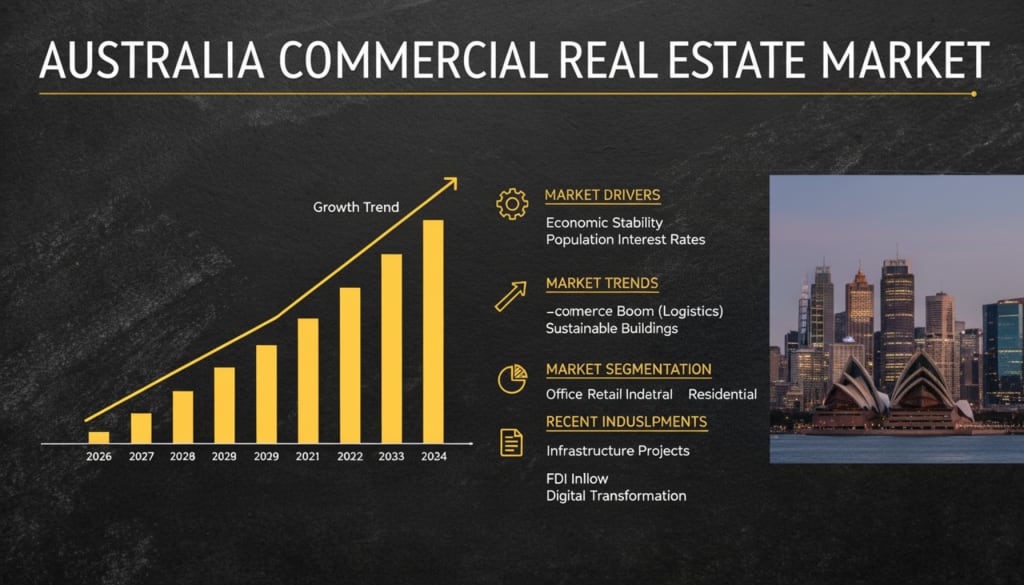
According to IMARC Group, the Australia commercial real estate market reached a value of USD 11.96 Billion in 2024 and is projected to expand to USD 21.03 Billion by 2033, growing at a compound annual growth rate (CAGR) of 5.80% during 2025–2033. This steady growth trajectory reflects the sector’s evolving role within Australia’s broader economic and urban development framework. Commercial real estate is being reshaped by hybrid work models, accelerating demand for logistics and industrial assets, and rising investor focus on sustainability and asset quality. While traditional office space demand has adjusted post-pandemic, flexible work environments, premium-grade buildings and well-located assets continue to attract tenants and capital. Supported by urbanization, infrastructure investment and favorable policy settings, the commercial property market remains a key destination for long-term investment across Australia.
Why Should Smart Buyers and Investors Know About the Australia Commercial Real Estate Market?
Balanced Growth With Income Stability
Commercial real estate offers a blend of moderate growth and recurring rental income, making it attractive for long-term portfolio allocation.
Shift Toward Quality and Sustainability
Premium, green-certified assets are demonstrating stronger occupancy rates and pricing power, reducing long-term asset risk.
Logistics as a Defensive Growth Segment
Industrial and logistics properties provide resilience against economic volatility, supported by structural changes in commerce and supply chains.
Policy Support and Infrastructure Alignment
Government infrastructure investment enhances asset accessibility and long-term demand, supporting value appreciation in well-located properties.
Strategic Role in Economic Development
Commercial real estate underpins business activity, employment hubs and urban growth, reinforcing its importance within Australia’s economic ecosystem.
Recent Trends & Developments in the Australia Commercial Real Estate Market
May 2025:
Institutional investors increased allocations to logistics and industrial assets, reflecting strong tenant demand and limited supply in prime urban locations.
November 2024:
Office landlords accelerated retrofitting initiatives, upgrading older buildings with energy-efficient systems and flexible layouts to improve tenant retention.
July 2024:
Foreign investment activity strengthened in prime commercial districts, supported by favorable policy settings and stable long-term return expectations.
The Australia commercial real estate market illustrates how structural shifts in work, commerce and sustainability are redefining traditional property investment models. Backed by strong IMARC growth projections, the sector’s future will be shaped by asset quality, flexibility and environmental performance rather than scale alone. As hybrid work stabilizes, logistics demand accelerates and capital increasingly favors resilient, future-ready assets, commercial real estate remains a vital component of Australia’s long-term economic momentum. For investors, developers and asset managers, success in this evolving market will depend on aligning strategy with sustainability, technology and changing tenant expectations—positioning commercial property not just as a physical asset class, but as a dynamic platform for future economic activity.
Australia Commercial Real Estate Market Vision 2050
1. Experience-Driven and Flexible Work Environments
By 2050, commercial office spaces are expected to prioritize collaboration, wellness and adaptability, functioning as experience-driven environments rather than fixed workstations.
2. Logistics as Core Urban Infrastructure
Industrial and logistics real estate will increasingly be viewed as essential urban infrastructure, supporting digital commerce, food distribution and advanced manufacturing ecosystems.
3. Net-Zero and Climate-Resilient Assets
Sustainability will transition from a differentiator to a baseline requirement. Net-zero buildings, climate-resilient design and lifecycle emissions management will define asset competitiveness.
4. Technology-Enabled Asset Management
Smart building systems, data analytics and automation will optimize energy use, occupancy and maintenance, improving operational efficiency and tenant satisfaction.
5. Long-Term Capital Alignment
Commercial real estate strategies will increasingly align with long-term capital providers such as pension and superannuation funds, emphasizing income stability and sustainable value creation.
What Are the Key Growth Drivers in the Australia Commercial Real Estate Market?
Evolution of Office Demand and Hybrid Work Models
The widespread adoption of hybrid work has redefined office utilization rather than eliminated demand. Tenants are prioritizing flexibility, location quality and workplace experience, driving demand for premium, well-connected office assets while placing pressure on older, less efficient stock.
Rapid Expansion of Logistics and Industrial Assets
E-commerce growth, supply-chain reconfiguration and last-mile delivery needs are fueling strong demand for logistics and industrial real estate. Low vacancy rates and long-term lease structures make this segment one of the most resilient components of the commercial real estate market.
Sustainability and Green-Certified Buildings
Environmental performance is becoming a decisive factor in tenant selection and investment strategy. Green-certified buildings with strong energy efficiency, emissions reduction and wellness features are commanding rental premiums and demonstrating higher occupancy stability.
Urbanization and Infrastructure-Led Development
Ongoing urban population growth and government-backed infrastructure projects are enhancing the attractiveness of major commercial hubs. Improved transport connectivity and mixed-use developments are supporting demand for centrally located commercial properties.
Foreign Capital Inflows and Institutional Investment
International investors and domestic institutions continue to allocate capital to Australian commercial real estate, drawn by regulatory transparency, stable returns and long-term economic fundamentals. This sustained capital inflow is supporting asset valuations and development activity.
About the Creator
Keep reading
More stories from Shrestha Roy and writers in Futurism and other communities.
Australia Private Equity Market: Strategic Capital, Business Transformation & Long-Term Value
According to IMARC Group, the Australia private equity market reached a size of USD 23.9 Billion in 2025 and is projected to expand to USD 48.5 Billion by 2034, growing at a compound annual growth rate (CAGR) of 8.21% during 2026–2034. This robust growth outlook reflects the rising importance of private equity as a strategic source of long-term capital for business expansion, restructuring and value creation across Australia. As public markets become more volatile and capital efficiency takes center stage, private equity firms are increasingly viewed as active partners rather than passive financiers. The Australian private equity landscape is evolving through higher buyout activity, expanding venture capital participation and increasing exposure to infrastructure, real estate and technology assets. Supported by improving investor confidence and a maturing deal ecosystem, the market is transitioning into a critical pillar of Australia’s broader investment and corporate transformation framework.
By Shrestha Royabout 9 hours ago in Futurism
Why Is the B2B Payments Market Undergoing a Major Digital Transformation?
Business-to-business payments form the backbone of global trade and commerce. Every transaction between manufacturers, suppliers, distributors, wholesalers, and service providers depends on reliable payment systems. Unlike consumer payments, B2B payments often involve large transaction values, longer payment cycles, multiple approval layers, and complex documentation. Because of this complexity, B2B payments have traditionally relied on manual and paper-based processes.
By Rohit Shahabout 9 hours ago in Futurism



Comments
There are no comments for this story
Be the first to respond and start the conversation.