
ATM Managed Services Market Size and Forecast 2025–2033
Outsourcing the Backbone of Banking Infrastructure in a Digital-First World


Global ATM Managed Services Market Outlook
The global ATM Managed Services Market is gaining steady momentum as financial institutions worldwide seek to streamline operations, reduce costs, and enhance service reliability in an increasingly digital banking ecosystem. According to Renub Research, the ATM Managed Services Market is expected to reach US$ 12.29 billion by 2033, growing from US$ 8.45 billion in 2024, at a compound annual growth rate (CAGR) of 4.25% between 2025 and 2033.
ATM managed services refer to the outsourcing of end-to-end ATM operations, including installation, maintenance, cash replenishment, monitoring, incident management, security, and network optimization. As banks balance rising customer expectations with operational efficiency, outsourcing ATM services has become a strategic necessity rather than an optional cost-saving measure.
Despite the rapid growth of digital and mobile banking, ATMs remain a critical channel—especially in emerging economies, semi-urban areas, and regions with high cash dependency. Managed services ensure that these machines operate reliably, securely, and cost-effectively while allowing banks to focus on innovation and customer engagement.
Market Size and Forecast: Renub Research Perspective
Renub Research highlights that consistent ATM usage, combined with increasing outsourcing trends, is supporting sustained growth in the market. While banks continue to invest heavily in digital platforms, ATMs still serve as essential touchpoints for cash withdrawals, deposits, account inquiries, and card-based services.
The forecast growth reflects:
Rising ATM installations in developing cities
Expansion of brown-label and white-label ATMs
Growing adoption of AI-enabled monitoring systems
Heightened focus on security and fraud prevention
Increasing pressure on banks to optimize operational expenditure
Managed service providers are increasingly offering bundled solutions that integrate hardware maintenance, software upgrades, regulatory compliance, and real-time analytics, creating long-term service contracts and predictable revenue streams.
Global ATM Managed Services Industry Overview
The global ATM managed services industry has evolved significantly over the past decade. What was once limited to basic maintenance and cash loading has transformed into a technology-driven service ecosystem powered by artificial intelligence (AI), the Internet of Things (IoT), predictive analytics, and cloud-based platforms.
Banks and financial institutions are outsourcing ATM management to specialist providers to reduce downtime, enhance uptime performance, and meet stringent regulatory requirements. Managed services ensure seamless ATM functionality while minimizing risks associated with fraud, cyber threats, and equipment failure.
Additionally, rising concerns related to magnetic stripe skimming, card fraud, and cyber intrusions have pushed banks toward professional security management solutions. The widespread adoption of EMV chip cards, biometric authentication, QR-based transactions, and NFC-enabled services further reinforces the need for sophisticated ATM management frameworks.
Key Factors Driving the ATM Managed Services Market Growth
1. Focus on Core Banking Competencies
Outsourcing ATM operations allows banks to focus on their core strengths such as customer experience enhancement, product innovation, digital banking expansion, and data-driven decision-making. Managing ATMs internally requires significant capital investment, skilled manpower, and constant technology upgrades.
By partnering with managed service providers, banks can delegate non-core activities such as hardware servicing, software updates, cash replenishment, and compliance monitoring. This shift improves operational efficiency while freeing up internal resources for strategic initiatives.
2. Rising ATM Footprint in Emerging Economies
The expansion of ATM networks, particularly in Asia-Pacific, Latin America, the Middle East, and Africa, remains a major growth driver. Governments and financial institutions are prioritizing financial inclusion, resulting in increased ATM deployments in rural and semi-urban areas.
Managing large and geographically dispersed ATM networks is operationally complex. Managed service providers offer scalable solutions that ensure consistent performance, real-time monitoring, and regulatory compliance across regions, making outsourcing an attractive option for banks expanding their ATM footprint.
3. Technological Advancements and Digital Integration
Technological innovation is reshaping the ATM managed services landscape. AI-powered predictive maintenance enables early detection of equipment issues, reducing downtime and service disruptions. IoT sensors continuously monitor machine health, connectivity, temperature, and security status.
Advanced analytics improve cash forecasting accuracy, optimizing replenishment schedules and reducing idle cash. AI-driven security systems help detect suspicious activities in real time, strengthening fraud prevention measures. These innovations not only lower operational costs but also enhance customer satisfaction.
Challenges in the ATM Managed Services Market
Service Reliability and Downtime Risks
Service reliability remains one of the most critical challenges in the ATM managed services market. Even brief outages can lead to customer dissatisfaction, reputational damage, and financial losses—especially in regions with limited banking alternatives.
Managed service providers must maintain strict service-level agreements (SLAs), deploy real-time monitoring tools, and ensure rapid response mechanisms to minimize disruptions. Balancing cost efficiency with high uptime performance remains a constant operational challenge.
Cash Management and Logistics Complexity
Efficient cash management is a core yet challenging component of ATM services. Providers must accurately forecast cash demand to avoid both cash-outs and excessive idle cash. Poor forecasting leads to customer frustration, increased security risks, and higher operational costs.
Additionally, coordinating secure cash transportation, especially in high-risk or remote areas, requires robust logistics networks, compliance with regulatory norms, and coordination with armored carriers. Cash management remains a resource-intensive but indispensable aspect of ATM managed services.
ATM Managed Services Market Overview by Region
North America
North America holds a significant share of the global ATM managed services market due to mature banking infrastructure and high outsourcing adoption. Banks in the region emphasize cost optimization, advanced security, and AI-driven monitoring solutions.
United States
The U.S. market is driven by large ATM networks, regulatory compliance requirements, and strong demand for predictive maintenance and fraud prevention solutions. Financial institutions increasingly rely on managed services to maintain uptime while controlling operational expenses.
Europe
Europe shows steady growth supported by stringent regulatory frameworks, technological adoption, and expanding smart ATM networks.
Germany
Germany’s strong banking ecosystem and focus on operational efficiency drive demand for managed services. The integration of AI, IoT, and real-time monitoring supports secure and cost-effective ATM operations.
Asia-Pacific
Asia-Pacific represents the fastest-growing region due to expanding ATM installations, rising cash usage in developing economies, and government-led financial inclusion initiatives.
China
China’s vast banking network and rapid technological adoption fuel strong demand for ATM managed services. AI-enabled monitoring, security upgrades, and rural ATM expansion support sustained market growth.
Middle East & Africa
The region is experiencing steady growth driven by digital banking adoption, expanding ATM networks, and government initiatives.
Saudi Arabia
Saudi Arabia’s market benefits from rising debit card usage, financial modernization efforts, and increasing reliance on outsourced ATM operations. Local and international service providers play a key role in supporting secure and efficient ATM infrastructure.
Market Segmentation
By Service Type
ATM Replenishment and Currency Management
Incident Management
Network Management
Security Management
Other Service Types
By ATM Location
Offsite ATMs
Onsite ATMs
Mobile ATMs
Worksite ATMs
Competitive Landscape and Key Players
The global ATM managed services market is moderately consolidated, with established players offering comprehensive service portfolios and long-term contracts.
Key Companies Covered:
NCR Atleos
Diebold Nixdorf, Inc.
Euronet Worldwide, Inc.
Fiserv, Inc.
AGS Transact Technologies Ltd.
Brink’s Incorporated
Hitachi, Ltd.
CMS Info Systems Limited
These companies focus on strategic partnerships, technological upgrades, AI integration, and geographic expansion to strengthen their market position.
Final Thoughts
The ATM Managed Services Market is evolving alongside the global banking industry’s transition toward efficiency, security, and digital integration. While digital banking continues to grow, ATMs remain indispensable—especially in cash-dependent and underserved regions.
With the market projected to reach US$ 12.29 billion by 2033, managed services will play an increasingly critical role in ensuring reliable ATM operations, cost optimization, and enhanced customer experience. As banks prioritize scalability and innovation, outsourcing ATM management will remain a strategic pillar of modern banking infrastructure.
About the Creator
Renub Research
Renub Research is a Market Research and Consulting Company. We have more than 15 years of experience especially in international Business-to-Business Researches, Surveys and Consulting. Call Us : +1-478-202-3244
Keep reading
More stories from Renub Research and writers in Futurism and other communities.
Asia Halal Food Market Size & Forecast 2025–2033
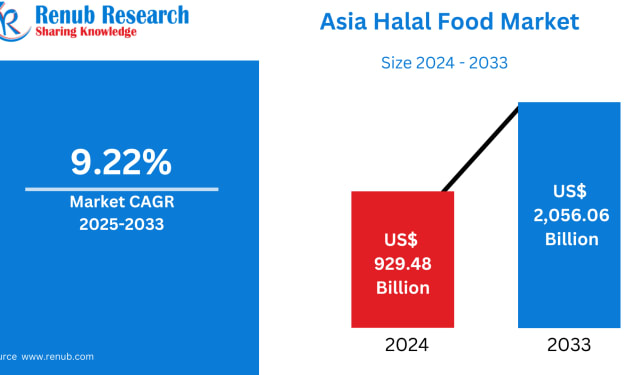
Asia Halal Food Market Overview The Asia Halal Food Market is emerging as one of the most dynamic and influential segments within the global food and beverage industry. According to Renub Research, the market is projected to grow from US$ 929.48 billion in 2024 to US$ 2,056.06 billion by 2033, registering a strong CAGR of 9.22% from 2025 to 2033. This impressive expansion is driven by a combination of demographic growth, rising consumer awareness, globalization, stricter halal standards, rapid e-commerce adoption, and increasing concerns around food safety and quality.
By Renub Research24 days ago in Futurism
About Binding Prometheus
I want to start actively advocating on behalf of my own work, and the most valuable part of my canon is, without a doubt, Binding Prometheus, the play I have been working on since 2019 and only finished in 2023 as part of my MA. The play itself is an amalgamation of a million different inspirations. On one end, it evokes the Ancient Greek myth-play, deriving its own title from the earliest extant work of Western drama we have, Aeschylus’s Prometheus Bound. On the other end, it borrows significantly from the sci-fi bulwarks from over the years, namely Mary Shelley’s Frankenstein and Karel Capek’s Rossum’s Universal Robots. The play could be an episode of Black Mirror, I fear. I don’t know. I’ve only ever seen one episode of Black Mirror.
By Steven Christopher McKnight11 days ago in Futurism
Real Time Location System Market: Asset Tracking, Workflow Optimization & Market Momentum
According to IMARC Group's latest research publication, The global real time location system market size reached USD 9.2 Billion in 2024. Looking forward, IMARC Group expects the market to reach USD 68.3 Billion by 2033, exhibiting a growth rate (CAGR) of 23.64% during 2025-2033
By James Whitman3 days ago in Futurism



Comments
There are no comments for this story
Be the first to respond and start the conversation.