
Artificial Intelligence
The Impact of Artificial Intelligence on the Future

Artificial intelligence:
Artificial intelligence (AI) is a branch of computer science that deals with creating machines that can perform tasks that would normally require human intelligence, such as visual perception, speech recognition, decision-making, and language understanding.
"The potential for AI is massive. But it will be up to us to make sure it's used for good" - Sundar Pichai, CEO of Google
AI can be categorized into two main types: narrow or weak AI, which is designed to perform a specific task, and general or strong AI, which is designed to perform any intellectual task that a human can.
There are several subfields of AI, each focusing on a specific area of research:
1.Machine learning: this subfield deals with the development of algorithms and statistical models that enable machines to learn from and make predictions or decisions without being explicitly programmed.
2.Computer vision: this subfield deals with the ability of machines to interpret and understand visual information from the world.
3.Natural language processing: this subfield deals with the ability of machines to understand and generate human language.
4.Robotics: this subfield deals with the design, construction, and operation of robots.
5.Planning: this subfield deals with the ability of machines to make decisions and plan actions in dynamic environments.
6.Knowledge representation and reasoning: this subfield deals with the representation of knowledge in a machine-understandable form, and the ability of machines to reason with this knowledge.
7.Evolutionary computation: this subfield deals with the use of evolutionary algorithms, such as genetic algorithms, to optimize and evolve artificial systems.
8.Multi-agent systems: this subfield deals with the interaction and coordination of multiple intelligent agents, both artificial and human.
9.Artificial general intelligence: This subfield is the branch of AI that deals with creating machines that can perform any intellectual task that a human can.
10.Deep learning: this subfield deals with the use of artificial neural networks, which are modeled after the human brain, to analyze and understand complex data.
Each of these subfields is an active area of research and development, with new advancements and breakthroughs being made regularly. AI has the potential to revolutionize many industries, including healthcare, finance, transportation, and manufacturing, and it will likely play an increasingly important role in our daily lives in the future.
Future trends in AI:
1.Edge AI: With the increase in the number of connected devices and the need for real-time processing, edge AI is expected to become more popular. Edge AI involves deploying AI models on devices at the edge of the network, such as cameras and sensors, to enable them to process data and make decisions locally without the need for a connection to a centralized server. This reduces the need for data transfer and increases the speed of decision-making.
2.Federated Learning: With the increasing amount of data being generated and the need to protect user privacy, Federated Learning is expected to become more popular. It is a technique where multiple devices work together to train a machine learning model while keeping the data on the device. This allows devices to learn from each other while keeping the data private and secure.
3.Explainable AI: With the increasing use of AI in critical decision-making and safety-critical applications, there is a growing need for AI systems that can be understood and trusted by humans. Explainable AI, which is focused on making AI systems transparent and interpretable, is expected to become more important.
4.AI-powered Robotics: Advancements in AI are also expected to bring about more sophisticated and capable robots. Robotics is an area where AI can be used to enable robots to perform tasks that were previously beyond their capabilities, such as fine manipulation, grasping and grasping objects, and to work with humans in the same environment.
5.AI-powered Healthcare: AI has the potential to revolutionize the healthcare industry by improving the accuracy and speed of medical diagnosis, treatment planning, and drug discovery. AI-powered healthcare is expected to become more prevalent with more sophisticated and accurate diagnostic tools, personalized treatment plans, and improved patient outcomes.
6.AI-driven Automation: Automation is expected to become more prevalent in many industries, as AI technology is used to automate repetitive tasks, improve efficiency, and reduce costs.
AI in Cybersecurity: With the increasing number of cyber-attacks, AI-powered cybersecurity is expected to become more prevalent. AI can be used to detect and respond to cyber-attacks.
"Artificial intelligence is the next big thing, and there will be no stopping it. It will change the way we live, work and think" - Satya Nadella, CEO of Microsoft
About the Creator
Keep reading
More stories from writers in Futurism and other communities.
About Binding Prometheus
I want to start actively advocating on behalf of my own work, and the most valuable part of my canon is, without a doubt, Binding Prometheus, the play I have been working on since 2019 and only finished in 2023 as part of my MA. The play itself is an amalgamation of a million different inspirations. On one end, it evokes the Ancient Greek myth-play, deriving its own title from the earliest extant work of Western drama we have, Aeschylus’s Prometheus Bound. On the other end, it borrows significantly from the sci-fi bulwarks from over the years, namely Mary Shelley’s Frankenstein and Karel Capek’s Rossum’s Universal Robots. The play could be an episode of Black Mirror, I fear. I don’t know. I’ve only ever seen one episode of Black Mirror.
By Steven Christopher McKnight21 days ago in Futurism
Crane Market: Energy Projects, Wind Installation Demand & Market Opportunities
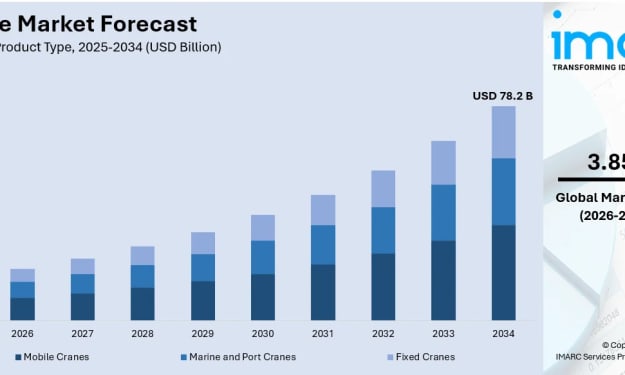
Infrastructure investments, urbanization, renewable energy projects, industrial expansion, and increased equipment rental adoption are accelerating demand for advanced, efficient, and safety-compliant crane solutions worldwide. According to IMARC Group's latest research publication, global crane market size reached USD 55.6 Billion in 2025. Looking forward, IMARC Group expects the market to reach USD 78.2 Billion by 2034, exhibiting a growth rate (CAGR) of 3.85% during 2026-2034.
By Andrew Sullivana day ago in Futurism
How to Succeed at the Benson Directory®
Congratulations and welcome to the Benson Directory® employee #22391! As our newest call handler, you will have the privilege of speaking with dozens of unique and interesting people on a daily basis as well as the opportunity to earn bonuses for high performance. Contained within this handbook you will find a set of ease to follow instructions designed to help you settle in to your new role and begin paving the way to success.
By S. A. Crawford5 days ago in Fiction



Comments
There are no comments for this story
Be the first to respond and start the conversation.