
Arsonist In The Waste Land
The Value of Decay (in Ash and Scars and Ink)


Once the bells rang, their day began.
Kant kept their hours on a strict schedule. If you were not sent to collect trash on the outskirts, and you weren’t on the roster to work in the recycling factory that day, then you were subject to cleaning duty.
Blue was in charge of cleaning. He wore a cheaply made prosthetic leg. His left leg had been removed above the knee after an accident that happened in the factory years ago.
Working with Blue meant you were working from morning to dark scraping and washing dishes, sterilizing clothes, scrubbing and polishing floors, cleaning bathrooms, sweeping the outdoors, and raking the gravel around the factories to prevent a buildup of contaminated debris blew in from the Waste Land.
That morning, however, Blue had not been expecting Mort.
“Why are you here?” Blue demanded when Mort turned the corner around the stairs. Children were already on their hands and knees busy at work. Blue was nursing the stump of his leg with an ointment. His prosthetic leg leaned against a banister.
“Kant told me to come here.”
“You’re kidding,” Blue replied, not particularly happy about it. Mort was rarely sent on cleaning duty. “Where did you go yesterday?”
“The Waste Land.”
“The Waste Land,” Blue repeated, looking down at him. “You’re the only one besides Kant whoever volunteers for that job, and he told you to come here anyway? Must have really done bad last time.”
It’s raining today,” Mort said.
“Thought you liked the rain.”
“Not when it’s dirty.”
“Dirty,” Blue echoed. He handed him a rag and pointed to a bucket filled with lye water. “I hate that word.”
Mort gripped the rag close to his body and dropped his gaze to the floor. There were a dozen other kids on their hands and knees, scrubbing. No one had gloves. Their hands were red, cracked, and covered with sores.
The processing ward was lined with recesses filled with empty ration crates pressed against the dank, limestone wall. There were no windows and barely any light here. A thin vein of fluorescent lighting trailed through the ceiling. A waterspout drained directly into a metal grating set in the concrete floor near Mort.
That’s where he started.
Mort secured gloves over his hands, which he had stashed inside the pockets of his shapeless gown—and got to work. These were the same ones he would use in the Waste Land. He cleaned in silence, total stagnation, scrubbing the water spout with as much strength as he could muster under his hands blistered under his gloves.
A hand glossed over his gloved fingers.
It was Aletheia.
“You di-didn’t guh-go into the Waste Land?” she asked him, teeth chattering. There was no heat down here. Aletheia was shaking from the cold.
Mort nodded.
Aletheia understood. “Because of the rain.”
Rain carried toxins and acid. Some rainfall was more dangerous than others, and there was sometimes no way of knowing until it was too late.
There was something else Aletheia was not telling him.
“What is it?” Mort pressed.
"That strange paper you found. I have it.”
“Kant threw it all back onto the belt,” Mort remembered. “Fuel for the furnace, he said is all it was.”
“I took it before it could be burned.”
She then placed a folded piece of paper into his hand.
Mort examined the paper now in his hands. It was sturdy, soft. Red and blue synthetic fibers were weaved through the green paper. There was an image of a strange man inked onto one side, and an ornate building on the back.
“I thought it was pretty,” Aletheia told him. “Take it. I hid the rest.”
“Where?”
“You know where.”
“You can keep this,” Mort offered, pushing the paper back to her.
“You sure?”
“I’m sure.”
Aletheia tucked the green paper under the cuff of her gown.
Mort waited for the bell to ring again.
While everyone else filed into the dining hall, Mort bolted and ran to the attic and flipped over his sleeping mat. The floors of the attic were lined with steel floor grates and paved with a vinyl floor base, but the nature of time had worn down the fundamental facilities and systems that held this place together.
Mort jostled a loose spot on the floor. It caved in under the weight of his palm. He pried the vinyl apart. Stashed inside a hollowed-out space was his prized possession—a treasure trove of stolen and scavenged trash.
Mostly, he collected audio files. There was even an earpiece he had scavenged that allowed him to listen to them. Many were instrumental pieces of music or first-account memoirs—long-forgotten messages from a time Mort did not recognize, some in languages Mort did not understand.
It was as Aletheia had said. Between the audio files were stacks of the strange green paper. Whoever had last possessed this paper had gone to great lengths to safeguard it. It had been wrapped in black plastic and adhesive. By chance alone when Mort accidentally tore the plastic did he discover what was hidden.
Perhaps this green paper had once been a currency that could be exchanged for food, clothes, and equipment the same way ration notes were used now. Mort wondered if they could still be exchanged as such, but if that had been the case, Kant would not have told him to burn it.
Nestled against a wall of steel grating was a small black notebook—another stolen item he had stuffed under his gown while he was supposed to be sorting metal alloys on the conveyors. Mort pried it free and flipped through its blank pages.
He proceeded to lace each ivory page with the strange green paper, ironing them flat between each page, a few at a time, counting each one. There was a total of 200 slips (minus the one Aletheia had), each one seemingly identical to the last. After every page was lined and stuffed, he clamped the notebook tight and wrapped the elastic closure band around the durable hardcover.
Mort tucked the small black notebook under his arm and hurried down the stairs. He snuck past the dining hall where everyone had now gathered. Lunch was hot that day. Children were handed meal portions inside tin containers. Unsweetened wheat that had been baked, ground, and mashed into a dough.
No one noticed Mort walk sneak past them. It wasn’t until he turned the corner that he was face to face with Kant.
“Mort.” Kant greeted. He held in one hand a single, lit cigarette. A lighter in the other. Polished silver. It was remarkably designed with an ornate pattern. “Why aren’t you eating with the others?”
“Not hungry.”
Kant stared at him for a moment, then parted his lips to let wisps of smoke escape through his teeth. He gestured to the small black notebook Mort clutched. “Let me see that.”
“It's mine.”
Kant met his gaze and gave him a small smile. He knelt to meet him at eye-level now. Mort suddenly wanted that lighter. He could light this entire factory on fire—watch it burn. “I could make it mine.”
Mort expected Kant to overpower him and wrest the notebook from his grasp. He could have done it. Instead, Kant said, “There’s something I want to tell you, but would you believe me? I wonder.”
Kant eyed him for a bit, then took a drag from his cigarette. “That currency you believe you’re hiding from me is worthless.”
Kant could have snatched the notebook out of his hands then, but he did not. Instead, he removed the cigarette from his mouth and parted his lips to breathe out the smoke. Ash fell to the floor, peppering their shoes.
“Your lighter,” Mort said
“This lighter?” Kant flashed the polished silver in the dim fluorescent light. “It’s hardly worth much.”
“There’s fire in it.”
“And that makes you curious, does it?” Kant said. “Let's make a trade. This lighter for that notebook.”
It was already evident Kant found no value in the frayed and wrinkled, bright green paper flattened between these notebook pages. But the notebook itself was what Kant seemed to see the value, and that in return made Mort curious.
Mort turned the notebook over in his hands, inspecting it. “I was going to trade it in the underground outposts for more gloves—”
"No chance," Kant snorted. “People out there kill for protective clothing like that. No one will trade you anything of value for…twenty-thousand American dollars last time I checked, was it? That notebook on the other hand? You tell a story worth hearing, and people will find value in that."
“Is that why you want it?” Mort asked.
Kant stared at him for a moment, then parted his lips to let a wisp of smoke escape past his lips. “If you thought this through, it’s why you should want it.”
“I don’t have any stories to tell.”
“You do. There is always a story to tell. We are merely too well-versed in withholding ours."
.
.
.
That was the day Mort wrote about years later, long after the Waste Land had flame-ravaged the recycling factory where he used to stay—a burned-down facility that was now buried in acidic seawater that reeked of rotten fish and decay.
Water had spilled in from the Waste Land like an infection. Gray, murky seawater drowned the machinery, rendering it dead before the ocean swallowed the facility entirely.
But the memory from that day—a memory that was now seared into these pages. That was the day Mort set fire to everything he thought he was and began to learn who he was.
Mort had only seen the ocean once before now. This was before his internment at the recycling factory, a place where refugees at the time from surrounding uninhabitable zones had been sent to work.
The ocean, as he recalled, had been dirty. Its shores had been nearly frozen and blanketed with the remains of dead sea creatures, bones fossilized in the sand. He remembered how the sand, icy and paste-like suctioned around his boots with each step. Gray seawater lapped the decay from rot on the sandbanks, pushing rotting slime back and forth over his calves.
Blue would have hated the ocean.
Yet the ocean was where Mort had returned. He traveled with other refugees, like him. Some could read. Most could not. Those who could not listened. They passed around the little black notebook now amongst themselves.
“What happened to those ration slips?”
Mort stopped. The unmistakable crunch of semi-frozen sand cracked under their feet, grinding the ice deeper underground as they walked onward. “What?” he asked, having nearly forgotten.
“Those weren’t ration slips,” someone else called out. “Twenty-thousand American dollars is what he wrote. Yeah, what became of it?”
Mort held a lighter in his hand—ornate, polished silver. There was something flammable to put into his body. The desire was there, but there was nothing to breathe. Nothing to light. He took a deep inhale and remembered:
“It burned to ash.”
“Ah, that’s a shame. Sounds like it was really something.”
Among the caravan was Aletheia. When Mort answered, she looked over at him, eyebrows furrowed. It was a lie. A half-truth; and she knew it. Aletheia knew too much about him, and Mort resented that. He peered down at her, a small smile hooking the corners of his lips.
Aletheia couldn’t look at him anymore.
That—
should not have burned him.
(as much as it did).
How the cold could burn.
Mort was burning. There was a lighter in his hand. He wondered if he could light himself on fire—watch himself burn to ash, too.
The desire was there. The temptation was becoming the start of what could be considered insanity, and who was the remnants of this world to deny him this state of mind.
About the Creator
Ava
Advertising exec. Lacklaster pianist. Horror aficionado.
Keep reading
More stories from writers in Futurism and other communities.
About Binding Prometheus
I want to start actively advocating on behalf of my own work, and the most valuable part of my canon is, without a doubt, Binding Prometheus, the play I have been working on since 2019 and only finished in 2023 as part of my MA. The play itself is an amalgamation of a million different inspirations. On one end, it evokes the Ancient Greek myth-play, deriving its own title from the earliest extant work of Western drama we have, Aeschylus’s Prometheus Bound. On the other end, it borrows significantly from the sci-fi bulwarks from over the years, namely Mary Shelley’s Frankenstein and Karel Capek’s Rossum’s Universal Robots. The play could be an episode of Black Mirror, I fear. I don’t know. I’ve only ever seen one episode of Black Mirror.
By Steven Christopher McKnight28 days ago in Futurism
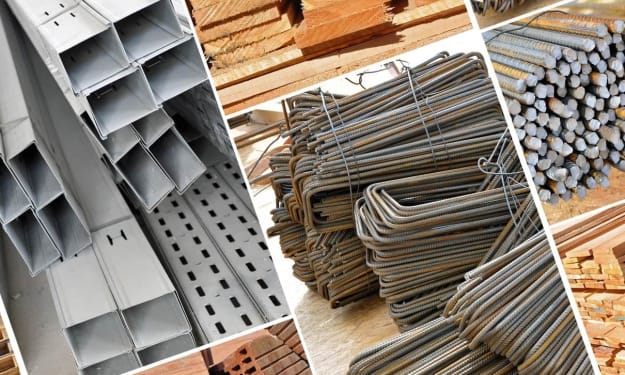
UAE Building Materials Market Outlook: Industry Trends, Key Players & Forecast
According to IMARC Group's latest research publication, the UAE building materials market size reached USD 6.75 Billion in 2024. The market is projected to reach USD 11.44 Billion by 2033, exhibiting a growth rate of 5% during 2025-2033.
By Abhay Rajput2 days ago in Futurism
The Path to Salvation
The late autumn evening air filled the monk's lungs, but it wasn't the season that chilled his bones. The heavy-handed presence of evil he had sensed upon entering the woods surrounding this mountain village had not bothered to conceal itself from him.
By Made in DNA7 days ago in Fiction



Comments
There are no comments for this story
Be the first to respond and start the conversation.