
Are humans exploring Mars to colonize It?
Forget it. Earth's deserts are better than Mars

If human beings want to survive, the primary conditions to meet are air and water, to be precise, oxygen and fresh water resources.
Does the fact that a helicopter can take off on Mars prove there is air?
Indeed, unlike space vehicles, a plane needs air to take off. It needs air to provide upward force.
Fish can't swim without water.
Aircraft flight needs to solve two problems, rising lift and forward propulsion. Forward motion depends on the forward traction generated by the engine's power to turn the propeller or forward thrust generated by the jet.
The rise is based on Bernoulli's principle, that is, the higher the flow rate of a fluid, the lower its pressure; The lower the flow rate, the higher the pressure. As the air flows through, it creates a pressure difference that creates lift. The amount of lift also depends on the Angle of attack.
Have you all played kites?
The reason is similar, but also use the air flow generated by the power to fly into the sky. And need to fly against the wind, I believe that you can obviously feel the wind resistance when running against the wind.
Theoretically, you could fly as long as you could reach enough speed and maintain an inclined position.
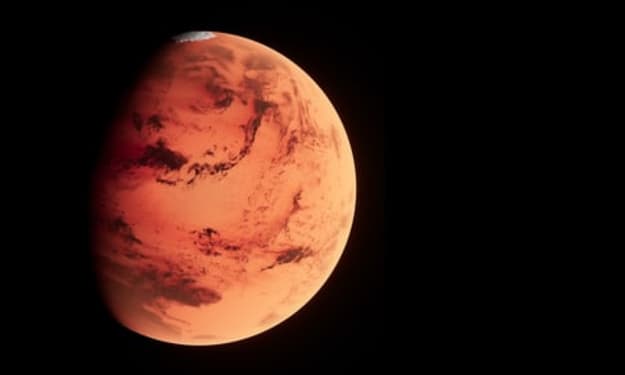
The fact that tact took off on Mars suggests there is air on the surface. However, the air on Mars is very thin, only 1% of the density of earth, which is the average plane, it is not really able to fly on Mars.
That is, "Mechanism" helicopter has this ability, it is ordinary, because its flight principle is the same as other ordinary aircraft, it is not simple, because it is not only the first unmanned helicopter on Mars, but also because it costs up to 500 million yuan.
The Martian atmosphere is only 1 percent as dense as Earth's, which is equivalent to an altitude of 30,000 meters on Earth. The helicopter would have to get more lift and thrust, either by spinning its rotors faster, lengthening them longer, or reducing its own weight.
To challenge the Mars launch feat, scientists have built a high-tech rotorcraft system from the design and materials. It uses a coaxial twin rotor design, the torque generated by the rotation of the two rotors can cancel each other, so there is no need to install the tail slurry.
Each blade is 1.2 metres long, made of carbon fibre, and the rotors spin at 2,400 revolutions a minute, ten times the speed of a normal helicopter. Weighing in at just 1.8 kilograms, it is pitifully small.
Despite its advanced materials and design, Tact's flight capabilities are particularly limited. The maximum flying distance is 300 meters and the maximum flying altitude is only 5 meters. Because flying on Mars is so demanding, the rotors need to rotate 2,800 times a minute to keep Tact going.
Witty is designed to last just a month and is expected to fly up to five times. Because the weight can't be designed to be too heavy, the battery can't be too large, plus the power of each run, so it can only fly for 90 seconds at a time. ,
Tact carries solar panels that sit on top of the drone and use sunlight to recharge lithium batteries. In just 90 seconds, it takes a Martian day (24.62 hours) to recharge.
So some people have to ask, this little gadget, it can't fly high, it can't fly fast, it can't fly long, what can it do to Mars? The rover's primary mission is to probe the actual conditions of Mars, which are difficult to observe in detail due to its limited field of vision and difficult terrain.
Uavs combine the advantages of an orbiter and a rover. It can be seen from the air, observed close to the earth, and even, when the technology matures, can fly into Mars caves, canyons and other complex terrain to explore.
The successful launch of Tact proved the feasibility of this plan. Future uAVs could carry small avionics, communications equipment and imaging equipment so it can follow instructions from scientists on the ground and fly into areas that are difficult for rovers to reach.
So is the mission to Mars designed to allow humans to colonize the planet? Dan Dan is here to assure you that Mars exploration is not about planetary colonization.
Mars has a thin atmosphere, with an average surface pressure of about 0.75 percent of Earth's, 95 percent carbon dioxide, little oxygen and a lot of dust. Surface temperatures can reach 28℃ during the day and as low as -132℃ at night, with an average of -57℃. Compared to Earth, Mars is completely unsuited for human life.
No matter how hostile the earth is or how populous it is, it is far easier, by necessity, to remake the deserts of the Earth than it is to remake Mars.
Exploration of Mars from the point of view of scientific value, Mars can reflect a lot of questions, human understanding of the Earth will help. We can find out more about Earth by exploring other celestial bodies.
And for us, the earth is our only home, due to human pollution and destruction, resulting in the deterioration of the earth's ecological environment, we should not hope to emigrate to other planets, environmental protection is fundamental!
About the Creator
GCC Fruit Juice Market Analysis: Key Drivers, Market Dynamics & Future Prospects
According to IMARC Group's latest research publication, GCC fruit juice market size reached USD 3.7 Billion in 2024. The market is projected to reach USD 5.6 Billion by 2033, exhibiting a growth rate (CAGR) of 4.8% during 2025-2033.
By Abhay Rajput7 days ago in Futurism
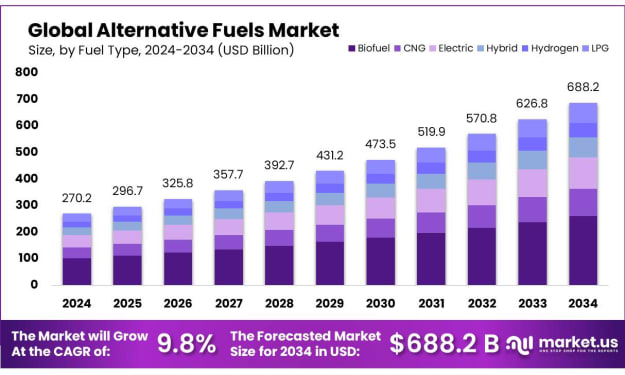
Alternative Fuels Market Insights: USD 688.2 Billion by 2034
Overview The Global Alternative Fuels Market is on a strong growth trajectory, projected to expand from USD 270.2 billion in 2024 to USD 688.2 billion by 2034, representing a compound annual growth rate of 9.8% over the forecast period. North America currently leads the market, accounting for a 43.2% share of global revenue in 2024.
By Hayden Kulasabout 7 hours ago in Futurism


Comments
There are no comments for this story
Be the first to respond and start the conversation.