
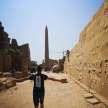

What if I told you that all of humanity is living with amnesia, that they have forgotten their origins and roots. What if I told you that there is a society that spends huge amounts of money and time to continue to keep humanity in that particular amnesia. To keep us in constant ignorance and a semi-conscious state just to be passive consumers who unconsciously serve the system and do not ask any questions.
Is it possible that we have forgotten our history?
A history that is much older than official science claims.
Long before our time, people worshiped Gods and Demigods have you ever wondered how people then found out about them at all?
Many people are looking for answers to these questions, among them scientists and researchers who have offered a different interpretation of our history.
People like the writer-researcher Graham Hancock, who believes that our civilization is just one in a series that has risen from the ashes after the cataclysms that hit our planet.
All the technology and knowledge we possess are not our inventions but only the rediscovered ancient technologies of our ancestors. Ancient technology and knowledge given to them by ancient beings they called Gods.
What if I told you they weren't Gods at all ?
We will begin our journey in the land that stands between two rivers. Ancient Mesopotamia located between the rivers Euphrates and Tigris, a place where a highly developed civilization and a people called the Sumerians suddenly appeared.
The emergence of such a highly developed civilization would not be strange at all if there was a gradual developmental history of that civilization. Before them, we walked in the mountains, hunted in the woods and lived in caves, and suddenly "overnight" a civilization emerged that understood the construction of tall buildings and cities.
To be better clear with the appearance of the Sumerians, many things have appeared that we still use today, (laws, schools, agriculture, medicine, economics, astronomy, business contracts,) And the most important thing that appeared 6,000 years ago #The First Alphabet#. The Sumerians created the first alphabet, the alphabet we know today as clay tablets.
A letter they imprinted on clay tablets in which they wrote down almost all their daily activities.
From laws, epochs, songs all the way to land and livestock sales contracts. Now that you have an insight into who the Sumerians really were and how developed they were, it is time to hear what they said about our history, what they believed, what they said about the ancient times before them. The story you will hear is thousands of years older than us and our time. The story of the Sumerian Book of Genesis.
In 1840, British archaeologists discovered 14 clay tablets that spoke of the Father of all beginnings.

To the supreme being and creator whom they worshiped as a deity.
This being was not worshiped by humans.
But just by those beings that people considered gods.
The first two clay tablets tell who these beings were and where they came from.
The third clay tablet speaks the creation of us and our purpose by these beings called ANUNNAKI. Their name means in translation * Those who came down from heaven * Their home planet was called Nibiru. A planet that enters our solar system every 3,600 years moving in an extremely elongated ellipse around our sun.
Nibiru has been described as several times larger than our planet.
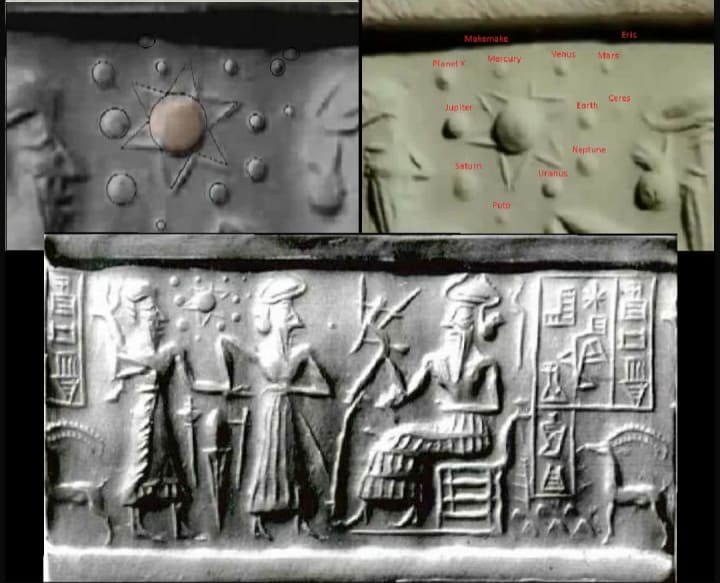
Full of iron oxides this planet was completely red. According to Sumerian records, the atmosphere of Nibiru, the home planet of Anunnaki, began to decay, turning the planet into an inhospitable place to live.
In their attempt to protect the planet and the atmosphere, the Anunnki were looking for one very rare and important element that was able to save their atmosphere.
That element was Gold.
In their search for gold, they came to earth. They established a mining base called Eridug. And at that time 445,000 years ago this Anunnaki creature had a lifespan of hundreds of thousands of years.
Which was later only confirmed in the Sumerian ancient list of kings. This Anunnaki expedition was led by a commander-in-chief named Enki.
It is interesting that they brought with them another race called Idjidji. For them, they were just slaves who were the main source of labor for digging for gold. After centuries of this hard labor,race rebelled and turned against the Anunnaki, it was a mistake.
Almost all were exterminated after the war with the Anunnaki.
Of course this was a boomerang for the Anunnaki as well because they were left without manpower.
After that, the ruler of Nibiru back then named Anu, ordered his son Enki to genetically create a new race of workers. A species that must be intelligent enough to do intelligent jobs but not so advanced as not to pose a threat to the Anunnaki themselves.
These experiments were recorded in the work of Atrahasis and many were unsuccessful until Enki decided to create a genetic link between the Anunnaki and Homoerectus with which he obtained a new species of Homosapiens.
Because the Anunnaki were taller then us, the early man also called them giants.
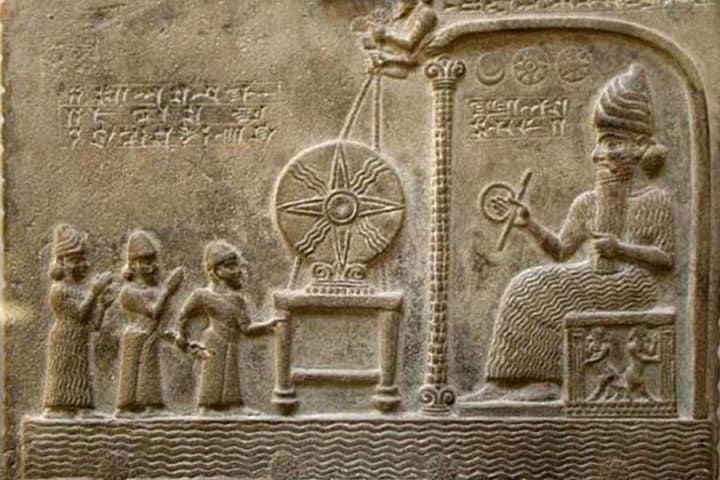
The main task of the man was to serve as a worker to the Anunnaki, and because of this they taught the man their skills, social relations, academic education and taught the people to handle their technologies. The only problem was overcrowding. Since they shared DNA with the Anunnaki, the first humans lived much longer than they do today, and their reproduction has been a problem over time.
Over time, men became more intelligent and the Anunnaki began to have relationships with women, which led to the birth of giants and even greater overcrowding.
This move angered the new ruler Enlil who was brother of Enki.
Enlil did not want to warn people that a cataclysm was approaching because Niburu would appear in their solar system causing earthquakes, floods hoping to get rid of a larger part of the population.
And he succeeded in that. After returning back to earth, they made new mining excavations, new places where those who survived the cataclysm worked.

It is also written that they made pyramids, and shortly afterwards they suddenly left the Earth. Now the only question remains
will they come back?
About the Creator
Keep reading
More stories from Haris Hadzic and writers in Futurism and other communities.
Solar and Battery Storage in NSW: The Complete Guide for Homeowners in 2026
Solar energy is becoming an essential part of the energy mix in Australia, and understanding how solar production peaks throughout the day can help you make the most of its benefits. Solar panels are most efficient during certain periods of the day, and knowing when these peak times occur allows you to optimise your system for maximum energy savings.
By SolarLoverabout 21 hours ago in Futurism
Australia Smoothies Market: Health & Wellness Trends, Retail Expansion & Product Innovation
According to IMARC Group, the Australia smoothies market reached USD 504.6 Million in 2025 and is projected to grow to USD 749.1 Million by 2034, exhibiting a compound annual growth rate (CAGR) of 4.26% during 2026–2034. The market’s expansion reflects increasing consumer focus on health, nutrition, and convenience across Australia. Rising demand for nutrient-rich beverages, growing availability of ready-to-drink (RTD) options, and the proliferation of smoothie bars in urban centers are collectively strengthening Australia smoothies market share. As consumers prioritize balanced diets and functional ingredients, smoothies are becoming a mainstream component of daily nutrition.
By Shrestha Roy5 days ago in Futurism




Comments (1)
It offers a unique perspective on human history but should be approached with a critical mindset, impressive! Is this conversation helpful so far?