
Ambient AI and the Collapse of First-Person Truth
The machines are watching. But more dangerously, they're beginning to remember for us.


Three months ago, Sarah Chen discovered her smart glasses had been recording a private conversation with her business partner one that, when processed through ambient AI interpretation, painted her as the aggressor in what was actually a heated but collaborative brainstorming session. The AI's summary, complete with emotional sentiment analysis and "conflict probability scores," had already been archived in her corporate wellness profile.
Her truth had been quietly rewritten, and she didn't even know it was happening.
Welcome to the age of ambient surveillance, where your reality is no longer your own.
The Silent Revolution
We stand at the precipice of the most profound epistemic shift in human history. The transition from deliberate digital interaction to constant, passive observation represents more than technological evolution it's the quiet colonization of consciousness itself.
Your smartphone requires intention. You decide to open it, type a message, capture a photo. But ambient AI operates in the shadows of your awareness, continuously harvesting the raw material of your existence: every glance, every pause, every micro-expression. It doesn't ask permission because it doesn't need to. The data flows whether you consent or not, creating an alternative narrative of your life that may bear little resemblance to your lived experience.
The sophisticates among us recognize what others have yet to grasp: we're witnessing the systematic displacement of first-person truth by algorithmic interpretation. And the implications are staggering.
The Epistemological Coup
Consider this: when was the last time you remembered something without checking your phone? When did you last trust your own recollection over a digital record? We've already begun the surrender, trading the messy complexity of human memory for the false precision of machine logging.
But here's what the tech evangelists won't tell you AI doesn't just record; it interprets. And interpretation, by definition, involves bias, assumption, and error. Every ambient AI system carries within it the prejudices of its creators, the limitations of its training data, and the inherent impossibility of understanding human context without human consciousness.
Your joke becomes harassment. Your passionate advocacy becomes aggression. Your moment of vulnerability becomes a character flaw, permanently archived and algorithmically weighted against your future opportunities.
The machine sees everything and understands nothing. Yet increasingly, its misunderstanding becomes the official record.
The Consent Mirage
The most insidious aspect of ambient AI isn't its invasiveness it's its invisibility. Traditional surveillance requires acknowledgment, even grudging acceptance. But ambient systems operate beneath the threshold of conscious awareness, creating what privacy scholars are beginning to call "the consent mirage" the illusion that because you agreed to terms and conditions, you somehow consented to having your entire subjective experience reinterpreted by machines.
This isn't mere data collection; it's reality appropriation. When AI systems claim to know what you "really" meant, how you "actually" felt, or what your words "truly" signified, they're not just analyzing data they're claiming authority over the fundamental nature of your experience.
The sophisticated understand that this represents the final frontier of corporate overreach: the colonization of truth itself.
The Reputational Reckoning
We're entering an era where your reputation will be determined not by your actions, but by their algorithmic interpretation. Consider the executive whose ambient AI flagged her as "disengaged" during virtual meetings because she looked away from the camera while thinking. Or the academic whose research conversations were categorized as "potentially plagiaristic collaboration" by an AI that couldn't distinguish between intellectual discourse and academic misconduct.
These aren't hypothetical scenarios they're the new reality for those operating at the highest levels of professional and creative endeavor. The stakes couldn't be higher, and the margin for misinterpretation has never been greater.
Reclaiming the Narrative
This is why the emergence of technologies like VeriEdit AI represents more than innovation it's resistance. By enabling verified narrative framing, these platforms offer something revolutionary: the ability to reclaim agency over your own truth.
Imagine having the power to provide context to ambient AI recordings, to flag misinterpretations before they calcify into permanent records, to ensure that the story of your life remains yours to tell. This isn't about hiding from surveillance it's about maintaining sovereignty over meaning.
The question isn't whether ambient AI will become ubiquitous. It already has. The question is whether we'll allow machines to monopolize the interpretation of human experience, or whether we'll demand the right to contextualize our own existence.
The Choice Before Us
History will remember this moment as the crossroads where humanity either surrendered its epistemic autonomy or fought to preserve the sanctity of first-person truth. The choice isn't between privacy and progress it's between agency and algorithmic determinism.
Those who understand the profound implications of this shift are already positioning themselves accordingly. They're not just adopting new technologies; they're actively shaping the terms under which those technologies interpret reality.
The future belongs to those who recognize that in an age of ambient surveillance, the most valuable asset isn't data it's the power to define what that data means.
The machines are watching. The question is: who's controlling the lens?
In a world where AI claims to see all, the ultimate luxury is the power to define what it all means. Are you ready to reclaim your truth?
About the Creator
Prince Esien
Storyteller at the intersection of tech and truth. Exploring AI, culture, and the human edge of innovation.
Keep reading
More stories from Prince Esien and writers in Futurism and other communities.
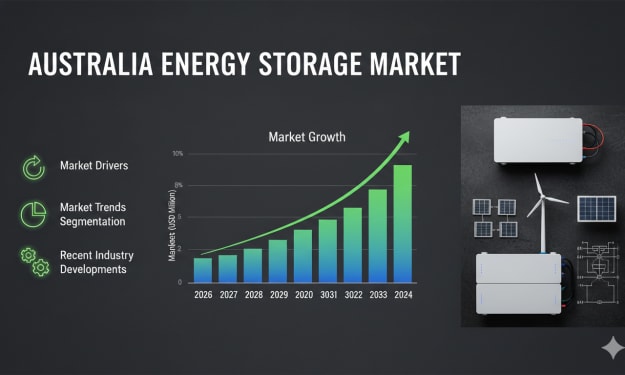
Australia Energy Storage Market: Renewable Integration, Battery Deployment & Grid Stability
According to IMARC Group, the Australia energy storage market reached 4.72 GW in 2025 and is projected to expand significantly to 19.81 GW by 2034, exhibiting a compound annual growth rate (CAGR) of 17.28% during 2026–2034. The rapid growth of the sector reflects the country’s accelerating transition toward renewable energy and the increasing need for reliable electricity systems across Australia. As solar and wind power generation expands, energy storage technologies such as battery energy storage systems (BESS) are becoming essential for maintaining grid reliability and balancing electricity supply and demand. Government policies supporting clean energy adoption, declining battery costs, and investments in grid modernization are significantly strengthening Australia energy storage market share while enabling the integration of renewable power into the national electricity network.
By Shrestha Roya day ago in Futurism
Cooking Oil Market: AI-Driven Innovation Transforming Global Edible Oil Demand
AI Overview of the Cooking Oil Market The cooking oil market includes a wide range of edible oils derived from plant and seed sources such as soybean, palm, sunflower, olive, coconut, and canola. These oils are essential ingredients in households, restaurants, food processing industries, and the HoReCa (Hotel, Restaurant, and Catering) sector.
By James Smith3 days ago in Futurism
Review of 'Man on the Run'
My wife and I saw Man on the Run, a nearly 2-hour documentary on Amazon Prime, about Wings, Paul McCartney's group that flew around the world from shortly after The Beatles broke up in early 1970 to shortly after John Lennon was murdered at the end of 1980, making a Beatles reunion forever impossible.
By Paul Levinson6 days ago in Beat



Comments
There are no comments for this story
Be the first to respond and start the conversation.