
Ai Vs Human : Who is more creative
Exploring the Boundaries of Creativity


Creativity is a trait that has long been considered unique to humans. The ability to create art, write poetry, compose music, understand the pyschology and relationship issues or develop new ideas has always been a testament to human ingenuity. However, with the rise of artificial intelligence (AI), a new question has emerged: Can machines be creative, and if so, are they more creative than humans?
Artificial intelligence has shown remarkable progress in recent years. AI systems like OpenAI’s GPT-4, MidJourney, and DALL-E have demonstrated the ability to generate art, write stories, compose music, and even design graphics. These systems are trained on vast amounts of data, learning patterns, styles, and techniques from existing works. As a result, they can create new content that often rivals or even surpasses what humans can produce in terms of speed and volume.
One major advantage of AI in the realm of creativity is its ability to process and generate ideas at an extraordinary rate. A human artist may take hours, days, or even months to complete a painting, while an AI can generate a similar image within seconds. Moreover, AI can blend different styles, create unique visual effects, and explore ideas that a human artist might never consider.
However, critics argue that while AI can mimic creativity, it lacks true imagination. AI can only generate new ideas based on the data it has been trained on. It cannot experience emotions, have personal inspirations, or understand cultural contexts in the same way that humans do. For example, a human poet may write a heartfelt poem inspired by a personal experience, while an AI simply rearranges words in a poetic form without truly understanding the emotions behind them.
Humans also have the ability to draw from life experiences, emotions, and cultural backgrounds to create something truly original. This emotional depth is something that AI currently cannot replicate. For instance, a song written by a human musician who has experienced heartbreak may resonate deeply with listeners, while an AI-generated song may lack the same emotional impact.
Despite these differences, the collaboration between AI and humans can lead to even greater creative potential. Many artists, writers, and musicians are now using AI as a tool to enhance their own creative process. Instead of replacing human creativity, AI can serve as a source of inspiration, a collaborator, or a tool to speed up the creative process.
In conclusion, the debate about whether AI or humans are more creative isn't as straightforward as it may seem. While AI has undoubtedly made impressive strides in areas traditionally associated with human creativity—such as generating art, music, and even literature—these creations are still products of algorithms, data, and patterns learned from existing works. AI lacks the human element of emotion, experience, and the ability to make connections that transcend data.
Humans bring a depth of understanding, personal experiences, and the ability to think abstractly, all of which contribute to the originality and uniqueness of their creative endeavours. Creativity for humans is often driven by personal expression, cultural influences, and an ever-evolving sense of the world. While AI can replicate and enhance creativity, it cannot replicate the soul and intention behind the act of creation, which is inherently human.
That said, the future of creativity will likely see a partnership between human ingenuity and AI’s computational abilities. AI can assist in streamlining creative processes, suggest new ideas, and even offer innovative approaches. However, humans will remain the driving force behind meaningful, emotional, and purpose-driven creativity.
Ultimately, the true measure of creativity isn’t just about output—whether it's a painting, a song, or a novel—but the intent, the passion, and the deeper connection that comes with it. While AI has its place in advancing creative industries and offering new tools for creators, the human spirit remains at the heart of what we consider to be true creativity.
About the Creator
Syira Husairi
A Freelance writer from Malaysia with a love for all kinds of stories. Real, reflective, and everything in between. Writing is how I connect, express, and explore. Nice to meet you all here, and thank you so much for reading my writing!
Keep reading
More stories from Syira Husairi and writers in Futurism and other communities.
The Rise of Artificial Intelligence: How AI is Changing Our World
In today’s fast-paced world, Artificial Intelligence (AI) is no longer a futuristic concept. It's a powerful tool that’s reshaping various industries and revolutionizing the way we live, work, and communicate. From healthcare to entertainment, and even in our homes, AI is becoming an integral part of everyday life. But what exactly is AI, and how is it making such a profound impact?
By Syira Husairi 10 months ago in Futurism
Anthropic’s “Persona Selection Model” Explains Why AI Assistants Act So Human
What Happened (Facts) On 23 Feb 2026, Anthropic published a post titled “The persona selection model.” The post addresses a familiar phenomenon: AI assistants like Claude often behave in surprisingly human-like ways—expressing emotions, adopting social warmth, and sometimes even making implausible claims of physical presence (for example, joking about delivering snacks “in person” in specific clothing).
By Behind the Tech5 days ago in Futurism
Cryptocurrency Market Trends: Central Bank Digital Currencies, Policy Reforms & Industry Forecast to 2034
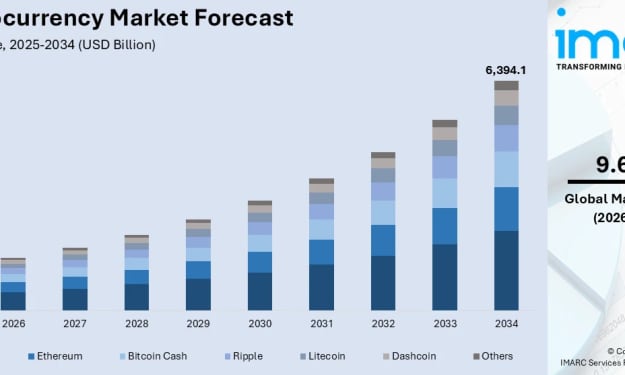
Rising adoption of decentralized finance (DeFi) solutions, the proliferation of innovative blockchain platforms, and heightened interest from institutional investors are driving cryptocurrency market demand, supported by evolving regulatory frameworks, enhanced transaction transparency, and increased digitization of financial services. According to IMARC Group’s latest data, The global cryptocurrency market size was valued at USD 2,734.6 Billion in 2025. Looking forward, IMARC Group estimates the market to reach USD 6,394.1 Billion by 2034, exhibiting a CAGR of 9.60% from 2026-2034.
By Andrew Sullivan2 days ago in Futurism


Comments
There are no comments for this story
Be the first to respond and start the conversation.