
AI Boom Powers SK Hynix to Record Profits – But Tariff Storm Looms Ahead
How the Korean chipmaker's success with Nvidia and HBM chips is fueling growth, even as global trade tensions raise questions for the future.

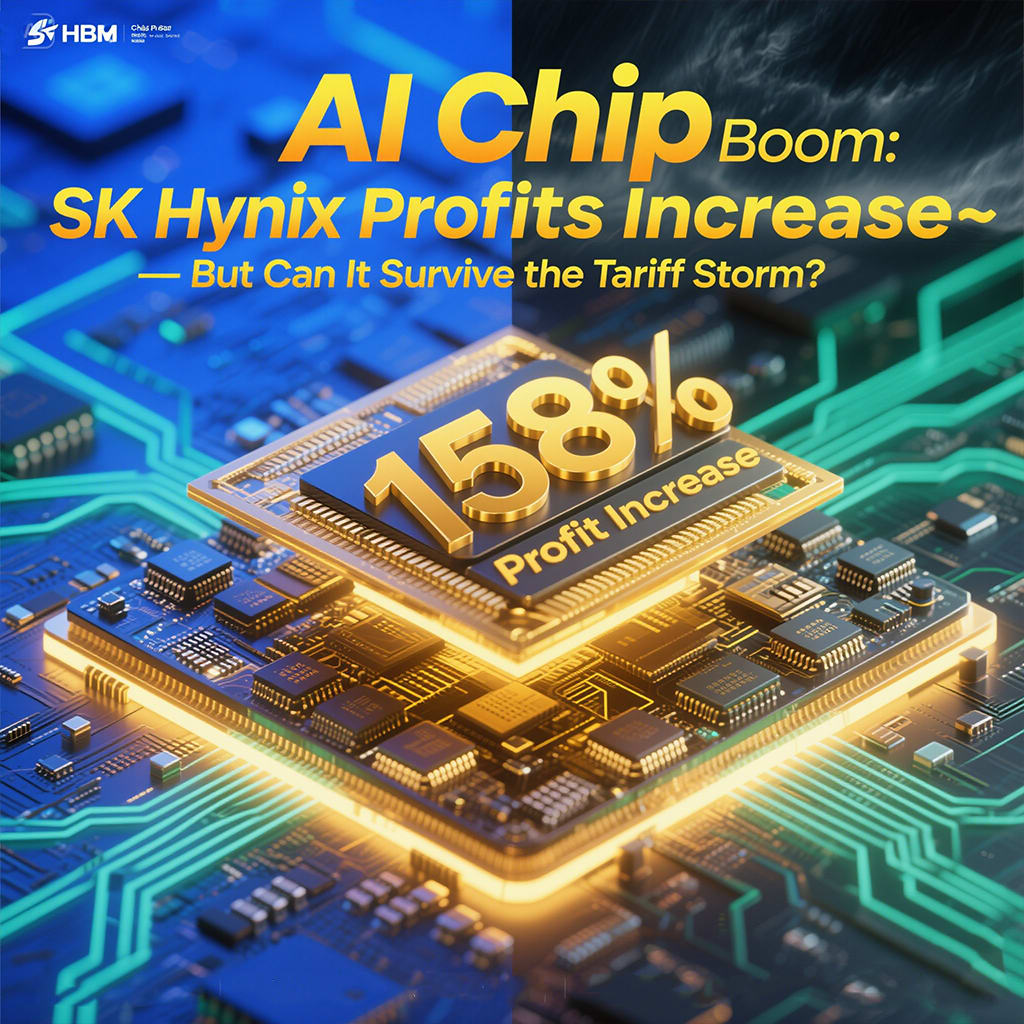
SK Hynix Reports Strong Q1 Earnings Driven by AI Chip Demand, Warns of Future Uncertainty
SK Hynix, a leading memory chip maker from South Korea and key supplier to tech giant Nvidia, had a very strong start to 2025. The company’s first-quarter profit more than doubled, thanks to the growing demand for chips used in artificial intelligence (AI). While the company is riding high on the current AI boom, it has also issued a cautious note about potential risks in the future, especially due to the uncertainty around U.S. trade tariffs.
Strong Q1 Results Boosted by AI
In the first quarter, SK Hynix reported an operating profit of 7.4 trillion won (about $5.2 billion), which is a 158% increase compared to the same period last year. This figure also beat analysts’ expectations by a wide margin. The company’s revenue also rose by 42% to 17.64 trillion won ($12.36 billion).
These results mark the second-highest quarterly operating profit in the company’s history. A big part of this success comes from high-bandwidth memory (HBM) chips, which are in high demand due to their use in AI servers. SK Hynix is a major supplier of these chips to Nvidia, a company at the center of the AI revolution.
Stockpiling and Tariff Concerns
The strong earnings were also helped by stockpiling of chips by tech companies who fear possible price hikes due to U.S. tariffs. With the U.S. investigating semiconductor imports over national security concerns, many companies are preparing for potential changes by purchasing in advance.
However, SK Hynix believes that the impact of these tariffs on their AI chip business will be limited. According to Kim Ki-tae, head of the HBM sales and marketing team, there are no changes to the company’s sales plans for the year. He confirmed that SK Hynix is continuing to supply chips to major clients under existing agreements.
AI Boom Driving Demand
The AI wave is not slowing down, and SK Hynix expects that large tech companies will keep spending big on server chips. The growing popularity of AI features in smartphones is also expected to boost demand for mobile memory chips. Even though the company faces some risk from global economic uncertainty, the current momentum from AI is helping to cushion the impact.
A company executive mentioned that lower development costs and open-source AI projects are helping new players enter the market, which is pushing up demand for high-density memory chips even more. A good example of this trend is China’s DeepSeek, which recently developed a powerful AI model that works efficiently even with limited hardware.
Market Leadership and Future Plans
SK Hynix’s success in the AI memory market is clearly visible. A report from Counterpoint Research revealed that SK Hynix captured 70% of the HBM market by revenue in the first quarter. This performance even helped the company overtake long-time leader Samsung in the global DRAM market, achieving a 36% share compared to Samsung’s 34%.
To keep up with the rising demand, SK Hynix has announced plans to build a new chip production facility in Cheongju, South Korea. Construction will begin at the end of April, and the factory is expected to start mass production by November 2025. The total investment for this project will be over 20 trillion won in the long run.
Looking Ahead: Challenges and Opportunities
Despite the strong performance, SK Hynix warned that the second half of 2025 could be more unpredictable. The company pointed out that U.S. tariffs and other global trade tensions could affect demand. However, since a large portion of its products are shipped to countries outside the U.S., the direct impact might be limited.
Moreover, SK Hynix continues to benefit from strong demand from companies like Apple and Nvidia, which assemble many of their products in countries such as China, India, Mexico, and Taiwan. This makes SK Hynix less vulnerable to U.S. trade actions.
In addition, the South Korean government recently announced a 33 trillion won support package for its chip industry. This move is expected to help local companies like SK Hynix weather future trade challenges and continue investing in innovation.
Conclusion
SK Hynix is clearly riding the wave of the AI boom, with impressive first-quarter results and a dominant position in the HBM chip market. The company is expanding production and looking to maintain its lead in a competitive and fast-growing field. Still, the road ahead could be bumpy due to global economic and political uncertainties. For now, though, SK Hynix remains one of the biggest winners of the AI era.
Would you invest in AI chipmakers like SK Hynix, or do you think the market is too unpredictable? Let us know your thoughts! 🚀
About the Creator
Only true
Storyteller | Explorer of ideas | Sharing thoughts, tales, and truths—one post at a time. Join me on Vocal as we dive into creativity, curiosity, and conversation.
About Binding Prometheus
I want to start actively advocating on behalf of my own work, and the most valuable part of my canon is, without a doubt, Binding Prometheus, the play I have been working on since 2019 and only finished in 2023 as part of my MA. The play itself is an amalgamation of a million different inspirations. On one end, it evokes the Ancient Greek myth-play, deriving its own title from the earliest extant work of Western drama we have, Aeschylus’s Prometheus Bound. On the other end, it borrows significantly from the sci-fi bulwarks from over the years, namely Mary Shelley’s Frankenstein and Karel Capek’s Rossum’s Universal Robots. The play could be an episode of Black Mirror, I fear. I don’t know. I’ve only ever seen one episode of Black Mirror.
By Steven Christopher McKnight17 days ago in Futurism
Gaming Peripherals Market Size and Forecast 2025–2033
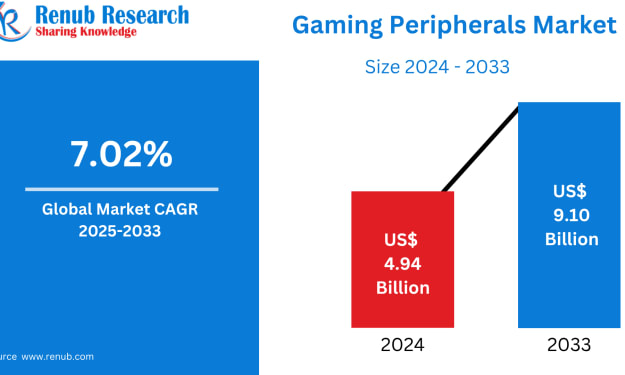
Gaming Peripherals Market: An Industry in Rapid Transformation The global gaming peripherals market is entering a decisive growth phase as gaming continues to evolve from a leisure activity into a mainstream form of digital entertainment and professional competition. According to Renub Research, the Gaming Peripherals Market is expected to grow from US$ 4.94 billion in 2024 to US$ 9.10 billion by 2033, registering a compound annual growth rate (CAGR) of 7.02% from 2025 to 2033. This expansion reflects not only the surging popularity of gaming worldwide but also the rising demand for high-performance devices such as gaming mice, mechanical keyboards, headsets, controllers, and other immersive accessories.
By Aaina Oberoi5 days ago in Futurism



Comments
There are no comments for this story
Be the first to respond and start the conversation.