
Aerospace Foam Market Outlook: Lightweight Materials Demand and Aircraft Efficiency Growth Opportunities
The aerospace foam market is experiencing steady growth, driven by increasing demand for lightweight and high-performance materials in aircraft manufacturing and interior applications.


According to IMARC Group's latest research publication, The global aerospace foam market size was valued at USD 5.9 Billion in 2024. Looking forward, IMARC Group estimates the market to reach USD 9.4 Billion by 2033, exhibiting a CAGR of 5.4% from 2025-2033.
How AI is Reshaping the Future of Aerospace Foam Market
- Material Discovery and Formulation Optimization: Machine learning analyzes vast material datasets to identify foam compositions with superior thermal resistance and weight reduction properties. AI accelerates development cycles by predicting foam performance characteristics before physical prototyping, cutting research timelines significantly while enhancing durability.
- Automated Quality Inspection and Defect Detection: Computer vision systems equipped with AI detect micro-cracks, delamination, and density inconsistencies in foam materials during production. These automated inspection processes analyze thousands of data points per second, ensuring consistent quality standards while reducing manual labor and catching defects traditional methods miss.
- Predictive Maintenance for Manufacturing Equipment: AI monitors foam production machinery through sensor data analysis, predicting equipment failures before breakdowns occur. Companies implementing predictive systems improve forecast accuracy by approximately 10-20%, reducing downtime and ensuring continuous manufacturing operations while extending machinery lifespan through optimized maintenance scheduling.

Aerospace Foam Industry Overview:
The aerospace foam sector is experiencing transformation driven by significant defense modernization programs and commercial aviation expansion. India's Ministry of Defence secured a USD 2.5 billion agreement to acquire 56 Airbus C-295 military transport aircraft, exemplifying how government procurement drives demand for advanced lightweight materials like polyurethane and metal foams. GE Aerospace committed over USD 650 million to manufacturing facility upgrades and supply chain enhancements, with USD 550 million directed to U.S. operations, demonstrating industry investment in production capacity to meet rising demand for high-performance foam solutions across commercial and military applications.
Aerospace Foam Market Trends & Drivers
Commercial aviation recovery is fueling unprecedented demand for aerospace foam materials as global air travel rebounds strongly. Airbus forecasts demand for 43,420 new passenger and freighter aircraft between now and the mid-2040s, nearly doubling the existing fleet. Boeing delivered 537 aircraft units through November of this year, representing a remarkable 69% increase over the previous year's deliveries. Each wide-body aircraft contains substantial quantities of foam across seating, insulation, soundproofing, and cabin walls, with a single Boeing 777 seating over 300 passengers requiring extensive polyurethane foam throughout its interior. Airlines worldwide are expanding fleets to serve emerging markets while replacing aging aircraft with fuel-efficient models, creating sustained demand for lightweight foam materials that enhance performance and reduce operational costs.
Defense modernization programs across multiple continents are accelerating aerospace foam adoption as militaries upgrade aging fleets with advanced aircraft featuring sophisticated materials. The U.S. Department of Defense's budget request exceeding USD 849 billion emphasizes investments in unmanned systems, space technologies, and supply chain resilience where foam materials play critical roles. Countries including China, India, and Japan are channeling substantial resources into both military and commercial aviation development, driving requirements for specialized foams meeting strict military specifications. Modern fighter jets, transport aircraft, and helicopters incorporate advanced foam solutions across multiple systems and components, from cockpit insulation to structural applications. Military specifications demand foams with exceptional fire resistance, extreme temperature tolerance, and superior vibration damping properties, pushing manufacturers toward continuous innovation.
Sustainability initiatives and regulatory pressures are reshaping aerospace foam development as the industry confronts environmental challenges. Airbus is exploring bio-sourced materials and circular economy approaches to counter resource scarcity while reducing production energy intensity. The European Union reduced greenhouse gas emissions by 8% while manufacturers work toward further reductions through advanced materials. Companies like BASF and Huntsman are investing heavily in research and development to create bio-based foam alternatives derived from renewable feedstocks that maintain performance while lowering carbon footprints. Airlines prioritize weight reduction to achieve fuel efficiency targets, with lightweight foams delivering measurable improvements in aircraft range and emissions. Stringent noise reduction regulations in urban areas near airports drive demand for sound-absorbing foam solutions, while evolving fire safety standards push development of advanced fire-retardant formulations.
Leading Companies Operating in the Global Aerospace Foam Industry:
- Aerofoam Industries, LLC
- Armacell
- BASF SE
- Boyd
- DuPont de Nemours, Inc.
- Evonik Industries AG
- General Plastics Manufacturing Company
- Greiner AG
- Huntsman International LLC
- NCFI Polyurethanes
- Rogers Corporation
- SABIC
- Zotefoams plc
Aerospace Foam Market Report Segmentation:
By Type:
- Polyurethane
- Polyimide
- Metal Foams
- Melamine
- Polyethylene
- Others
Polyurethane represents the largest class, as it offers exceptional durability, lightweight structure, and superior thermal insulation making it suitable for diverse aerospace applications.
By Application:
- Aircraft Seats
- Aircraft Floor Carpets
- Cabin Walls and Ceilings
- Flight Deck Pads
- Overhead Stow Bins
- Others
Aircraft seats have the largest market share owing to rising demand for lightweight, comfortable seating solutions that improve fuel efficiency and enhance passenger experience.
By End User:
- General Aviation
- Military Aircraft
- Commercial Aviation
Commercial aviation exhibits a clear dominance in the market due to rising global air travel demand, fleet expansions, and widespread foam use in seating and cabin interiors.
Regional Insights:
- North America (United States, Canada)
- Asia Pacific (China, Japan, India, South Korea, Australia, Indonesia, Others)
- Europe (Germany, France, United Kingdom, Italy, Spain, Russia, Others)
- Latin America (Brazil, Mexico, Others)
- Middle East and Africa
North America exhibits a clear dominance in the aerospace foam market due to its well-established aerospace industry and high investment in defense and commercial aviation.
Recent News and Developments in Aerospace Foam Market
- March 2026: Recent industry reports highlight strong growth in aerospace foam demand due to increasing aircraft production and the need for lightweight materials. The global aerospace foam market is expected to grow from about USD 7.6 billion in 2026 to more than USD 12.5 billion by 2034, driven by the aviation sector’s focus on fuel efficiency and passenger comfort.
- February 2026: Several aerospace manufacturers are increasing the use of advanced insulation foams in aircraft cabins and structural components to reduce aircraft weight and improve energy efficiency. These materials are widely used in aircraft seating, insulation panels, and vibration-dampening systems.
- November 2025: A market report released in late 2025 indicated that the aerospace foam industry could exceed USD 13 billion by 2034, supported by rising air travel demand, fleet modernization programs, and increasing production of next-generation commercial aircraft.
- September 2025: Aerospace material suppliers introduced new high-performance polyurethane and polyimide foam solutions designed for aircraft interiors. These materials provide improved fire resistance, noise reduction, and thermal insulation for modern aircraft cabins.
- July 2025: Aircraft manufacturers and suppliers expanded investments in lightweight foam materials for next-generation aircraft to improve fuel efficiency and reduce emissions, supporting sustainability goals in the aviation industry.
Note: If you require specific details, data, or insights that are not currently included in the scope of this report, we are happy to accommodate your request. As part of our customization service, we will gather and provide the additional information you need, tailored to your specific requirements. Please let us know your exact needs, and we will ensure the report is updated accordingly to meet your expectations.
About the Creator
James Whitman
With years of experience in analyzing global industries, I specialize in delivering actionable market insights that help businesses stay ahead in an ever-changing landscape.
Keep reading
More stories from James Whitman and writers in Futurism and other communities.
Automotive Adhesives Market Outlook: Lightweight Vehicle Manufacturing and Advanced Bonding Growth Opportunities
According to IMARC Group's latest research publication, The global automotive adhesives market size reached USD 6.4 Billion in 2024. Looking forward, the market is expected to reach USD 13.5 Billion by 2033, exhibiting a growth rate (CAGR) of 4.3% during 2025-2033.
By James Whitmanabout 14 hours ago in Futurism
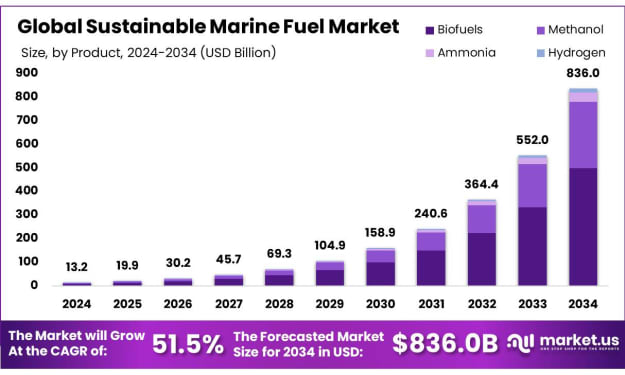
Sustainable Marine Fuel Market To Reach USD 836.0 Billion by 2034 at 51.5% CAGR
The global Sustainable Marine Fuel Market is projected to grow rapidly, increasing from USD 13.1 billion in 2024 to around USD 836.0 billion by 2034, representing a compound annual growth rate (CAGR) of 51.5% between 2025 and 2034. In 2024, Europe led the market with more than 51.0% of the global share, generating approximately USD 6.7 billion in revenue. This expansion is largely driven by the maritime sector’s urgent need to reduce emissions, as shipping currently accounts for about 2.5% of global greenhouse gas (GHG) emissions, a figure that could rise to nearly 17% by 2050 without effective mitigation measures.
By Hayden Kulas6 days ago in Futurism
Wind Energy Market Trends: Floating Wind Technology, Energy Transition & industry Outlook to 2034
The global wind energy sector is undergoing a transformative shift as nations prioritize energy security and decarbonization. Governments are moving away from simple subsidies toward sophisticated industrial policies, such as India’s USD 890 million Viability Gap Funding for offshore wind and the Netherlands’ €3.9 billion IJmuiden Ver subsidy. This transition is further fueled by the integration of AI-driven grid management and the rapid scaling of 15 MW+ turbines, which can reduce installation costs by up to 20% per gigawatt. According to IMARC Group’s latest data, the global wind energy market size reached USD 102.1 Billion in 2025. Looking forward, IMARC Group estimates the market to reach USD 180.0 Billion by 2034, exhibiting a CAGR of 6.31% from 2026-2034.
By Andrew Sullivanabout 7 hours ago in Futurism



Comments
There are no comments for this story
Be the first to respond and start the conversation.