

In today’s fast-paced, digitally driven work culture, Australians in business, education, and government sectors are spending more time at their desks than ever. While this sedentary shift may appear harmless, it carries significant consequences for physical and mental health. Enter desk yoga and ergonomic office furniture—two powerful tools that, when combined, offer a comprehensive approach to workplace wellness.
Workplace ergonomics is no longer a luxury—it is a necessity. The rise in musculoskeletal disorders (MSDs), poor posture-related ailments, and employee burnout has led employers to rethink the traditional office setup. In the Australian context, Safe Work Australia has identified prolonged static postures and repetitive movements as major contributors to workplace injuries.
Ergonomic interventions, such as height-adjustable desks and ergonomic monitor arm setups, address these issues by aligning the body in a neutral posture. This reduces strain on the spine, neck, and wrists—common pain points in office environments.
While ergonomic furniture provides the structural foundation, it doesn’t address the need for mobility and circulation throughout the workday. This is where desk yoga plays a vital role.
Desk yoga refers to simple stretches and mindfulness techniques that can be performed at or near one’s workstation. From seated spinal twists to neck rolls and wrist stretches, these movements improve circulation, relieve tension, and enhance mental clarity—all without requiring a yoga mat or dedicated studio space.
Integrating movement with ergonomic support ensures a holistic wellness strategy, tackling both the causes and symptoms of sedentary discomfort.
Synergy in Action: Ergonomics Meets Movement
When ergonomics and desk yoga are deployed together, the result is a synergistic approach to employee wellbeing. Here’s how they complement each other:
1. Postural Correction
Ergonomic chairs encourage upright posture, while yoga relieves stiffness caused by prolonged sitting. Together, they reinforce alignment and comfort.
2. Improved Circulation
Alternating between seated and standing positions improves blood flow. Using anti-fatigue standing support further enhances standing comfort by reducing strain on feet and joints during prolonged standing periods.
3. Mental Resilience
Desk yoga includes breathing and mindfulness techniques that combat cognitive fatigue. Paired with ergonomic furniture, these practices support both physical relaxation and mental focus.
4. Increased Engagement
When organisations visibly invest in wellbeing, staff feel valued and motivated. It’s a signal that goes beyond words and policies—wellness becomes part of the company culture.
Practical Implementation Tips for Workplaces
Business leaders and procurement officers often ask: How do we make this feasible in a busy work environment?
Start with a Needs Audit: Identify common discomfort points among employees through surveys or ergonomic assessments.
Upgrade Strategically: Begin with critical items like supportive task chairs that provide lumbar support and adjustability.
Encourage Micro-Breaks: Introduce short, guided stretch routines during meetings or in shared spaces.
Provide Training Resources: Share videos or host brief sessions on desk yoga that anyone can follow without special equipment.
Lead by Example: Senior staff should actively engage in wellness practices to set a tone of collective care.
The Broader Business Case
For Australian government and business offices, wellness initiatives are more than just a feel-good effort—they’re strategic investments. Healthy, comfortable staff are more productive, take fewer sick days, and demonstrate improved morale. Furthermore, the introduction of desk yoga and ergonomic furniture contributes to compliance with occupational safety requirements and boosts retention.
Whether your team is in-office or hybrid, implementing ergonomic tools and promoting movement can be done at scale with minimal disruption and maximum long-term benefit.
Final Thoughts
Organizations seeking to future-proof their workforce must evolve past conventional desk setups. Desk yoga, combined with ergonomic innovation, creates a human-centred workspace that nurtures the body and mind alike. For Australian offices in every sector, this is not just a trend—it’s a blueprint for sustainable success.
About the Creator
Keep reading
More stories from Zair Fateh Ali and writers in Futurism and other communities.
What Happened When One SEO Agency Stopped Writing for Keywords
Many agencies approach content creation with the same routine. A list of keywords is generated, topics are planned around those phrases, and then content is optimized to improve rankings. This process brings traffic, but traffic doesn’t always lead to qualified leads or meaningful engagement. One SEO agency decided to break that cycle. For 90 days, keyword tools were removed from the process. No volume estimates were used. No keyword targets were assigned. Every topic was chosen based on real client interactions. The team focused entirely on the types of questions people were already asking. This was not a one-off experiment. It was applied across every piece of blog content for three straight months. The results revealed what happens when SEO writing shifts from keyword-first to audience-first.
By Zair Fateh Ali8 months ago in Futurism
Australia Power Market: Renewable Energy Expansion, Grid Modernization & Electricity Demand Growth
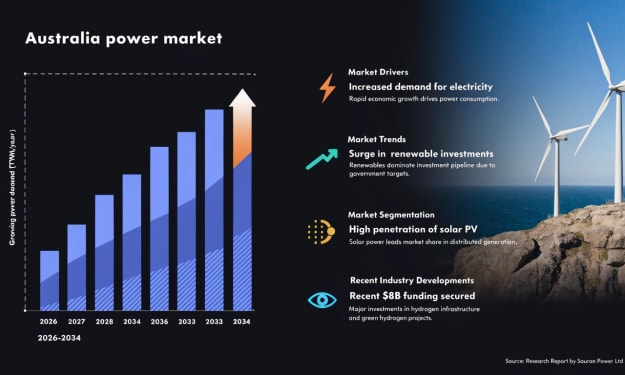
According to IMARC Group, the Australia power market reached 285.7 TWh in 2025 and is projected to reach 377.0 TWh by 2034, growing at a compound annual growth rate (CAGR) of 3.04% during 2026–2034. The market’s growth is being shaped by accelerating renewable energy adoption, increasing electricity demand and large-scale investments in grid modernization. Government incentives supporting clean energy transition, combined with rising corporate sustainability commitments, are encouraging the expansion of solar, wind and battery storage infrastructure. At the same time, the gradual phase-out of coal-fired power plants is transforming the structure of Australia’s electricity generation mix. With emerging technologies such as hydrogen energy systems and virtual power plants gaining traction, Australia’s power sector is evolving into a more diversified, digitally integrated and sustainable energy ecosystem.
By Kevin Cooper3 days ago in Futurism
Stanislav Kondrashov Oligarch Series: Oligarchy and the Expansion of Global Supergrids
The energy transition is often discussed through new technologies, but the systems that carry electricity are just as important. As electricity demand grows and networks become more interconnected, attention is turning toward the idea of global supergrids. These large transmission systems are designed to connect distant regions through long-distance electricity corridors, allowing energy to move across vast geographic areas.
By Stanislav Kondrashov 5 days ago in Futurism



Comments
There are no comments for this story
Be the first to respond and start the conversation.