
A Dangerous Crossing
Belarus to Ukraine


Adelaide unzips her windbreaker a little so she can feel the fresh air on her skin. She is already exhausted, and the most perilous part of the journey is about to begin. The border crossing from Belarus to Ukraine is three kilometres. Not far at all, even in this oppressive heat. Back at home in Sydney, whenever a virus flare-up or a heatwave shuts-down the public transport, she has to walk seven kilometres to work in the morning, and seven back. But at home she isn’t carrying a 30kg backpack, and she isn’t running on no sleep.
She bends to secure her boot, which had come loose. The lace is stiff from baked-in mud and as she pulls it, it snaps in her hand.
“Dammit,” she breathes. She needs to be able to run.
There is just enough to tie a knot that will hopefully hold until she is safely on the other side. She opens her pack and searches for anything she can jettison that will lighten her load. She has a change of underwear, water and some energy bars for herself. Everything else is for the baby. Nappies. Clothes. Water. Formula. Medicine. She needs it all. There’s one more thing too.
She unzips the concealed interior pocket and feels around until her fingers find the delicate figaro chain. She pulls it out. The forest is black as pitch but the light from the idling car’s headlights captures a glimmer of gold. She removed it from around her neck before going through airport security, like Silas had instructed. She returns it to its hiding place.
“Thank you, Artur,” she calls to her taxi driver. “Balshoye spasiba.”
He had driven her the five hours from Minsk airport to this crossing point in the red forest, talking in broken English the whole time about his grandchildren so she would feel safe. He gives her a nod and she presses some coins into his calloused hands. He shakes his head. “Ne bud’ glupym. Keep it. You may need it for the guards.”
“Spasiba.” She hopes it won’t come to that.
“Be as fast as you can,” he cautions.
“I will.”
“Try not to touch anything in the forest.”
“I understand.”
All week the sun has been scorching, the temperatures in the 50s, and the forest fires around the old Chernobyl power plant have been worse than anyone can remember. A large swathe of the exclusion zone has become a merciless furnace, throwing off acrid smoke and forcing windows closed as far east as Bryansk. It is the worst time to travel, but Adelaide has no choice. The surrogate in Kiev carrying the baby that has Adelaide’s DNA but not her genetic mutations is due to give birth any day, and if Adelaide isn’t there to collect the little girl, she could be sold. She has to risk it.
There is a tense crackle of energy in the air and she wonders if it is radiation, filling her lungs and landing on her skin, or it it’s just nerves. She lifts her pack up onto her shoulders and wishes James was with her.
“I will wait,” Artur says, patting the hood of his vehicle as she starts to walk. Adelaide is grateful for the headlights’ glow but it isn’t long before she is in complete darkness.
There are rumours that during the GEN1 phase of its gene editing program, the Belarusian government created not just genetically modified soldiers, but animals too. Rottweilers with steel-trap jaws. Alsatians that can outpace a train. Both relentless trackers. There is a competing rumour that the animals that slide and scurry through the forest carry radiation from the plant. Wild boars are one threat. Being bitten by an insect that will fill your veins with radiation as well as venom is another.
But the air is still. The only sound is the rustle of Adelaide’s windbreaker and the crunch of the dried undergrowth beneath her boots. The soil is soft and sandy which will make running more difficult. She takes a breath.
To give herself courage, Adelaide fishes her phone from her pocket and turns it on. Just for a moment. She has to conserve its battery. She can’t be certain the safe house will have electricity. She scrolls through her messages until she finds the thread with the agency. She isn’t allowed to communicate directly with Lucya but her handler sometimes passes on messages and photos. In the most recent one, Lucya is holding up her T-shirt, showing off her round, rosy belly. She can’t be more than 22 or 23, but the agency, and her Australian contact has assured Adelaide that the surrogates are given comfortable homes and the best medical care. Ukraine is one of only a handful of countries that has refused to sign the UN moratorium banning assisted reproductive technology to stamp out gene editing, and its unintended consequences, which is why it cost her and James almost a million dollars to commission a baby, and why that baby will an extremely desirable commodity on the red market. It’s a lucrative business, which is why the surrogates are treated like queens, Silas has promised her. Adelaide isn’t sure if she believes that, or just has to.
She uses the faint glow of her phone to examine the environment around her. Skeletal pines loom overhead, their leaves burned off. They are menacing but she can see she is on the right path. Adelaide looks at Lucya’s belly one more time then turns off the phone and forges ahead.
*
The first checkpoint is a simple wood structure, painted white. Inside is a desk, an old-fashioned phone and three guards with AK47s casually slung over their shoulders and pistols holstered to their boots. Mosquitos and moths hum around the fluorescent bars that bathe the lonely sentries in a ghostly white glow.
“Papers,” the seated guard says. Adelaide hands them over.
“You are alone?”
“Yes.”
He shakes his head and tuts. “Very dangerous to cross the red forest alone.”
The other guards are watching her. Their braided uniforms are made of heavy wool and they all have thick Bolshevik beards. She wonders how they can stand it in the heat, and then thinks perhaps their genetic modifications make it easier. She knows all of the GEN2 Belarusian babies bred for the military had their LRP5 gene tweaked to give them unbreakable bones. Their skeletons are eight times denser than a normal human’s and stronger than steel. They could walk away from the twisted wreckage of a road accident in better shape than the car. This particular enhancement wasn’t popular in Australia because dense bones make it impossible to swim. Like every genetic modification, bone strength has a downside.
Stamping her passport, the guard gives Adelaide a declaration to sign. As she reaches for the pen, her hand freezes. “Not now,” she thinks urgently. The spasms pass and her eyes flick up to the guard to see if he noticed. His focus is not on her hand but on the open V of her windbreaker. His mouth is open and she feels a shiver of fear, followed by a rush of rage. She wants to pound her fist on the desk. She hasn’t come this far to be ogled. But she knows it’s better that he stare at her breasts than her shaky hand, which might suggest an illness and a reason to detain her.
“All done,” she says sliding back the form. She holds her breath while he reads it. Through the window she can see a flatback truck, and more guards smoking. Silas warned they could drive her back to Minsk on the slightest provocation, or worse, into the red forest.
The guard says something in Russian then stamps her passport and waves her through.
“Spasiba.” She nods her thanks and hurries onward.
The light of the small wooden checkpoint fades fast and soon she is she is cloaked in black again. The sounds are different now. Rustles, and howls, and distant, foreign machinery. Her pack is cutting into her shoulders but she can’t slow down. Her Visa is only valid until midnight and she doesn’t know what will happen if she reaches the last checkpoint after it has expired.
Mercifully the guards at the second stop are civil and efficient. There is even an urn of boiling water that they allow her to use to make some black coffee with heaps of sugar in it, for fuel. They stamp her passport quickly and send her off again.
Two down, one to go, but the last will be the hardest. She has crossed the invisible border between the two countries. The Belarussians had no stake in her movements. She was leaving their land. The Ukrainians are being asked to let her in during a global amber alert, when any respectable person would fly. They will be highly suspicious.
Every crack of wood or rush of wind makes Adelaide jump. It is the longest kilometre she has ever walked in her life, but soon a spot of light appears up ahead of her. She tells herself the guards are just government employees, like her. Their country is lawless, but the soldiers are mere men.
The third checkpoint is brick, and the guards have different uniforms and weapons. They’re also shorter, and less muscular than their enhanced Belarusian neighbours. When Adelaide hands over her paperwork, the guard at the desk picks up the phone.
She feels her left hand seize and cramp. A panic response. Her heart has sped up. Silas warned her this may happen. The guard is checking to make sure her Visa isn’t a counterfeit. Adelaide clasps her hands behind her back to hide the tremors. The guard hangs up the phone and turns to talk to his comrades. She tries to latch onto words she knows but they are speaking too low and fast. One of them comes towards her, his face stern.
“I cannot let you through,” he says.
“What? Why?!” It is her worst fear.
“Regulations.”
He folds his arms and she understands. She takes the money Artur had told her to keep and offers it to the guard. He peers at it as if it’s a specimen he can’t identify then unleashes a cruel booming laugh. He turns and talks to the men. His tone is mocking.
“No,” he says. “Tebe nuzhno sdelat’ luchshe chem eto. I need more.”
“I have nothing,” she says.
The guard turns out his hands and shrugs his shoulders to show he doesn’t care.
“If you have nothing then you cannot pass,” he says in an uncaring growl.
“But I have all my paperwork,” she tries.
“Visa is about to expire. Nothing I can do.”
Adelaide pulls off her pack, searching for something to appease him. She has come so far.
“Back to Minsk,” the guard barks. He presses a red button on his desk.
“No!” Adelaide pleads. “There must be something.”
Then she remembers. She opens the concealed pocket and tugs at the chain. It is the most valuable thing she has left in the world: a 24-carat heart-shaped locket given to her by her grandmother. She has carried it all the way from Sydney, overland through Germany and Hungary where she flew to Minsk. She’s lost so much just to get this far, but she has held onto the little piece of gold. She wants so badly to be able to give it to her daughter, but she knows if she doesn’t hand it over now to bribe this guard she may never get to her.
More guards have arrived, with their machine guns in their hands.
“Zhdat’,” she cries out. “One moment.” She opens her palm and offers up the treasure.
The guard picks up the locket by the chain and smiles. “Okay,” he says. “You may cross.”
About the Creator
Genevieve Gannon
I am a journalist from Australia.
Keep reading
More stories from writers in Futurism and other communities.
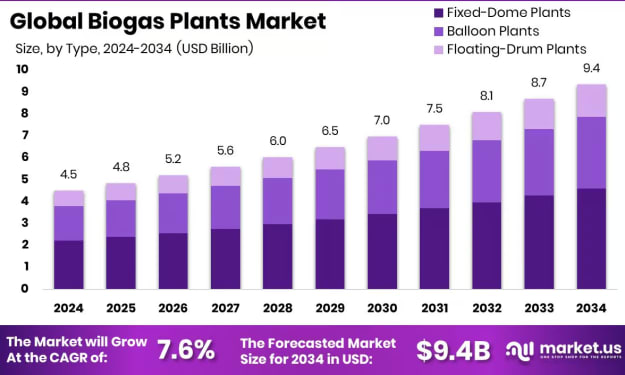
Biogas Plants Market To Reach USD 9.4 Billion by 2034 at 7.6% CAGR
Overview The Biogas Plants Market is projected to experience steady growth over the coming decade, driven by increasing demand for renewable energy and sustainable waste management solutions. The market is expected to be worth around USD 9.4 billion by 2034, up from USD 4.5 billion in 2024, growing at a compound annual growth rate (CAGR) of 7.6% from 2025 to 2034. Biogas plants convert organic waste such as agricultural residues, food waste, and animal manure into renewable energy in the form of biogas, which can be used for electricity generation, heating, and transportation fuel.
By Hayden Kulas3 days ago in Futurism
Thermal Paper Market: POS Receipt Demand, Retail Digitization & Industry Growth Outlook
According to IMARC Group's latest research publication, The global thermal paper market size was valued at USD 4.7 Billion in 2025. Looking forward, IMARC Group estimates the market to reach USD 6.9 Billion by 2034, exhibiting a CAGR of 4.22% during 2026-2034.
By sujeet. imarcgroup5 days ago in Futurism


Comments
There are no comments for this story
Be the first to respond and start the conversation.