
A Comprehensive Guide to Top AI Agent Frameworks
Explore LangChain, CrewAI, AutoGen, and Atomic Agent - Four Leading Frameworks Shaping Autonomous Systems and Intelligent Automation

Disclosure: I use GPT search to collection facts. The entire article is drafted by me.
Introduction
Artificial Intelligence (AI) is transforming industries at a breakneck pace, and AI agent frameworks are at the heart of this revolution. These frameworks enable the development of intelligent applications that can perform tasks autonomously, adapt to new information, and deliver automation at an unprecedented scale. However, with a wide range of available frameworks, choosing the right one can be a daunting task. In this guide, we'll explore four of the most popular AI agent frameworks: LangChain, CrewAI, AutoGen, and Atomic Agent. We'll assess their strengths, challenges, and best use cases, giving you the clarity you need to make an informed decision for your project.
1. LangChain
🔗 Strengths
Complex Task Handling: LangChain excels at managing intricate, multi-step processes, making it ideal for sophisticated AI systems.
Easy Integration: It seamlessly integrates with large language models (LLMs), databases, APIs, and external data sources, enabling smooth data interactions.
Autonomous Agents: LangChain enables LLMs to interact with their environment autonomously - querying databases, conducting web searches 🔍, and making API calls.
Modular Architecture: The framework is built around core components like Model I/O, Language Models, Prompts, and Output Parsers, offering high flexibility for customization.
Pre-built Chains: LangChain offers chains that automate specific tasks, which can be easily tailored to optimize workflows.
Memory: Its memory system ensures that virtual assistants and chatbots maintain context across interactions, allowing for smooth, coherent conversations.
Security: Strong security measures, including API key storage 🔑 and callback auditing 🔍, ensure data protection.
⚙️ Challenges
Overkill for Simple Tasks: Its complexity might be excessive for simpler applications, which could result in performance inefficiencies.
Scalability Issues: LangChain's rigid structure can present challenges when scaling up or transitioning to other frameworks.
Integration Instability: Some integrations are unstable, leading to potential vulnerabilities and technical debt.
🧩 Best Suited For:
LangChain is best for developers working on complex AI systems that require deep integrations and automation across multiple components.
2. CrewAI
🤝 Strengths
Collaboration-Centric: CrewAI shines in simulating teamwork and organizational structures, making it perfect for collaborative AI systems.
Task Automation: CrewAI automates routine tasks, reducing manual effort while also analyzing real-time data for valuable insights.
Smooth Communication: It facilitates intelligent communication within teams, ensuring efficient interactions and better decision-making.
Task Delegation: CrewAI assigns tasks based on individual skills, optimizing team productivity.
⚠️ Challenges
Limited Multimodal Capabilities: The framework struggles with handling various data types (text, voice, images) simultaneously, limiting its versatility.
Steep Learning Curve: New users may find it challenging to get up to speed with CrewAI's advanced features.
🧑🤝🧑 Best Suited For:
Ideal for teams working on AI systems focused on collaboration, internal processes, and task delegation, particularly in structured environments.
3. AutoGen
🗣️ Strengths
Perfect for Dialogue Systems: AutoGen is specifically designed for dialogue systems such as customer support chatbots and virtual assistants.
Smart Task Delegation: AutoGen uses intelligent role assignment to ensure that tasks are handled by the most qualified agents.
Efficient Message Routing: The framework effectively routes messages to the right agents, optimizing conversation flow.
Advanced Reasoning: With advanced LLM layers, AutoGen excels at reasoning, enhancing the performance and flexibility of dialogue-based systems.
⚠️ Challenges
Limited Customization: Extending AutoGen's functionality beyond basic dialogue agents can require complex custom code.
Learning Curve: The framework's rigid structure might make customization challenging, delaying development for some users.
🧑💻 Best Suited For:
AutoGen is ideal for teams developing dialogue-based AI systems like customer support bots, where the focus is on seamless conversations.
4. Atomic Agent
Modular Design: Atomic Agent's modularity allows for an easy combination of small, reusable components, ensuring flexibility in AI system development.
Scalability and Flexibility: This framework adapts well to rapidly evolving AI projects that need to scale efficiently and meet changing business demands.
Advanced Features: Features like system prompts, memory, and context providers enhance decision-making, making the system more context-aware.
🔑 Key Features
Image Credit: Atomic AgentsAtomicity: Break down systems into smallest functional units (atoms), allowing for easy reuse and interchangeability of components.
IPO Model: The input-process-output (IPO) model provides predictability in system behavior, ensuring clarity.
Extensibility: Components are interchangeable, enabling growth without disrupting system integrity.
Memory & Context: Context providers help the system remember previous interactions, allowing for better responses.
🌱 Best Practices:
Start with small projects to get familiar with the framework.
Explore example projects for faster development.
Use community forums for support.
⚙️ Best Suited For:
Atomic Agent is perfect for enterprises requiring scalable, customizable frameworks for long-term growth in the AI landscape.
Conclusion
Choosing the right AI agent framework can make or break your project's success. Whether you need a powerful framework for complex tasks, a collaborative solution, or a modular system for scalability, there is an option that fits your needs. By assessing your project's requirements, you can confidently select the ideal framework and unlock the potential of AI automation.
About the Creator
Jin
System Engineer
Pet Supplement Market Growth Accelerates with AI Innovation, Rising Pet Health Awareness, and Premium Nutrition Demand
Pet Supplement Market Overview The global pet supplement market has evolved rapidly over the last decade as pets are increasingly considered family members. Consumers are now willing to spend more on preventive healthcare, immunity boosters, joint care, digestive supplements, and skin & coat health products for their pets.
By James Smith2 days ago in Futurism
Australia Digital Payment Market: Consumer Adoption, Fintech Innovation & Regulatory Frameworks
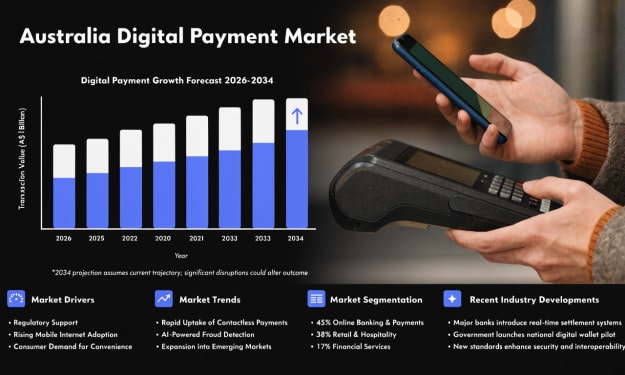
According to IMARC Group, the Australia digital payment market was valued at USD 142.7 Billion in 2025 and is projected to reach USD 728.1 Billion by 2034, exhibiting a robust compound annual growth rate (CAGR) of 19.86% during 2026–2034. Notably, Victoria & Tasmania dominate the market, accounting for a significant 38.3% share in 2025, reflecting strong regional digital infrastructure and consumer adoption trends. The rapid transition toward cashless transactions across Australia underscores a fundamental transformation in financial behavior, driven by smartphone penetration, mobile wallet usage, expanding e-commerce activity and increasing demand for peer-to-peer (P2P) and buy now, pay later (BNPL) services.
By Kevin Cooper6 days ago in Futurism



Comments
There are no comments for this story
Be the first to respond and start the conversation.