
A Comprehensive Guide to Data Labeling Techniques for Machine Learning
One of the most crucial steps in building a successful ML model is data labeling—the process of assigning labels or categories to raw data to help the machine learning algorithm understand and learn patterns.

Data is the cornerstone of modern machine learning (ML) models, and the accuracy of any ML system is largely dependent on the quality of the data used to train it. One of the most crucial steps in building a successful ML model is data labeling—the process of assigning labels or categories to raw data to help the machine learning algorithm understand and learn patterns. Without accurate and well-labeled data, even the most advanced models will fail to produce reliable results.
In this comprehensive guide, we will explore the various data labeling techniques, their importance in machine learning, and how businesses can leverage these methods to enhance their ML models. Along the way, we will also discuss the role of companies like Trantor in providing expert data annotation services to support the development of cutting-edge machine learning solutions.
What is Data Labeling?
Data labeling involves assigning labels or categories to unstructured data such as images, text, audio, or video. These labels serve as ground truth for the machine learning model, which uses this information to identify patterns, make predictions, and generate insights.
For example:
In image classification tasks, labels could indicate whether a photo contains an object such as a car, dog, or tree.
In natural language processing (NLP), labels might be used to classify text into categories like "positive" or "negative" sentiment.
In speech recognition, labels could identify specific words or phrases spoken in an audio file.
Data labeling is often a manual process, requiring human intervention to ensure that the labels are accurate. However, advances in automation, tools, and outsourcing solutions like those offered by Trantor are making the process more efficient and scalable.
Why is Data Labeling Important in Machine Learning?
Data labeling is critical for the success of machine learning models for several reasons:
Improves Accuracy: Well-labeled data helps the model accurately learn patterns and relationships within the data, leading to better predictions.
Reduces Bias: Properly labeled datasets prevent the model from developing biases based on inaccurate or incomplete information.
Enables Supervised Learning: Supervised learning algorithms rely on labeled datasets to map inputs to the correct outputs, such as predicting a label for unseen data based on patterns learned from the training data.
Supports Complex Models: Advanced models like deep learning architectures, which process complex data (e.g., images or video), require large amounts of labeled data to perform optimally.
Without accurate data labeling, models can struggle to generalize well to new or unseen data, reducing their performance and making them less useful in real-world applications.
Data Labeling Techniques
There are several data labeling techniques, each suited to different types of data and tasks. Below are the most common methods used in machine learning:
1. Manual Labeling
Manual labeling, as the name suggests, involves human annotators assigning labels to data. This method is labor-intensive but often necessary for high-quality annotations. It’s commonly used when dealing with complex or nuanced data types like medical images, legal texts, or fine-grained image classifications.
In manual labeling:
Annotators must be trained to understand the task and assign correct labels.
Quality control measures, such as cross-checking and multiple labelers, are used to ensure accuracy.
Use Case Example: In image recognition tasks where objects in pictures need to be accurately identified (e.g., autonomous driving systems), manual labeling is often used to train the model to distinguish between different objects on the road.
Pros:
High accuracy for complex tasks.
Flexibility in handling various types of data.
Cons:
Time-consuming and costly.
Limited scalability for large datasets.
2. Automated Labeling
Automated labeling involves the use of algorithms or software to assign labels to data without human intervention. This method is often used when dealing with large datasets, where manual labeling would be impractical or too expensive.
Common automation methods include:
Pre-trained models: Existing machine learning models can automatically label data based on patterns they've learned from other datasets.
Rule-based systems: Certain conditions or rules are applied to the data to automatically assign labels. For example, sentiment analysis models can use rule-based systems to classify text as positive, negative, or neutral.
Use Case Example: Automated labeling is widely used in large-scale natural language processing tasks, where algorithms are trained to classify emails as spam or not based on specific rules or previously trained models.
Pros:
Efficient for labeling large datasets.
Low cost once the system is in place.
Cons:
May lack accuracy compared to manual labeling.
Requires supervision and fine-tuning of algorithms.
3. Semi-Automated Labeling (Human-in-the-Loop)
In semi-automated labeling, a combination of automated techniques and human review is used. Machines initially label the data, and humans review or correct the labels where necessary. This method is ideal for striking a balance between efficiency and accuracy.
Use Case Example: In speech recognition systems, semi-automated labeling may be used to automatically transcribe audio, with human reviewers checking and correcting any errors in the transcription.
Pros:
Increases efficiency compared to manual labeling.
Improves accuracy compared to fully automated methods.
Cons:
Still requires human resources for review.
Can be slower than fully automated solutions.
4. Crowdsourcing
Crowdsourcing involves distributing labeling tasks to a large group of people, often through platforms like Amazon Mechanical Turk or specialized data labeling services. Crowdsourcing can be useful for simple labeling tasks that require many hands to process large volumes of data quickly.
Use Case Example: Sentiment analysis tasks, where large amounts of social media data need to be labeled as positive, negative, or neutral, can benefit from crowdsourced labeling.
Pros:
Scalable for large datasets.
Cost-effective for simple tasks.
Cons:
Quality control is difficult.
Not suitable for complex tasks requiring expertise.
5. Active Learning
Active learning is an iterative labeling process where the machine learning model actively queries the most uncertain or important examples in the dataset for labeling by human annotators. This method focuses human efforts on the most challenging data points, improving the model's performance more efficiently.
Use Case Example: In document classification tasks, active learning may be used to identify ambiguous documents that require human input, while easier cases are automatically labeled.
Pros:
Efficient use of human resources.
Reduces the number of labels required.
Cons:
Requires a pre-existing model to be effective.
May still be time-consuming for complex tasks.
Best Practices for Effective Data Labeling
Define Clear Labeling Guidelines: Before beginning the labeling process, it is essential to establish clear guidelines that all annotators follow. This helps to ensure consistency across the dataset.
Quality Control: Implement quality control mechanisms, such as double-checking labels, to ensure the accuracy of the data. You can also use inter-annotator agreement to measure the consistency between multiple labelers.
Train Labelers Properly: If using manual labeling or crowdsourcing, ensure that labelers are adequately trained and understand the specific requirements of the task.
Use Tools and Platforms: Leverage data labeling platforms and tools that offer features such as collaborative labeling, automation, and integrated quality control measures. Some tools also provide machine-assisted labeling, which can speed up the process.
Iterative Approach: Label data in batches and use model performance to inform where further labeling is needed. By iterating between labeling and training, you can focus on improving the model in areas where it performs poorly.
Trantor’s Expertise in Data Labeling
At Trantor, we understand that high-quality labeled data is the foundation of any successful machine learning model. With expertise in data annotation and a range of labeling techniques, Trantor helps businesses build accurate and efficient ML systems that can tackle even the most complex challenges. Our team offers end-to-end solutions for labeling data across different domains, ensuring high-quality results that improve the performance of machine learning models.
In conclusion, data labeling is a critical step in developing reliable machine learning models. The choice of data labeling technique depends on the specific needs of your project, the complexity of your data, and the resources available. Whether you opt for manual labeling, automation, or a combination of both, ensuring the quality and consistency of labeled data is key to the success of your machine learning endeavors.
About the Creator
Keep reading
More stories from Sam Wilson and writers in Futurism and other communities.
The Pros and Cons of Multi-Tenant SaaS Architecture
The cloud revolution has redefined how businesses build, deploy, and scale software applications. As companies shift towards Software-as-a-Service (SaaS) models, one architecture that has gained significant traction is multi-tenant SaaS architecture. This model allows multiple customers—or tenants—to share a single instance of the software, database, and infrastructure while maintaining data isolation.
By Sam Wilsonabout a year ago in Futurism
Australia Energy Storage Market: Renewable Integration, Battery Deployment & Grid Stability
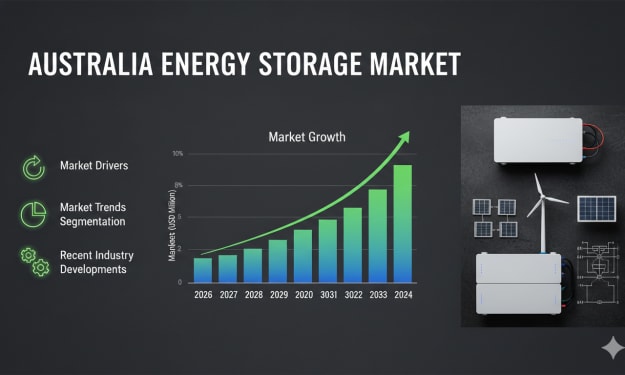
According to IMARC Group, the Australia energy storage market reached 4.72 GW in 2025 and is projected to expand significantly to 19.81 GW by 2034, exhibiting a compound annual growth rate (CAGR) of 17.28% during 2026–2034. The rapid growth of the sector reflects the country’s accelerating transition toward renewable energy and the increasing need for reliable electricity systems across Australia. As solar and wind power generation expands, energy storage technologies such as battery energy storage systems (BESS) are becoming essential for maintaining grid reliability and balancing electricity supply and demand. Government policies supporting clean energy adoption, declining battery costs, and investments in grid modernization are significantly strengthening Australia energy storage market share while enabling the integration of renewable power into the national electricity network.
By Shrestha Roy2 days ago in Futurism
Cooking Oil Market: AI-Driven Innovation Transforming Global Edible Oil Demand
AI Overview of the Cooking Oil Market The cooking oil market includes a wide range of edible oils derived from plant and seed sources such as soybean, palm, sunflower, olive, coconut, and canola. These oils are essential ingredients in households, restaurants, food processing industries, and the HoReCa (Hotel, Restaurant, and Catering) sector.
By James Smith4 days ago in Futurism
Review of 'Man on the Run'
My wife and I saw Man on the Run, a nearly 2-hour documentary on Amazon Prime, about Wings, Paul McCartney's group that flew around the world from shortly after The Beatles broke up in early 1970 to shortly after John Lennon was murdered at the end of 1980, making a Beatles reunion forever impossible.
By Paul Levinson6 days ago in Beat



Comments
There are no comments for this story
Be the first to respond and start the conversation.