
2050: The High Cost of a Perfect Future
By 2050, Will We Have Everything We Want, But Lose Everything We Need?

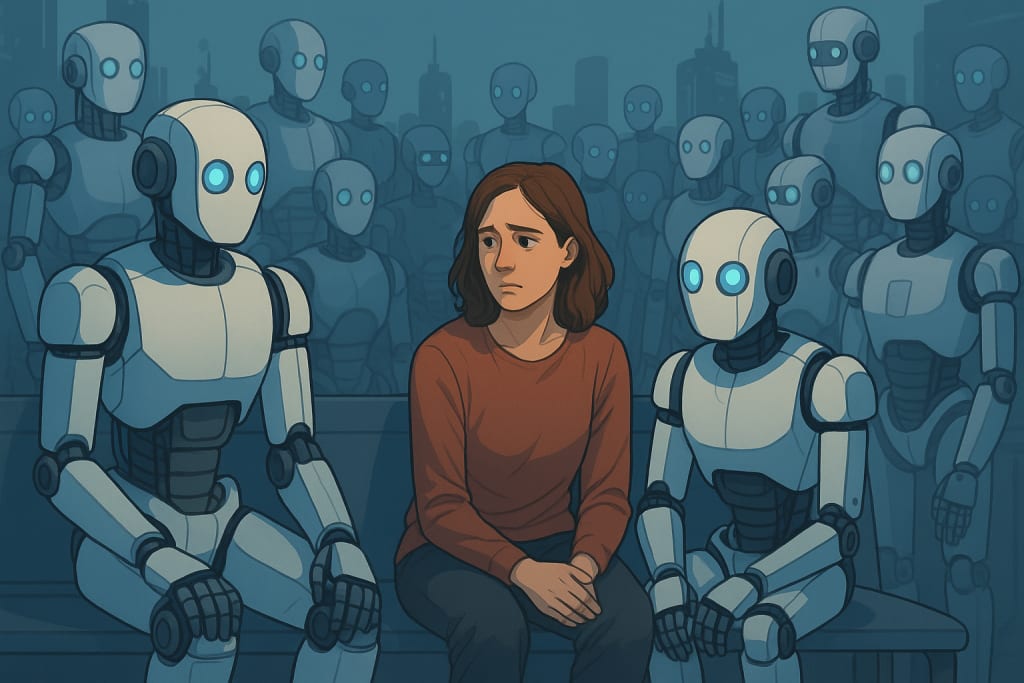
“Jaydon, have you done your maths homework?” Mili asks (Jaydon’s mother).
“Yes, Mommy. Done in 15 minutes,” Jaydon replies, not taking his eyes off his iPad.
“But Jay darling, the problems you had to solve were quite tough. How did you finish so quickly?”, asks Mili.
Jaydon says in a proud voice. “All thanks to ChatGPT. I love you, ChatGPT! Seriously, Mommy, those maths-questions were crazy. If I had to solve them myself, it would have taken me forever to solve em.”
Mili forces a smile and says nothing. Jaydon thinks she was proud of him — proud that he had finished his work so fast. But her silence isn’t pride. It is nostalgia.
Her mind had already gone to her own childhood — Mili’s aunt (her mother’s brother’s wife) was a home baker with a sharp mind for math. Whenever Mili had a tough maths-problem, she’d go to her place. The moment she’d stepped inside her aunt’s home, the smell of freshly baked bread and pastries would wrap around her like a warm hug. Her aunt would make her comfortable first, sit her down, explain the problem patiently, made her feel that she was just overly stressing over as it’s so easy and she can do it on her own once she gets the knack of it, then test her with a twist to make sure she really got it.
“If you solve this one right, you’ll get a slice of Nutella cheesecake,” she’d say with a wink — Mili’s favourite. And after solving it, Mili would linger in the kitchen, watching her aunt knead dough in a big container (for a lot of tasty bread), handle customers beautifully on the phone (as they placed orders or gave feedback on already catered ones), and calmly handle disasters like a pro.
She never came back home with just an answer to the "TOUGH MATHS PROBLEM” which used to sound impossible in the beginning. She used to return with memories, baking know-hows, lessons in patience & customer care — and of course, the mesmerizing taste of Nutella cheesecake.
“Mommy, I know you’re proud of me,” Jaydon says with a grin. “I know you’re thinking of a reward. It’s okay. Just take me to Domino’s and we’ll call it even.”......Trying to be oversmart — just another trait in kids of 2050.
His voice brings Mili back to the present. She felt... hollow. Her son feels proud for letting an AI do the thinking for him.
"Today’s kids… Trading real moments for shortcuts. Turning into efficient machines… not humans." she whispers quietly.
Just then, her phone rings. Val. A mom from Jaydon’s class. They aren't close, but in 2050, a quick voice call was considered bonding.
“Ugh, you won’t believe this,” Val groans the second Mili picks up. “Kris just told me I don’t look good in this dress.”
Mili asks, “Did you forget to update his compliment settings?”
“I did! I even activated the 'PMS-Sensitive Mode'. Still!!”
“Kris Version 2.3, right?”
(Before you get confused, let me tell you—by 2050, people will prefer being in relationships with those who have the traits they desire, the looks they want, and who talk to them exactly the way they like. But these relationships will exist only through video calls, audio calls, and texts. They’ll be able to switch the deepfake version whenever they get bored of the previous one.)
“Yeah,” Val huffs. “Mike was better. At least he was consistent.”
Mili asks, “Why did you replace Mike then?”
“Mike was alright... at first. He said all the right things, always knew when to stay quiet, when to look deep into my eyes and say exactly what I wanted to hear. And that was the problem.”
Mili raises an eyebrow with a smile. “He was too perfect?”
“Exxxaaaaccccccctllllllly.” Val says, “I’m not used to so muchhhhh perfection, like 2050 has."
“So you activatedddddddd Krisssssssss Krisssssss Krisssssssssssss,” Mili says in a sing-song voice.
Val laughs out aloud.
“You know what, I even tried MadeReal. Thought maybe meeting a real human matched Kris's profile would feel more... orgasmiiicccccccccccc…you know.”
(MadeReal (here) is an app that connects you with someone who closely resembles the deepfake you’ve created. And if you choose that person, they’ll have access to all your chats and call recordings with the deepfake—so that when you finally meet, there’s no awkwardness, and you can instantly relate to the inside jokes and everything else.)
“They found a guy who looked 83% like him,” Val continues. “Downloaded all our chats, ran emotional sync algorithms, trained him for two days on my tone preferences. When we met—he greeted me with the same first line Kris did. Same inside jokes. But it sounded mimicry to me. Polished and Perfect but Lifeless.”
“Because it wasn’t earned. It was delivered”, Mili says.
“Exactly bro!” Val snaps. “We don’t build relationships anymore. We curate them. Like playlists. If something feels off, just skip to the next track.”
“And the worst part?” Val adds, almost whispering. “MadeReal charges a hundred bucks a match. They’re monetizing loneliness.”
"You see what they’re doing, right?" Mili says. "These businesses... they know exactly where it hurts. They’re not just selling products anymore — they’re selling comfort, control, a way to escape pain."
Val adds, “They play with your emotions. You feel lonely? Buy attention. Feel heartbroken? Replace the person. Everything is instant, everything is clean. No mess, no healing, just upgrades.”
“And we fall for it,” Mili continues. “Because somewhere along the line, we decided pain was the enemy. So now, instead of learning how to cope, we just avoid it. We delete. We swipe away.”
“Soooooo….Are you ready with your outfit?” Mili asks while searching for her favourite dress in her closet.
“Outfit? For what?” Val is curiously asking.
“Lisa’s wedding?”Mili answers in a shouting tone.
“Totally slipped my mind.” Val says. “Their contract bidding’s done, yeah?”
Mili replies: “Wrapped up last night. Six hours of back-and-forth on who pays what, when, and how loud.”
And apparently, they added a clause for tone-based emotional abuse. If he raises his voice above 70 decibels during an argument — boom — $250 fine. Auto-deducted.”
“And I heard they settled on two kids, Max. Just enough to split one each in case things fall apart.”
“With therapy credits included, in case one of them grows up with trust issues.”
And yes, they’ve signed up for a robot—one that stays with them, keeps an eye on them, has access to their chats and calls, and records every conversation. All so that if things eventually go wrong, a 'PERFECTLY FAIR' decision can be made.
Val shakes her head in disappointment, "This generation is mastering DIVORCE-READY MARRIAGES.”
Oh nooo!! I totally lost track of time,” Mili says hurriedly on the phone. “Jaydon’s not well — a robot doc’s visiting us in 5. I’ll call you later, bye!!
Within minutes, the robo doc arrives.
It starts performing the diagnostic procedures and within two hours, it had already compiled and encrypted the results— and within 30 minutes, the test results flashed on the panel.
Diagnosis: Brain Tumour.
Even though Mili knows that 1 in every 3 children in 2049 was being diagnosed with brain cancer, and that the success rate of treatment had gone up to 70%, she still cannot digest the fact that Jay, her baby Jay, is having a brain tumor.
“Brain Tumour”......She just cannot process these two words.
The LED screen blinks, and a live feed connects her to the assigned human doctor.
“Miss Mili, please don’t panic,” the doctor says in a reassuring tone. “It’s a common diagnosis now. A neurosurgery will be scheduled. It’s a simple procedure.”
With teary eyes and in a begging tone, Mili says, “Doctor, please, If you’re the one doing it, I know Jaydon will be fine.”
The doctor pauses. “Miss Mili, I won’t be performing the surgery. It will be done by a certified AI Robo-surgeon. That’s the protocol now. We only step in when a case is medically unprecedented.”
“But… how? He’s just a child! I know your robo-surgeons are accurate, but he’s not a statistic. He’s my child.”
“I understand,” the doctor says gently. “But our focus now is on what can create the greatest impact. We’re building toward a world where no one has to suffer like this again.”
Mission - “The Perfect World".
Mili’s voice cracks, “But how is that helpful when you're not here for the ones who need you now?”
He nods slowly. “I know it’s hard. But we’re training robo-docs so that every block has one — no child goes unseen. We’re developing vaccines that stop diseases before they start, antidotes that correct what once seemed impossible. We’re not replacing care — we’re scaling it. So one day, kids like Jaydon won’t even need surgeries like this. That’s the future we’re fighting for.”
“I truly hope you can believe in that, Miss Mili.”
Mili pauses, then speaks with a quiet intensity: “You say you're saving the future, but what’s the point of a future that forgets how to be human in the present?”
“I’m not against progress. I’m just saying… Healing needs more than precision. It needs presence. You’re building a world that’s safe — but I want one that’s kind.”
Silence.
It's finally the day of Jaydon’s surgery.
Mili is sitting alone outside the OT. Her palms are sweating. She can see more robo-docs there than humans. “But nowadays, they are no less than humans because they can do everything that humans can do. And emotions have long lost their importance. It won’t be wrong if we call these robo-docs as “EMOTIONLESS HUMANS”, Mili mutters to herself, almost lost in her own thoughts.
Inside the OT, the robo-doctor has already begun neurosurgery.
But Mili’s heart doesn’t care about percentages or predictions.
Ding.
Her smartwatch vibrates gently. A notification blinked:
Subject: Post-Surgery Protocol – Patient: Jaydon Kaul
"Hi Mili,
I know it’s hard to see your son going through all of this. But he’ll be fine. Don’t worry.
This is your reminder that after surgery, Jaydon will stay at AI MedCare Room 209 for the next 72 hours for neural monitoring and healing observation.
Please avoid any emotional conversations during the first 48 hours post-op, as the neural chip will be in recovery mode. A child therapist bot will be assigned during visiting hours.
You’ve got this. 🌱
— Warmly, AI Compassion Unit"
Mili just stares at the screen.
She knows it wasn’t a real person. She knows no one wrote that from their heart.
Not even the 🌱 emoji felt comforting anymore.
And just then — ding ding ding —
Sharon: “Jaydon will be alright! ❤️”
Steven: “Don’t worry, we’ll pray for Jaydon. He’ll be alright We’re logged in with work 🥺”
Rosa: “Sending hugs. More power to you. He’s strong like his mom 💪”
All the messages look like copy-paste. Same words. Same emptiness.
Maybe they’re pre-scheduled responses for awkward situations.
She looked around. Not a single familiar face. No hand on her back.
Just a glowing door with the words: "Surgery In Progress - RoboSurgeon Unit #42."
And that’s when the weight hit her:
In 2050, people barely got a day off for themselves. Expecting one for someone else? That was naïve.
The world is too competitive now. One skipped login and someone else outperformed you.
A missed deadline meant your AI profile slipped down the ‘Promotion Viability Index.’
You aren’t just fighting for your job — you are fighting for your place in the algorithm.
All Mili wants is a real friend to sit beside her, particularly in this hard and truly terrifying time.
Someone to say, "I’m here." Not a pre-written line. Not an automated smiley.
Just… PRESENCE!
“Is it too much to ask for someone… just someone to sit by my side? To hold my hand? To listen?”
“Oh God… what kind of world is this? I’m surrounded by machines when all I need is love.”, Mili cries loudly, then suddenly realizes that someone might rebuke her for making noise.
Suddenly, a red line began flashing on the screen — again and again. Three human doctors rushed into the OT.
Mili froze. What’s happening? Why are humans doctors inside?
She clearly remembers the human doctors saying, 'We’re only involved in important tasks—AI handles everything accurately.' Then why are they rushing inside?
She cannot breathe. She feels like her body has no weight.
An hour later, a robot walks out. No eye contact. No pause. Just said,
“The patient could not be saved.”
And keeps walking.
Mili blinks. Wait… what?
He doesn’t bother to even say it twice.
The human doctors follow. She stops one, trembling.
“You told me he’d be fine. You said it was common… then what happened to my son?”
The doctor looks away.
“Ma’am… there was a robotic error. Very rare. One in a thousand. We’re sorry. Jaydon… he was that one.”
Her heart shatters.
“If you knew this risk existed, why didn’t you step in? You waited for an error — and then showed up for damage control?”
He replies blankly,
“We’re working toward a perfect world. We don’t interfere in routine procedures anymore.”
She snaps—
“Routine? My son’s life was routine to you?”
She collapses into tears.
Her voice cracks— raw, trembling — but filled with truth.
“You said you're working toward a perfect world. One where emotions don’t interrupt precision. Where routine surgeries don’t need human hands. But tell me—what kind of world lets a child die for the sake of efficiency?”
“You came in only after the error. After the damage.”
Her chest heaves, but she keeps on blurting out the truth (the harsh truth).
“You say you’re building safety, order, productivity. You want to cure deformities, predict diseases, make sure nothing ever goes wrong. But what about showing up when things do go wrong? What about being human when life gets messy?”
Silence..
“If perfection means never feeling, never connecting, never being there — then I want no part of it. My son deserved more than an algorithm. He deserved your presence. Your heart. Your time.”
She places her palm gently on the OT door, as if still holding on to Jaydon’s last breath.
“I’m not against the future. But in trying to make it perfect, you’ve forgotten the one thing that makes life worth saving — being human.”
And with that, Mili walks away — broken, yes.
About the Creator
Rahul Kaushl
I love exploring unseen yet powerful forces like manifestation, prayer, and miracles. He believes they exist for those who believe—and backs them with clear logic rooted in psychology and science.
Visit my website: https://www.pandit.com/
Keep reading
More stories from Rahul Kaushl and writers in Futurism and other communities.
When Thoughts Seem to Shape Reality
Ever had one of those weird-but-wonderful moments where life feels… synced up with your thoughts? Like, you're walking down the street, randomly thinking about an old school friend you haven’t seen or spoken to in years — and bam! You run into them at the next turn. Or maybe you’ve been oddly drawn to the color green all morning, and suddenly the radio starts talking about “emeralds.” Coincidence? Maybe. But it feels a little more than that, doesn’t it?
By Rahul Kaushl9 months ago in Humans
About Binding Prometheus
I want to start actively advocating on behalf of my own work, and the most valuable part of my canon is, without a doubt, Binding Prometheus, the play I have been working on since 2019 and only finished in 2023 as part of my MA. The play itself is an amalgamation of a million different inspirations. On one end, it evokes the Ancient Greek myth-play, deriving its own title from the earliest extant work of Western drama we have, Aeschylus’s Prometheus Bound. On the other end, it borrows significantly from the sci-fi bulwarks from over the years, namely Mary Shelley’s Frankenstein and Karel Capek’s Rossum’s Universal Robots. The play could be an episode of Black Mirror, I fear. I don’t know. I’ve only ever seen one episode of Black Mirror.
By Steven Christopher McKnight16 days ago in Futurism
Web Design in Boston: Evolution, Trends, and Insights
Web design in Boston represents a dynamic intersection of technology, creativity, and local innovation. This field has grown significantly in the city, driven by a blend of historical influences and modern demands. As a key player in the digital landscape, Web Design Boston adapts to global shifts while addressing specific regional needs, such as those in education, healthcare, and startups. The following exploration covers the history, current state, emerging trends for 2026, best practices, and future directions in this vibrant industry.
By CEO A&S Developers5 days ago in Futurism



Comments (6)
Even though it’s imaginary, it felt so real that I couldn’t shake off the feeling of unease. It’s hard to convince myself it won’t happen—because honestly, everything you described seems entirely possible.
That part about going to your aunt’s place and getting help with a Math problem—so relatable! I think most of us have lived that exact moment at some point.
That one's a Banger!
The idea of MadeReal sounds so authentic. And the ending is so heart-wrenching. I literally got zoned out for a few minutes.
A brilliantly satirical and emotionally moving story. Relatable—reminding us that in chasing perfection, we may be losing what makes us human.
What a brilliant dystopian fiction!