
The Fifth Flame: Indo-Pak 2025
The Final Ignition Between Two Nations

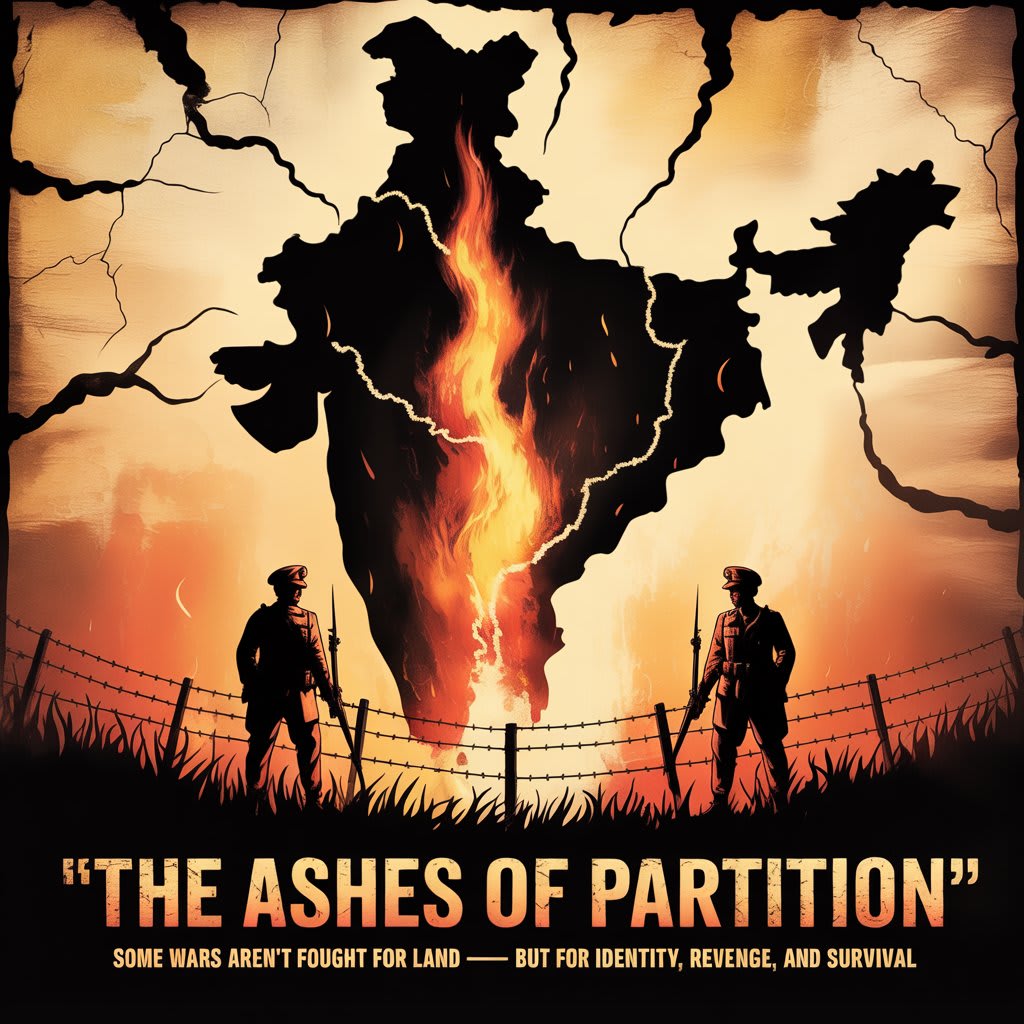
- Chapter 1: The Flicker
- In the winter of 2025, tensions between India and Pakistan simmered at their highest since the Kargil conflict. The world watched with baited breath. Skirmishes along the Line of Control had evolved into calculated drone strikes and cyber-attacks. But this time, it wasn’t just about territory—it was about pride, retaliation, and political survival.
- Major Ayaan Malik of the Pakistan Army stood beside the charred remains of a telecommunications tower in Muzaffarabad. A recent Indian drone strike had cut off critical infrastructure. Yet, in his eyes, there was less anger and more fatigue. War had aged him. He had lost comrades, friends—and in a way, a part of himself. But orders were orders.
- Across the border, Captain Raghav Verma of the Indian Army received his own briefings in Srinagar. Fluent in strategy and calm under fire, Raghav was chosen to lead the new offensive into the northern sector. He had once studied with Pakistani officers in a UN peacekeeping simulation in Geneva. Ironically, one of them had been Ayaan.
- Neither of them knew they would meet again—not on neutral ground, but on a battlefield.
- Chapter 2: Spark and Smoke
- The war officially ignited on January 16th, 2025, after a cyberattack on Mumbai’s power grid plunged the city into chaos. India responded with a preemptive strike on a weapons depot in Bahawalpur. The world condemned the escalation but could do little. Both nations had grown increasingly self-reliant and nationalistic. Diplomacy was drowning in flames.
- Civilians bore the worst. Families in Lahore and Amritsar were displaced. Air-raid sirens screamed day and night. Schools were shuttered; social media turned into a battleground of disinformation.
- On the front lines, Raghav and Ayaan pushed forward with grim resolve. Skirmishes grew bloodier, and intelligence failed both sides repeatedly. Rumors spread of chemical weapons being prepped, and whispers of nuclear retaliation floated through war rooms like ghosts.
- But there was one mission—codenamed Fifth Flame—that neither knew about. Conceived in secrecy by rogue elements within both militaries, it aimed to conduct a false-flag attack with nuclear overtones, forcing a full-scale confrontation. Its goal: total war.
- Chapter 3: The Crossroads
- Lieutenant Zara Hashmi, a Pakistani intelligence officer, intercepted fragments of communication that hinted at Fifth Flame. Trained in psychological warfare, she realized this operation wasn’t sanctioned at the highest levels—it was being manipulated by zealots within.
- Across the border, journalist Nisha Bedi stumbled on similar documents while investigating cyber sabotage. Her report was suppressed by the government, but not before she reached out to her college friend—Captain Raghav Verma.
- Raghav was skeptical, but his gut told him something was wrong. He quietly reached out through backchannels to a contact in Pakistan—a name he hadn’t heard in years: Major Ayaan Malik.
- The two exchanged encrypted messages over a secure server once used for UN operations. It was a gamble, possibly treason. But both knew if Fifth Flame succeeded, millions could die.
- Chapter 4: The Silent Pact
- Ayaan and Raghav arranged an unsanctioned meeting near the Sharda Peeth ruins, a site sacred to both nations. Under the cloak of darkness, with only a crescent moon above, they met face-to-face for the first time in over a decade.
- No handshakes. Just words.
- They shared intelligence, confirmed the existence of Fifth Flame, and identified the rogue elements—ultranationalist commanders and foreign arms dealers with vested interests.
- They devised a plan: expose the operation to the world. But to do that, they needed access to two separate locations—one in Rawalpindi and one in New Delhi—where the plans were stored.
- It was a suicide mission, but they had no choice.
- Chapter 5: Flames Within
- Zara coordinated with Ayaan to extract the data from Rawalpindi. She used her influence within the ISI to create diversions while Ayaan infiltrated a restricted server facility. On the other side, Raghav enlisted Nisha Bedi and a disillusioned Indian intelligence agent to break into a defense hub in New Delhi.
- Both missions nearly failed. Zara was shot while covering Ayaan’s escape. Raghav barely avoided capture by jumping from a second-story window.
- But they got the data.
- They sent it to global watchdogs, UN representatives, and broadcast media via encrypted satellite links.
- Within hours, the world knew about Fifth Flame.
- Chapter 6: The Afterburn
- The fallout was immediate. Protests erupted in Islamabad and Delhi. Generals were arrested. The rogue networks were dismantled. And the world, for once, held its breath and acted—mediating an emergency ceasefire.
- Ayaan was court-martialed but spared execution. He vanished from public life.
- Raghav resigned his commission and became a security advisor at an international peacekeeping NGO. Nisha’s story won global awards. Zara survived, though she walked with a limp—and became a symbol of resistance.
- But the borders remained.
- Epilogue: The Fifth Flame
- In a children’s school rebuilt near Sharda Peeth, there stands a plaque.
- It reads:
- "Here, under the light of the fifth flame, strangers became brothers, war turned to ash, and peace—if only for a moment—burned brighter than hate."
- They never took credit. But they lit the flame.
- And for now, it still flickers.
- Epilogue: The Fifth Flame
- In a children’s school rebuilt near Sharda Peeth, there stands a plaque.
- It reads:
- "Here, under the light of the fifth flame, strangers became brothers, war turned to ash, and peace—if only for a moment—burned brighter than hate."
- They never took credit. But they lit the flame.
- And for now, it still flickers.
- 1. First Indo-Pak War (1947–1948)
- Cause: Dispute over the princely state of Jammu and Kashmir.
- Outcome: Ceasefire brokered by the United Nations. Kashmir was divided between India (administered part) and Pakistan (Azad Kashmir and Gilgit-Baltistan).
- 2. Second Indo-Pak War (1965)
- Cause: Continued dispute over Kashmir; Pakistan launched Operation Gibraltar to infiltrate forces into Jammu and Kashmir.
- Outcome: Stalemate. The Tashkent Agreement was signed under Soviet mediation.
- 3. Third Indo-Pak War (1971)
- Cause: Political and humanitarian crisis in East Pakistan (now Bangladesh).
- Outcome: India supported the Bangladeshi independence movement. Pakistan surrendered in Dhaka. Resulted in the creation of Bangladesh.
- 4. Kargil War (1999)
- Cause: Pakistani soldiers and militants infiltrated Indian positions in Kargil (Ladakh region).
- Outcome: India recaptured the occupied territories. Significant international pressure on Pakistan to withdraw.
- Ongoing Tensions
- Both countries have nuclear weapons and engage in periodic border skirmishes, especially across the Line of Control (LoC) in Kashmir.
- Diplomatic relations remain strained, often affected by terrorism, ceasefire violations, and political rhetoric.
- Would you like a timeline, maps, or key facts about a specific war?
- You said: wilder
- india pak war 2025
- As of May 8, 2025, India and Pakistan are engaged in a significant military confrontation, marking the most severe escalation in their relations since the 2019 Balakot crisis.
- 🔥 Timeline of Events
- April 22, 2025: A terrorist attack in Pahalgam, Indian-administered Kashmir, kills 28 civilians, predominantly Hindu tourists. The Resistance Front, linked to Pakistan-based Lashkar-e-Taiba, claims responsibility. India accuses Pakistan of complicity, citing the group's ties to Pakistan's military intelligence.
- May 6, 2025: India launches "Operation Sindoor," targeting nine sites in Pakistan and Pakistan-administered Kashmir, including Bahawalpur, Muridke, and Muzaffarabad. India claims to have killed over 100 militants from Jaish-e-Mohammed and Lashkar-e-Taiba. Pakistan reports 31 civilian deaths and 57 injuries, including children, and accuses India of targeting civilian areas such as mosques and educational facilities.
- May 7, 2025: Pakistan claims to have downed five Indian fighter jets and engages in artillery exchanges along the Line of Control (LoC), resulting in additional casualties on both sides.
- May 8, 2025: Pakistan reports shooting down 25 Indian drones and accuses India of sending drones to strike military facilities in Lahore. India confirms the loss of aircraft but cites unclear causes. Both countries report civilian casualties from cross-border shelling.
- ⚠️ Nuclear Risk and Global Concerns
- Both India and Pakistan possess nuclear arsenals, with estimates ranging from 170 to 200 warheads each. Experts warn that even limited conventional conflicts, especially involving missiles or drones, could rapidly escalate due to the lack of well-defined thresholds and increasing military capabilities. Global leaders, including U.S. President Donald Trump, have urged both nations to de-escalate and engage in dialogue to prevent further escalation.
- Diplomatic Efforts
- International organizations and global powers, including the United Nations, the United States, China, and the United Kingdom, have called for maximum restraint and diplomatic resolution. Pakistan's Prime Minister Shehbaz Sharif has condemned India's strikes as "cowardly acts of war" and vowed consequences, while India's Foreign Minister Subrahmanyam Jaishankar has warned of a firm response to any attacks.
- 📍 Impact on Fort Munro, Punjab
- Fort Munro, located in Punjab, Pakistan, is situated far from the immediate conflict zones in Kashmir and Punjab provinces. However, the ongoing military activities and heightened tensions may affect the region indirectly through increased security measures, potential disruptions in communication, and economic impacts due to the broader instability.
About the Creator
wilder
"Storyteller at heart, explorer by soul. I share ideas, experiences, and little sparks of inspiration to light up your day. Dive in — there's a world waiting inside every word."
Reader insights
Outstanding
Excellent work. Looking forward to reading more!
Top insights
Easy to read and follow
Well-structured & engaging content
Excellent storytelling
Original narrative & well developed characters
Heartfelt and relatable
The story invoked strong personal emotions
Compelling and original writing
Creative use of language & vocab
Expert insights and opinions
Arguments were carefully researched and presented
Eye opening
Niche topic & fresh perspectives
Masterful proofreading
Zero grammar & spelling mistakes
On-point and relevant
Writing reflected the title & theme
Real-World Challenges In Open Relationships And How To Overcome Them
One of the most widespread issues in open relationship is jealousy. Despite full approval with all the knowledge, the thought of a partner relating to another may cause insecurity and fear. The acknowledgement of the fact that these emotions are natural is the initial step to managing them. Couples would need to establish a secure environment to talk honestly without faulting feelings. Rather than repressing jealousy, the partners can talk about their underlying needs of reassurance or closeness. Knowing your triggers and being open about them will help avoid feeling bitter and foster emotional intimacy, transforming possible conflict into the chance of better connection.
By Hayley Kiyoko5 days ago in Filthy
Real-World Strategies To Strengthen Intimacy In Long-Term Relationships
Due to the routine that accompanies long-term relationships, it is common to have the problem of overshadowing romance. With the growing responsibilities, couples might unknowingly lose emotional attachment to their focus and start focusing on logistics. Putting emphasis on constant emotional interaction is a priority to sustain intimacy in the long run. Such mundane actions as posing significant questions, saying thank you, or highlighting the best things of the day can create intimacy. Emotional bonding is enhanced by the partners being perceived and being appreciated in other ways other than utilitarianism. Setting up planned conversations, however, short ones, strengthens the connection and keeps the communication available. Through emotional awareness, couples avoid the occurrence of distance and enhance the underpinnings of intimacy that will lead to the achievement of long-term satisfaction in the relationship.
By Willian James6 days ago in Filthy
Cassie and Johnny
I’m the kind of dame you notice. I’m no femme fatale, but you can’t ignore me, at least not until I warn you about what’s coming, then everybody ignores me. Hell, they usually blame me afterwards and give Johnny all the credit for saving the day, but my Johnny couldn’t save a seat at the movies without my help. Sure, he’s brawny, but brainy? Not so much. Like that time I asked him to spot me five bucks, and he said he didn’t see it anywhere on me, and believe you me, he looked but good.
By Harper Lewis5 days ago in Critique




Comments (5)
1947-1948 (First Indo-Pak War): Cause: Following the partition of British India, both India and Pakistan laid claim to the princely state of Jammu and Kashmir. Outcome: The war ended with a ceasefire and the establishment of the Line of Control (LoC), dividing Kashmir between India and Pakistan. A UN-mandated ceasefire was implemented, but the region remained disputed.
best
zaberdast thank you
goood information for pak and india thank you sir . do more post
good information thank you sir