
Japan Laundry Appliances Market Size and Forecast 2025–2033
Smart Living, Compact Homes, and Sustainable Innovation Shape Japan’s Laundry Appliance Industry


Japan Laundry Appliances Market Overview
The Japan Laundry Appliances Market is positioned for steady and resilient growth over the forecast period, reflecting the country’s deep-rooted culture of technological innovation, premium consumer expectations, and lifestyle-driven purchasing behavior. According to Renub Research, the market is projected to grow from US$ 3.12 billion in 2024 to US$ 4.08 billion by 2033, registering a CAGR of 3.02% from 2025 to 2033.
This expansion is largely driven by continuous advancements in laundry appliance technology, including smart connectivity, enhanced energy efficiency, automation, and improved washing and drying performance. Japan’s consumers are known for prioritizing quality, reliability, hygiene, and compact design—factors that continue to define purchasing decisions across both urban and semi-urban regions.
Despite being a mature market with household penetration rates between 95% and 100%, value growth remains robust. This is due to strong demand for high-end, intelligent, and multifunctional appliances, particularly among urban professionals, elderly households, and environmentally conscious consumers.
Japan Laundry Appliances Industry Landscape
Japan’s laundry appliance industry is both highly developed and intensely competitive, shaped by urban density, limited living space, and one of the world’s most technologically literate consumer bases. Compact, space-saving solutions dominate demand, especially in major metropolitan areas such as Tokyo and Osaka, where apartment sizes are often small and multifunctionality is essential.
Front-loading washing machines and washer-dryer combinations are widely preferred in urban households due to their water efficiency, quiet operation, and compact footprint. In contrast, top-loading machines still retain relevance in rural and semi-urban areas where space constraints are less severe.
Domestic manufacturers such as Panasonic, Hitachi, Toshiba, and Sharp continue to dominate the market through strong brand trust, extensive service networks, and innovation tailored specifically to Japanese lifestyles. At the same time, international players like LG Electronics and Samsung are steadily gaining market share by introducing IoT-enabled, AI-powered, and smart home–integrated appliances.
Annual washing machine sales in Japan are estimated at approximately 2.68 million units, indicating a replacement-driven market rather than first-time adoption. Consumers are increasingly willing to invest in premium products that deliver superior hygiene, automation, and long-term efficiency.
Key Factors Driving Growth in the Japan Laundry Appliances Market
Urbanization and Compact Living Spaces
Japan’s high urbanization rate has significantly influenced laundry appliance design and demand patterns. In densely populated cities, where residential space is at a premium, consumers actively seek compact, stackable, and multifunctional appliances. Washer-dryer combinations and slim-profile front-loading machines are particularly popular among young professionals and nuclear families.
Manufacturers are responding by developing quiet, vibration-free, and space-efficient models that can be installed in kitchens, bathrooms, or balconies without disrupting daily life. Built-in laundry appliances and modular designs are also gaining traction, especially in newly constructed apartments.
Technological Innovation and Smart Features
Japan’s reputation as a global technology leader is clearly reflected in its laundry appliance sector. Smart innovation is one of the strongest growth engines in the market, with features such as:
AI-based load detection and fabric care
Smartphone app control and remote monitoring
IoT connectivity within smart home ecosystems
Automatic detergent and water dosing
Steam cleaning and allergy removal functions
These innovations appeal strongly to tech-savvy consumers who value convenience, precision, and automation. Additionally, energy- and water-efficient technologies align closely with Japan’s environmental policies and consumer sustainability goals, making smart appliances both a lifestyle and ethical choice.
Aging Population and Demand for User-Friendly Design
Japan’s rapidly aging population is reshaping appliance design priorities. Elderly consumers prefer easy-to-use, low-effort, and ergonomic appliances that reduce physical strain. Features such as front-access doors, larger control panels, voice assistance, simplified wash programs, and self-cleaning mechanisms are increasingly in demand.
Manufacturers are adopting inclusive design principles to ensure products remain accessible to all age groups. Appliances that combine advanced technology with intuitive operation are particularly attractive to senior households seeking independence and convenience.
Challenges Facing the Japan Laundry Appliances Market
Market Saturation and Limited Volume Growth
With nearly universal household ownership of washing machines, Japan’s laundry appliance market is highly saturated. Growth opportunities are primarily driven by replacement demand and premium upgrades, rather than new installations. This limits volume expansion and places pressure on manufacturers to justify higher price points through innovation and added features.
Additionally, the long lifespan and high durability of Japanese appliances slow replacement cycles, making it challenging for brands to maintain rapid sales momentum.
Population Decline and Structural Demand Constraints
Japan’s declining birth rate and shrinking working-age population pose long-term challenges. Smaller household sizes reduce demand for large-capacity machines, while rural depopulation limits regional expansion opportunities. Furthermore, labor shortages in manufacturing and after-sales service may increase operational costs over time.
To sustain growth, brands must strike a balance between premium innovation and practical simplicity, particularly when targeting senior consumers and smaller households.
Market Segmentation Analysis
By Type
Freestanding Laundry Appliances
Built-in Laundry Appliances
By Product
Washing Machines
Dryers
Electric Smoothing Irons
Others
By Technology
Automatic
Semi-Automatic / Manual
Others
By Distribution Channel
Specialty Stores
Supermarkets and Hypermarkets
Department Stores
E-Commerce
Others
E-commerce continues to gain momentum as consumers increasingly research, compare, and purchase appliances online, supported by fast delivery and professional installation services.
Competitive Landscape and Company Insights
The Japanese laundry appliances market is characterized by strong domestic leadership and growing international competition. Key companies covered in the report include:
Hitachi
Panasonic
Toshiba
Sharp
Whirlpool Corporation
Electrolux Group
Miele
Haier Inc
LG Electronics
Midea Group Co.
Each company analysis includes business overviews, key executives, recent developments, SWOT analysis, and revenue insights, offering a comprehensive view of competitive strategies and market positioning.
Future Outlook: What Lies Ahead
While Japan’s laundry appliances market may not experience explosive volume growth, its value-driven expansion remains strong. Continued investment in smart technologies, sustainability, ergonomic design, and premium performance will shape the industry’s evolution through 2033.
Manufacturers that successfully align innovation with Japan’s changing demographics, urban lifestyles, and environmental priorities will be best positioned to thrive. As consumers increasingly upgrade to intelligent, energy-efficient, and multifunctional appliances, the market will continue to demonstrate resilience and long-term stability.
Final Thoughts
The Japan Laundry Appliances Market stands as a model of how a mature industry can continue to grow through innovation, quality, and consumer-centric design. With a projected market size of US$ 4.08 billion by 2033, steady CAGR growth, and strong replacement demand, the sector remains highly attractive for established players and new entrants alike.
Driven by smart living trends, compact housing, an aging population, and sustainability goals, Japan’s laundry appliance industry is not just evolving—it is redefining modern home convenience.
About the Creator
Marthan Sir
Educator with 30+ years of teaching experience | Passionate about sharing knowledge, life lessons & insights | Writing to inspire, inform, and empower readers.
Keep reading
More stories from Marthan Sir and writers in Filthy and other communities.
Germany Watch Market Trends & Summary
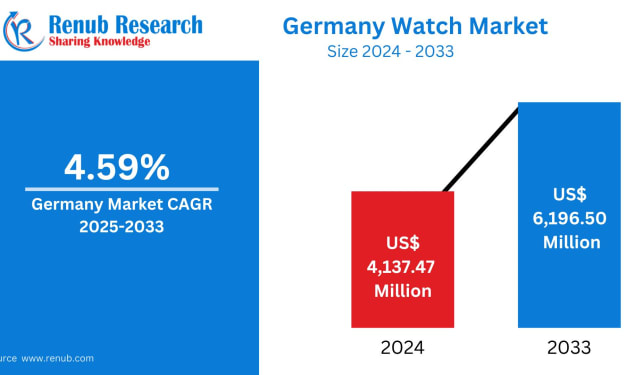
The Germany Watch Market, valued at US$ 6,196.50 million in 2024, is undergoing a dynamic transformation shaped by luxury craftsmanship, digital innovation, and shifting consumer preferences. According to Renub Research, the market is projected to reach US$ 4,137.47 million by 2033, expanding at a CAGR of 4.59% between 2025 and 2033. This steady rise reflects Germany’s enduring love for precision engineering and its rapid embrace of modern wearable technology.
By Marthan Sir30 days ago in Filthy
A Failed Artist, A Disillusioned Poet, An Underpaid Game Show Host
I took my son and niece to Gori, a small town in Georgia where Joseph Stalin was born. They talked me into visiting the Stalin's Museum, the largest in the post-Soviet space. I had resisted going there because I just can't stand the monster and know enough about him, or so I thought.
By Lana V Lynx6 days ago in FYI


Comments
There are no comments for this story
Be the first to respond and start the conversation.