
Bumble’s Revamp Fails to Impress Investors as Shares Drop
Can the Dating App Giant Regain Its Spark Amid Disappointing Forecasts and Growing Competition?


In the ever-evolving world of online dating, Bumble Inc. has long been a standout, known for its women-first approach and innovative features. But the company is now facing a tough reality: despite a major revamp aimed at reconnecting with users, its latest financial forecast has left investors unimpressed.
After reporting first-quarter sales projections that fell short of Wall Street’s expectations, Bumble’s shares dropped 18% in after-hours trading on Tuesday. This comes as the company grapples with increasing competition, shifting user preferences, and the challenge of appealing to a younger, more demanding audience.
Let’s dive into what’s behind Bumble’s struggles, its efforts to reinvent itself, and what the future might hold for the dating app giant.
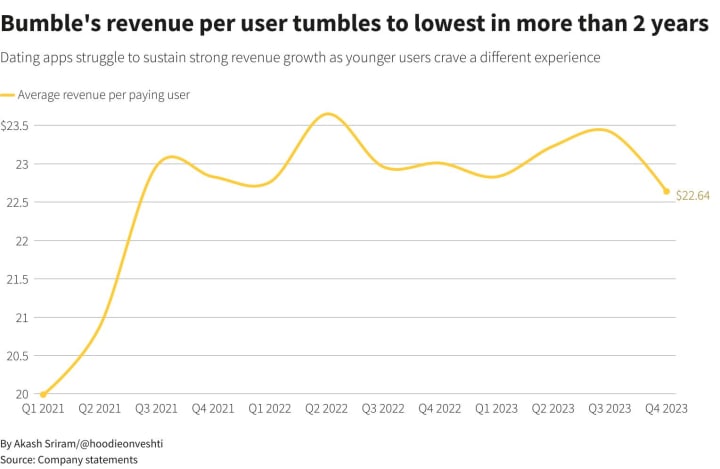
The Numbers: A Disappointing Forecast
Bumble’s first-quarter sales forecast of 242 million to 248 million missed analysts’ expectations of $256.9 million, sending its stock tumbling. This disappointing outlook follows a year of challenges for the company, including a 40% decline in its share price over the past 12 months.
Key Financial Highlights
Fourth-Quarter Sales: Fell 4.4% year over year to $261.6 million, though this was slightly above Wall Street’s expectations.
Paying Users: Increased by 5.3% to 4.2 million, a rare bright spot in an otherwise gloomy report.
Foreign Currency Impact: Sales took a $2.7 million hit due to currency fluctuations.
The Challenges: Competition and User Fatigue
Bumble’s struggles are emblematic of broader challenges in the online dating industry.
Growing Competition
The dating app market is more crowded than ever, with competitors like Tinder, Hinge, and niche apps vying for users’ attention. Bumble’s unique selling point—women making the first move—is no longer enough to set it apart in a sea of options.
Gen Z Fatigue
Younger users, particularly Gen Z, have grown increasingly disillusioned with dating apps. Many complain that these platforms prioritize fleeting connections over meaningful relationships and rely too heavily on monetization strategies.
Pressure to Innovate
To stay relevant, Bumble has had to rethink its approach. This includes revamping its app, experimenting with new features, and leveraging artificial intelligence to improve user experiences.

Bumble’s Revamp: A New Direction
In an effort to reignite growth and reconnect with users, Bumble has embarked on a major transformation.
Key Changes
Women No Longer Have to Make the First Move: In a significant shift, Bumble has relaxed its signature feature, allowing either party to initiate conversations.
App Redesign: The company has refreshed its app’s look and feel, aiming to make the dating experience less “exhausting” and more engaging.
AI Integration: Bumble is incorporating artificial intelligence to facilitate better matches and streamline user interactions.
Leadership Shakeup
Bumble has also made changes at the top, including the return of founder Whitney Wolfe Herd as CEO starting next month. Herd’s leadership is expected to bring fresh energy and a renewed focus on innovation.
The Road Ahead: Can Bumble Bounce Back?
Despite its challenges, Bumble remains optimistic about its future.
Product Innovation
The company has pledged to maintain a “regular cadence of product innovation” throughout the year, signaling its commitment to staying ahead of the curve.
Operational Discipline
Bumble’s leadership has emphasized the importance of operating with “discipline and rigor,” suggesting a focus on efficiency and profitability.
User Engagement
With paying users on the rise, Bumble has a solid foundation to build upon. The key will be retaining these users while attracting new ones through innovative features and improved experiences.
What This Means for the Dating App Industry
Bumble’s struggles reflect broader trends in the online dating world, where user expectations are higher than ever, and competition is fierce.
The Need for Authenticity
Users are increasingly seeking platforms that prioritize genuine connections over superficial interactions. Apps that can deliver on this promise are likely to thrive.
Monetization vs. User Experience
Balancing monetization strategies with user satisfaction is a delicate act. Companies that can strike this balance will have a competitive edge.
The Role of Technology
Artificial intelligence and other technological advancements will play a crucial role in shaping the future of online dating, offering new ways to connect and engage.
Conclusion
Bumble’s recent struggles highlight the challenges of staying relevant in a rapidly changing industry. While its revamp and renewed focus on innovation are steps in the right direction, the company faces an uphill battle to win back investors and users alike.
As the dating app giant navigates this critical juncture, one thing is clear: the future of online dating will belong to those who can adapt, innovate, and truly understand what users want. For Bumble, the stakes have never been higher—but the opportunity to redefine itself has never been greater.
- I'm so grateful you took the time to read. I hope this piece sparked something within you. I'd be delighted to hear your perspective in the comments, and subscribing will ensure you're along for the next adventure.
About the Creator
mureed hussain
Hi, I’m a creative writer passionate about health & wellness, love, longevity, aging, and pet care. With extensive Quora experience, I craft engaging posts, thoughtful questions, and insightful answers.
Find me at>>[email protected]
Keep reading
More stories from mureed hussain and writers in Filthy and other communities.
A Slice of Heartbreak: My Valentine's Day Story
Ah, high school—a chaotic mix of awkward first dates, fashion disasters, and cringe-worthy moments that refuse to be forgotten. But amidst all the teenage drama, nothing could have prepared me for the unforgettable saga of the guy who believed his bare hands were as heatproof as oven mitts. Brace yourself for a tale of reckless confidence, painful regrets, and a pizza that never stood a chance.
By mureed hussain11 months ago in Filthy
The steps to losing a child
Step One: Lose a child. Not what anyone wants to happen and nothing you can do to change it, but you can go through steps to becoming happy again. You can go through steps to loving again. You can go through steps to become a new you because after losing a child you will never be the same person you once were.
By Tabitha Hinkley3 days ago in Fiction



Comments
There are no comments for this story
Be the first to respond and start the conversation.