
Your Phone Is Already an AI
The Invisible Artificial Intelligence Powering Your Everyday Life

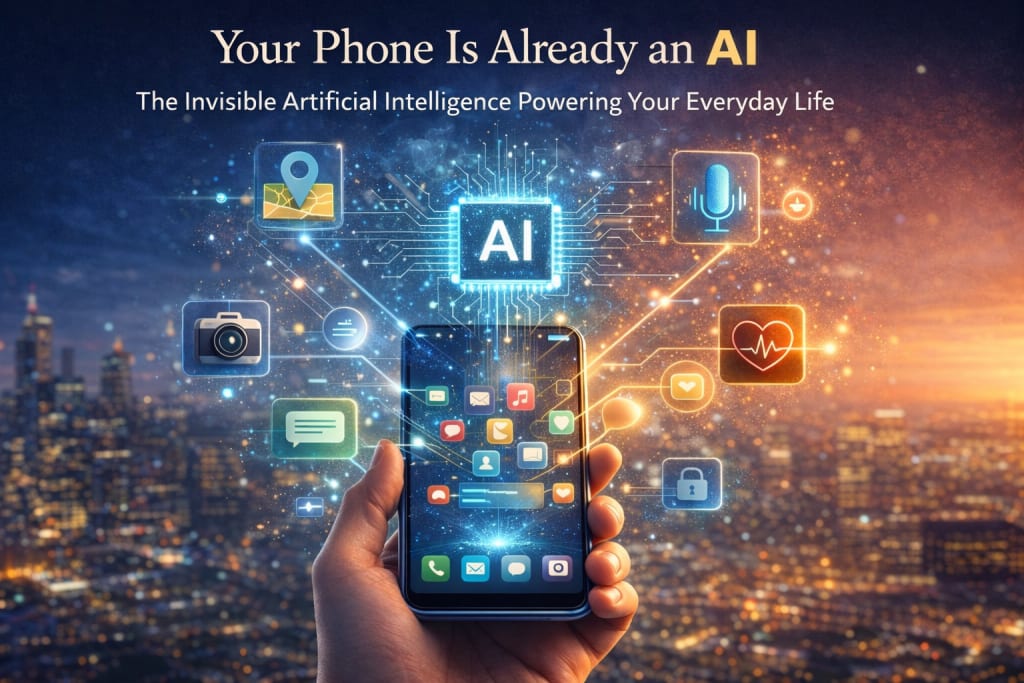
Take a moment right now.
Unlock your phone.
Type a quick message.
Open your favorite social media app.
Snap a photo.
Nothing about these actions feels futuristic.
Yet every single one of them is powered by artificial intelligence.
When most people hear the term AI, they imagine humanoid robots, sci-fi movies, or advanced chatbots having philosophical conversations. But the truth is far less dramatic — and far more powerful.
AI is already living in your pocket.
Your smartphone is one of the most sophisticated AI devices you use daily. It learns from you. It adapts to you. It predicts your behavior. And it quietly shapes your digital world — all without announcing itself.
Let’s explore how artificial intelligence in smartphones has already transformed daily life — and why understanding it matters more than ever in 2026.
________________________________________
AI on Your Phone: Silent, Seamless, and Smart
Unlike robots in movies, smartphone AI doesn’t demand attention. It operates invisibly, embedded into features we now take for granted.
Face ID and Fingerprint Recognition
When you unlock your phone using Face ID or a fingerprint, you’re not just matching a static image.
Machine learning models analyze:
• Facial depth patterns
• Micro-contours
• Lighting variations
• Angle changes
• Subtle aging shifts
Each time you unlock your phone, the system becomes slightly more accurate. It learns your face in different environments — with glasses, without glasses, under sunlight, in darkness.
This is adaptive AI authentication, and it’s happening in milliseconds.
________________________________________
AI-Powered Typing: Your Phone Knows How You Speak
Ever notice how autocorrect sometimes finishes your sentences perfectly?
That’s not random.
Predictive text, smart replies, and grammar correction tools rely on natural language processing (NLP) — a branch of artificial intelligence designed to understand human language.
Your phone analyzes:
• Sentence structure
• Writing patterns
• Frequently used phrases
• Emoji preferences
• Slang and abbreviations
Over time, your smartphone builds a linguistic profile of you. It mirrors your tone. It anticipates your responses. It adapts to your communication style.
It’s not just correcting mistakes.
It’s learning your voice.
________________________________________
AI Personalization: Why Your Phone Feels Psychic
Have you ever opened a music app and found the perfect song already recommended?
Or scrolled through videos that seem uncannily aligned with your interests?
That’s AI-driven recommendation algorithms at work.
These systems analyze:
• What you click
• What you skip
• How long you watch
• When you stop engaging
• What you search for
This data feeds machine learning models that continuously refine what you see.
The benefit?
Less time searching. More relevant content.
The hidden cost?
AI subtly shapes your digital environment — filtering what appears and what disappears.
Your phone becomes a curator of reality, deciding which information reaches you.
________________________________________
Your Smartphone Camera Is an AI Machine
Modern smartphone cameras are not just hardware upgrades — they are AI-driven imaging systems.
When you take a photo, artificial intelligence instantly:
• Detects faces
• Identifies objects
• Recognizes scenes (beach, sunset, food, pets)
• Adjusts brightness and contrast
• Applies HDR optimization
• Enhances sharpness
Night mode? AI.
Portrait blur? AI.
Automatic color correction? AI.
In less than a second, your phone makes dozens of computational decisions.
It doesn’t just capture an image.
It enhances it using machine learning trained on millions of photos.
Even your gallery uses AI. Search “birthday,” “mountain,” or “dog,” and your phone surfaces images without manual tagging.
In many ways, your phone remembers your life better than you do.
________________________________________
AI Navigation: Your Silent Co-Pilot
Navigation apps are among the most powerful examples of artificial intelligence in everyday life.
When you request directions, AI analyzes:
• Real-time traffic data
• Historical congestion patterns
• Weather conditions
• Accidents and road closures
• Rush hour behavior
It doesn’t just provide a route — it predicts the fastest path dynamically.
Have you noticed your phone suggesting directions before you even ask?
If you leave work at 6 PM every day, your phone anticipates your destination. This predictive assistance turns AI into a silent co-pilot, guiding routines without interrupting them.
________________________________________
AI in Health and Wellness Apps
Artificial intelligence on smartphones now supports both physical and mental health.
Fitness apps use AI to:
• Track steps
• Analyze movement patterns
• Monitor heart rate trends
• Identify irregular rhythms
• Detect falls
Some devices can alert emergency contacts if unusual health patterns are detected.
Mental health apps also use AI to:
• Track mood changes
• Suggest breathing exercises
• Offer stress management tools
• Analyze journaling patterns
While not a replacement for professionals, AI-powered health tracking provides accessible, real-time insights.
Your phone is becoming a personal wellness assistant.
________________________________________
The Trade-Off: AI and Data Privacy
All this intelligence relies on one critical resource:
Data.
Your location history.
Your search behavior.
Your app usage.
Your communication style.
Your purchase patterns.
The more data your phone collects, the smarter it becomes.
This creates an important question in 2026:
How much personalization is worth how much privacy?
Tech companies increasingly emphasize on-device processing and encryption. Still, the balance between convenience and data ownership remains a global debate.
AI in smartphones thrives on information. Understanding that trade-off empowers you to make informed choices.
________________________________________
From Device to Digital Companion
There’s something uniquely intimate about smartphone AI.
Your phone:
• Wakes you up
• Tracks your habits
• Stores your memories
• Connects you socially
• Manages your schedule
• Suggests what to watch, buy, and read
Unlike traditional tools that wait for instructions, AI-powered smartphones anticipate needs.
They suggest before you ask.
They predict before you decide.
They adapt without being told.
Over time, the relationship shifts.
It’s no longer just user and device.
It feels closer to partnership.
________________________________________
The Future of AI in Smartphones
As artificial intelligence evolves, the line between “advanced technology” and “normal life” continues to blur.
Upcoming innovations include:
• Real-time language translation during calls
• Smarter personal assistants with contextual memory
• Advanced AI-powered cybersecurity
• Predictive scheduling based on behavior patterns
• Emotion-aware digital interfaces
What feels impressive today will soon feel ordinary.
And that’s the defining characteristic of AI:
It becomes invisible once it works well enough.
________________________________________
Final Thoughts: The AI Revolution Already Happened
We often talk about “the future of AI” as if it’s coming someday.
But the truth is simpler:
The AI revolution already happened — quietly.
Your phone learns from you.
It adapts to you.
It predicts your needs.
It shapes your digital world.
Artificial intelligence isn’t a distant concept or a robotic threat.
It’s the invisible helper in your daily life.
And it’s been there all along — sitting in your pocket, making millions of micro-decisions every single day.
The next time you unlock your phone, remember:
You’re not just using a device.
You’re interacting with one of the most advanced AI systems ever created — and it already knows you better than you think.
About the Creator
Adil Ali Khan
I’m a passionate writer who loves exploring trending news topics, sharing insights, and keeping readers updated on what’s happening around the world.
Keep reading
More stories from Adil Ali Khan and writers in Fiction and other communities.
5 Biggest AI Fears: Which Are Sci-Fi — and Which Are Actually Real?
Artificial Intelligence is no longer a futuristic concept locked inside research labs. It writes emails, generates images, recommends what you watch, detects fraud, powers medical diagnostics, and even drives experimental vehicles. From startups to global corporations, AI is now embedded in daily life.
By Adil Ali Khanabout 2 hours ago in Fiction
If You Write A Book, Don’t Tell Anyone
There are days when I’m grateful Amazon doesn’t tell me specifically who has bought my book and who hasn’t. If they did, I would be heartbroken when I read the list and noticed all the important names in my life were not on my list of customers.
By Ellen Frances6 days ago in Writers



Comments
There are no comments for this story
Be the first to respond and start the conversation.