
🌍 World War II – Full History Summary (1939–1945)
"From the rise of fascism to the fall of empires—World War II reshaped the world in fire, blood, and courage.

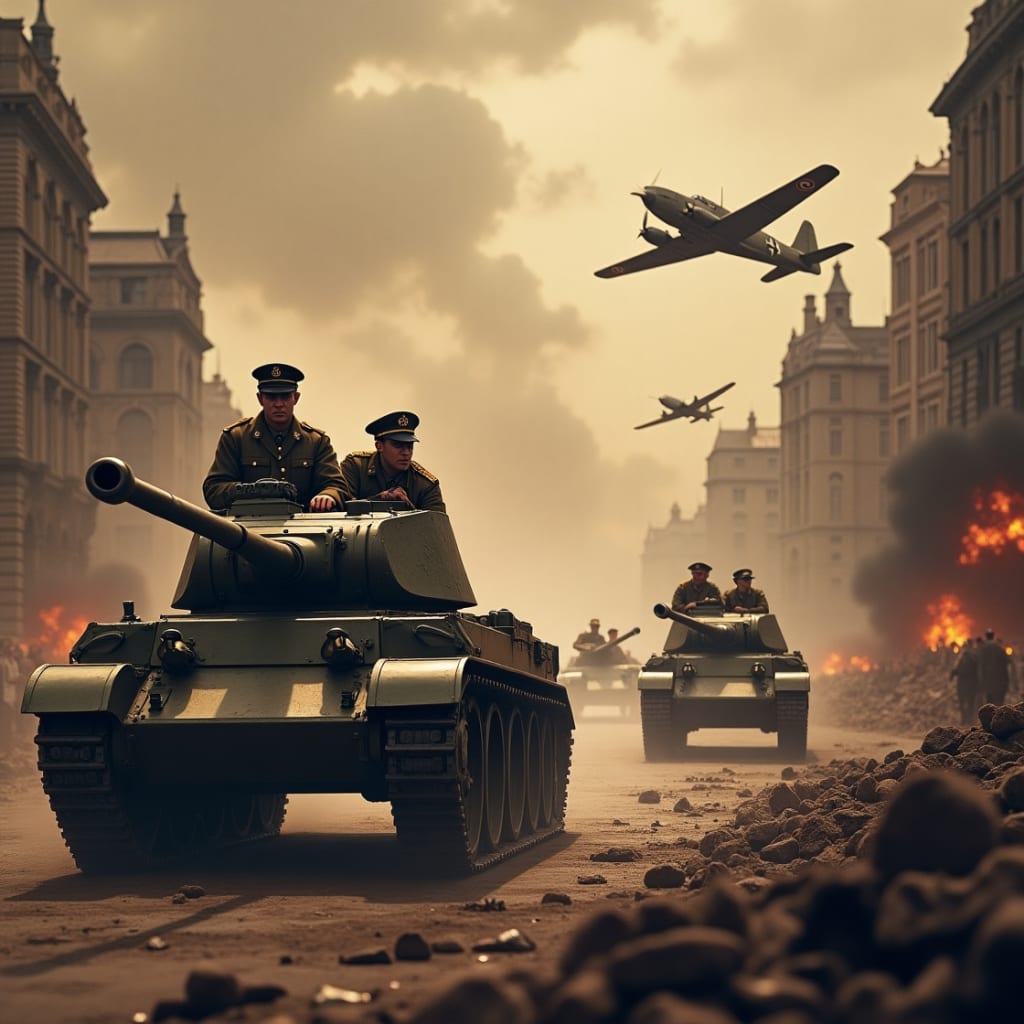
🌍 World War II – Full History Summary (1939–1945)
Duration: 6 years
Major Sides:
Allied Powers: United Kingdom, USSR, United States, France, China
Axis Powers: Nazi Germany, Italy, Japan
🧨 I. Causes of World War II
Treaty of Versailles (1919):
After WWI, Germany was harshly punished — forced to give up land, pay reparations, and disarm. This created resentment among Germans.
Rise of Adolf Hitler & Nazism:
Hitler came to power in 1933, promising to restore Germany's glory, rebuild its military, and expand its territory (“Lebensraum” — living space).
Expansionism by Axis Powers:
Germany invaded Austria and Czechoslovakia.
Italy invaded Ethiopia.
Japan invaded Manchuria (1931) and China (1937).
Failure of the League of Nations:
This global peace organization couldn’t stop aggressive countries.
Appeasement Policy:
Britain and France allowed Hitler to take land (like Sudetenland) hoping to avoid another war.
📆 II. Timeline of Major Events
🔰 1939: War Begins
September 1: Germany invades Poland using “Blitzkrieg” (lightning war).
September 3: Britain and France declare war on Germany.
🪖 1940: Europe Falls
Germany quickly defeats:
Poland, Denmark, Norway
Then Belgium, Netherlands, and France fall by June.
Battle of Britain:
The UK, under Winston Churchill, resists massive German air attacks (Luftwaffe).
🔥 1941: Global War
June 22: Hitler invades Soviet Union (Operation Barbarossa) — breaks pact with Stalin.
December 7: Japan bombs Pearl Harbor (Hawaii).
December 8–11: USA joins war; Germany & Italy declare war on the USA.
Now it’s a truly world war — in Europe, Africa, and Asia-Pacific.
🧭 1942–1943: Turning Points
Battle of Stalingrad (1942–43):
Soviet Red Army defeats Germany — a major turning point in the East.
Battle of El Alamein (1942):
British defeat Germans in North Africa.
Battle of Midway (1942):
USA defeats Japan in Pacific — turning point in the Pacific war.
⚔️ 1944: D-Day and Liberation
June 6, 1944: D-Day – Allied troops land in Normandy, France.
Massive operation to liberate Western Europe.
Soviet Union pushes Nazis from the East.
☠️ 1945: End of the War
April 30: Hitler commits suicide in Berlin.
May 8: Germany surrenders – called VE Day (Victory in Europe Day).
August 6 & 9: USA drops atomic bombs on Hiroshima and Nagasaki.
August 15: Japan surrenders – VJ Day (Victory over Japan Day).
🧪 III. The Holocaust
6 million Jews were killed by Nazis in concentration camps.
Other victims: Poles, Romani (Gypsies), disabled, and political enemies.
Known as the Holocaust — one of the greatest genocides in history.
🌐 IV. Countries Involved
🔵 Allied Powers:
United Kingdom
Soviet Union (USSR)
United States
France (Free France)
China
Canada, Australia, India, South Africa
🔴 Axis Powers:
Nazi Germany
Fascist Italy
Imperial Japan
Hungary, Romania, Bulgaria (later joined)
🏆 V. Outcomes of World War II
Deaths:
Over 70 million people died — civilians and soldiers.
Creation of the United Nations (UN):
To prevent future wars.
Europe in Ruins:
Cities, economies, and populations devastated.
Cold War Begins:
Tension rises between USA and USSR after the war.
Germany Divided:
Split into East (Soviet) and West (Allied) Germany.
Nuclear Age Starts:
Use of atomic bombs changed warfare forever.
Decolonization:
Many Asian and African countries began demanding independence (including India).
🇵🇰 Bonus: Impact on South Asia
Indian soldiers (under British rule) fought in:
North Africa
Burma
Europe
Over 2.5 million Indian soldiers served in WWII — largest volunteer army.
World War II sped up India’s independence movement (gained in 1947).
About the Creator
Wings of Time
I'm Wings of Time—a storyteller from Swat, Pakistan. I write immersive, researched tales of war, aviation, and history that bring the past roaring back to life
Keep reading
More stories from Wings of Time and writers in Fiction and other communities.
The Man Who Collected Goodbyes
The Man Who Collected Goodbyes He sat in the farthest corner of the café, where the sunlight met the shadows, sipping lukewarm coffee like it was sacred. Every day, at exactly 4 p.m., he arrived—never early, never late. Always alone.
By Wings of Time 6 months ago in Fiction
Miss Persephone's Manual to a Seemingly Ordinary Life
Miss Persephone was found at the dining table, her blue eyes swollen, her tears arriving and retreating like the tides of the ocean. Earlier that day, her family had visited her in the retirement home where she had lived for eight years. It was her eightieth birthday.
By Imola Tóth2 days ago in Fiction


Comments
There are no comments for this story
Be the first to respond and start the conversation.