
Why Willow Wept
A short story explaining the appearance of willow trees.

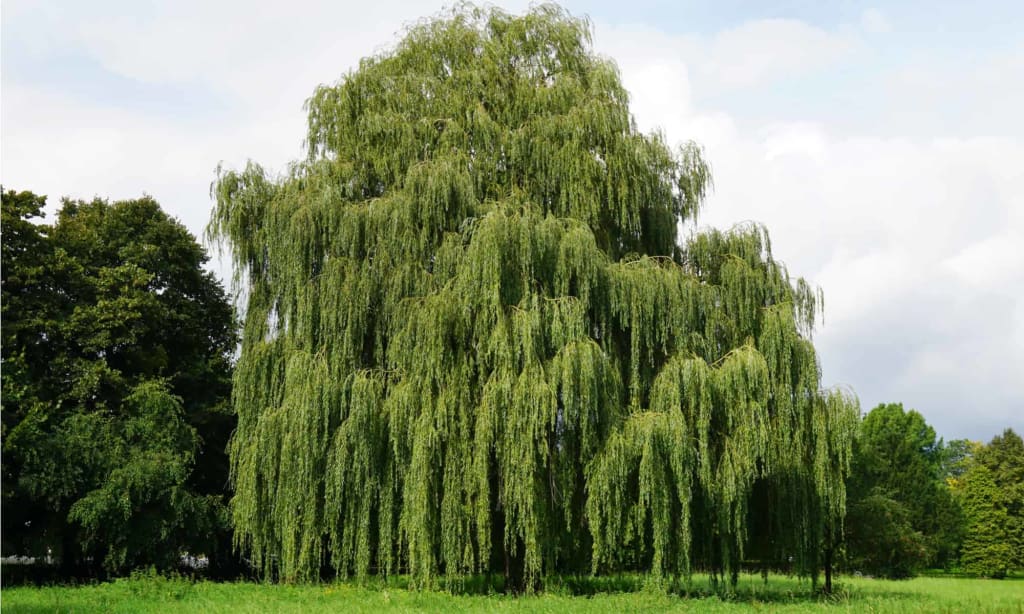
Willow was an old soul. He enjoyed the sun on his bark, the chirp of the birds and the kiss of a gentle breeze. He appreciated the company of his neighbors and was thankful for where he had taken root. It was a lovely wood.
Willow and his friends celebrated their differences and together they experienced happy, carefree days.
His closest neighbor, Birch, could light up the night with his pale bark. Aspen, she could dance, her leaves quaking with each changing breeze. Fraser and Douglas Fir were twin brothers, their fuzzy hairstyles and delightful scent comforting to the squirrels that called them home. Beech was a delicate perch for the birds, her grace glowing with warmth and familiarity. And Willow's closest friend Hemlock brought a shadowy peacefulness to her grove that helped deer sleep.
Willow enjoyed the company of Hemlock most of all for her quiet cleverness, patience and good advice. She was mysterious in her demeanor, but a fierce friend to all. Her beautiful needles created a cloak of shade that beckoned all kinds of critters to her roots, branches and canopy. The deer would bed in the moss her shade helped grow, her bark was a highway for bugs and her branches were an umbrella of soothing deep green.
Willow loved her dearly. But even his deep-rooted love would not be enough to protect her.
***
Willow and his friends had been left undisturbed for generations. Willow could not recall when he first took root—centuries ago perhaps. The days move slowly for trees but years go by in the blink of an eye.
And after what felt like several lifetimes of contented stillness, he could sense change on the horizon. In fact, change seemed to be happening all around him.
He could hear sounds in the distance, just outside the wood. These sounds were new, alien to him. He could hear unnerving screeching sounds, earth shattering bellows, even the rattling of hammers that would put a woodpecker to shame.
He started feeling warmer, his bark often damp from humid days during months he would not expect such humidity. The weight of the dampness made his leaves limp and his roots thirsty.
Above all, he saw things he never had before. Every now and again, he would see birds flying above him that gleamed, reflecting the light of the sun like water—how peculiar. He started to see colorful boxes appear on the hills, some taller than the tree line. And the strangest thing he saw were the odd new animals that would visit the wood. It happened the most when his leaves changed color. They would arrive in droves, scare the critters away and simply walk. Why he did not know, but he did not like them. Their presence worried him.
Hemlock did her best to assure him all were welcome in the wood. She did not mind the changes, however strange they were. Reluctantly, Willow agreed they were likely harmless. But he couldn't shake the feeling things would never be the same again.
It was at the start of the next summer Willow's fear was realized.
***
It was another unbearably hot season. Many of the animals and critters had retreated to the brook, yet some had hunkered down beneath Hemlock's canopy. Her ability to provide the coolness and shade so many needed brought Hemlock an immeasurable pride. Willow admired her good nature. His heart was moved whenever he noticed a fawn tucked neatly between her roots, fast asleep.
It was on one of these heated summer days Hemlock noticed something on one of her branches. She had felt an odd sensation on the twigs, movement on the bark under her needles.
The breeze shifted, fanning her limbs. Her branches moved in the wind, exposing the underside of her needles. That is when she saw a small cluster of a pillowy, cotton-like substance. It clung to the healthy green that extended from her twigs, and the protective layer of bark where they sat was picked apart.
Willow noticed her distress and asked what was wrong. He noticed Hemlock did not look like herself—she seemed pale, her needles a sickly mucus color instead of their usual magnificent deep green. But what disturbed him more than anything was her canopy.
It was allowing light into her grove.
***
To Willow's dismay, Hemlock's condition only seemed to worsen. The animals no longer slept beneath her branches—too many needleless pockets allowed evermore light to seep through. The moss near her roots was drying out, yellowed and fried by the relentless beams that gleamed like spotlights. The beetles and caterpillars that once traversed her bark did not dare touch it now—her bark had grown thin and brittle. Rotted.
All Willow could do now was watch in worry. He did his best to comfort his friend, but in his heart, he knew she was passing away.
Hemlock showed Willow her colorless branches. She showed him her needles, which now littered the ground around her as the cotton ball virus continued to spread. As their numbers grew, reaching every inch of her, she could feel her sap leaving her trunk. She could feel her bark being picked apart, piece by piece.
And throughout her sickness, Willow stood beside her. Worrying, wondering and anxiously waiting for a miracle.
It was at the start of the tenth summer Hemlock could take no more. No needles left, no shade blanketing her diseased trunk. Where her lush green canopy once grew, all that was left were specks of white. The woolly parasites had bombarded her tree long enough.
The first of Willow's tears rolled down his trunk as he watched Hemlock's frayed, brittle roots release their hold on the earth below her. The fresh scent of churned up dirt filled the air of the grove as his beautiful Hemlock tipped over. Her branches crashed against the bushes and brambles. The impact of her limbs against the needles and leaves created a soft whooshing sound, like the hush of a final exhaled breath.
And then all was quiet in the grove.
Willow gazed tearfully at his friend. He'd watch the environment evolve around her trunk, interact with her tree. The bushes held her in a tight embrace. The rain kissed her branches like a mother kissing a wound on a child. The animals who once longed for her shade climbed her trunk, bedded in her fallen needles and slept beside her with each nightfall.
Each day, Hemlock became more and more a part of the earth, and each day, Willow would weep. As he wept, he would grow. His limbs would grow, reaching as far as they could in the hope that he might hold her and pull her back from the earth.
He wept at her beauty even in death. He wept for his neighbors and the critters who would never experience the gentle quiet of her grove again. he wept for the kindness and care she brought to the wood—to all. And all the while, his beautiful, sunny limbs grew into a protective shell around his tree and hers.
Willow wept the day he lost his love, and he has wept every day since. Those who visit the wood in the season of changing leaves say Willow still weeps, his limbs now encasing the grove Hemlock's shade once embraced.
Until her canopy blankets him again, Willow will weep for his dear friend.
***
The Hemlock Woolly Adelgid (HWA) is an invasive species that can kill hemlock trees within 3–10 years if left untreated. The small insects feed on the tree's stored starches and sap, which damages the canopy and disrupts the flow of nutrients to the needles and twigs. This can cause the tree to lose needles, grow fewer new needles and branches, and eventually die.
Protect our natives. Stop the spread of invasives.
About the Creator
Madison "Maddy" Newton
I'm a Stony Brook University graduate and production services manager for the NYS Assembly. Writing is one of my passions, and Vocal has been a great creative outlet for me.
Follow me on Instagram! https://www.instagram.com/madleenewt120/
Reader insights
Outstanding
Excellent work. Looking forward to reading more!
Top insights
Compelling and original writing
Creative use of language & vocab
Easy to read and follow
Well-structured & engaging content
Excellent storytelling
Original narrative & well developed characters
Expert insights and opinions
Arguments were carefully researched and presented
Heartfelt and relatable
The story invoked strong personal emotions
On-point and relevant
Writing reflected the title & theme
Keep reading
More stories from Madison "Maddy" Newton and writers in Fiction and other communities.
Clarity. Runner-up in Epic Beginnings Challenge.
For Catherine Crane, life was muddled, murky. In a word, miserable. Until the eclipse made everything clear. *** Legally blind from birth, Catherine saw everything through an extraordinarily narrow lens. Her sight was nonexistent save for one exceedingly small point on each of her pupils—tunnel vision that forced her to put puzzle pieces together to realize the faces of those around her.
By Madison "Maddy" Newton2 years ago in Fiction
Lightning Never Strikes Twice
The distant rumble, the sudden deluge, the crescendo of sound, the flash of light, the explosive energy — it never gets old. I became an amateur storm chaser about two years ago. My wife, Cindy suggested it. Sort of. She said, "Alex, you know this cancer is killing me. I've come to terms with that, but you're smothering me. Go join a band, write a book, or become a storm chaser, for all I care. I love you, but you need a hobby."
By Julie Lacksonen3 days ago in Fiction
Mr Pig
There once was a pig who lived on a farm, in a truly magnificent pen. His home was surrounded by delightful sights and other farmyard animals. But Mr Pig decided early on (when he was just a new pink piglet) that he would not be concerned with matters of material value.
By Angie Allanby5 days ago in Fiction
A Historic Declaration
We the People of the Husbands of the United States of America, in Order to form a more perfect Union, and I mean you...with me...establish Justice, insure domestic Tranquility, provide for the common defence, promote the general Welfare, and secure the Blessings of Liberty to ourselves, after Puberty, do ordain and establish this Declaration of Co-Dependence.
By Gerard DiLeo5 days ago in Humans


Comments (2)
I love how willows look and love your story
Actually it's a nice idea. Well thought.