
Why is there evil in the world?
The Weaver of Shadows


No one knew when the Weaver arrived in the village. She simply appeared one morning, hunched beneath a heavy black shawl, her face hidden, hands always busy with her loom.
Her home was the smallest cottage at the edge of the forest, where mist curled thick around the door and the trees whispered things no one repeated. Children were warned to stay away. Even the crows gave her roof a wide berth.
But her tapestries were unmatched. That much was true.
She wove stories into fabric—tales of love and loss, war and redemption, gods and monsters. Each piece glowed faintly, as though it had swallowed some piece of the world it depicted. Merchants came from cities a week’s ride away to buy them. And yet, she never took coin.
Her price was always the same: “A memory. A true one.”
People gave them willingly. The smell of their mother’s soup. The feel of their lover’s first kiss. The day their brother didn’t come home from the river.
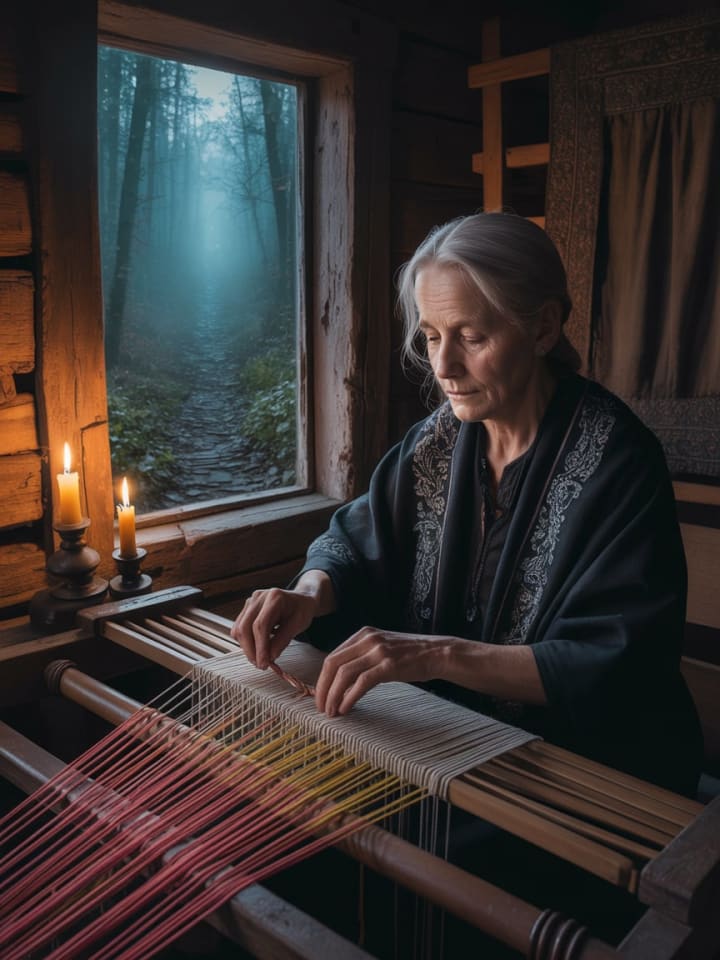
And always, she would nod and begin to weave.
It was Father Tomas who finally asked her the question.
He was a kind man, known for his patience, his warm bread, and his garden of blue roses. But age had taken his sight, and with it, some of his certainty.
One twilight, guided by a boy with a clear voice, he stood before the Weaver’s door and knocked.
“I’ve nothing to sell,” he said, when she let him in. “Only a question.”
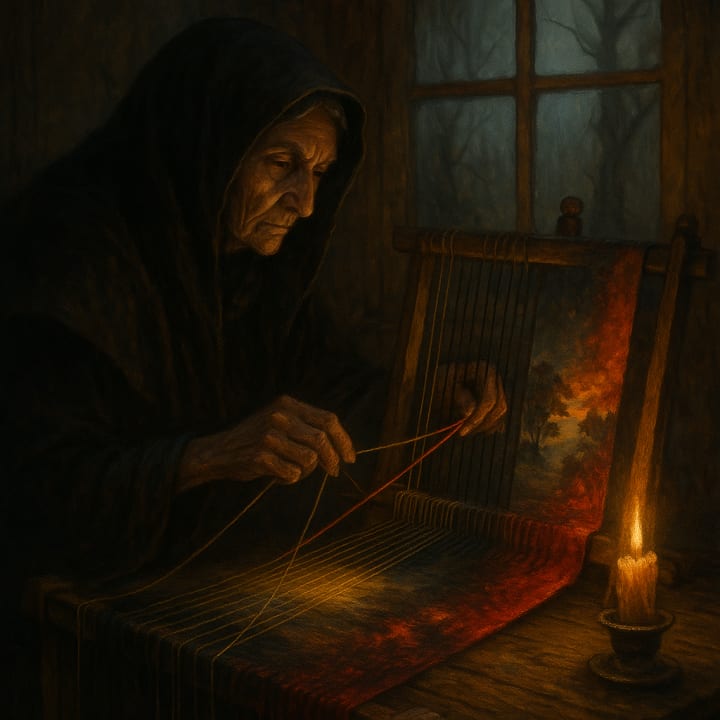
She didn’t answer, only motioned for him to sit by the fire. Her loom clicked steadily beside them, pulling black and crimson thread through a half-finished scene: a field of bodies beneath a burning sky.
“Why is there evil in the world?” he asked.
The fire cracked. Outside, the wind held its breath.
The Weaver sat back. Her hands stilled.
“There is no story without shadow,” she said.
“That’s not an answer,” Tomas replied gently.
“It’s the only one I can offer.”
She told him a tale.
Once, there was a kingdom with no sorrow.
No hunger. No war. No cruelty. Every day was soft. Every word was kind. The sun never burned too hot, and the rain fell only when the flowers were thirsty.
And yet the people grew restless. Bored, even. Joy turned hollow when it was constant. Without pain, love became routine. Without fear, courage meant nothing.
So the gods, in their mercy—or perhaps in their frustration—created the Shadowmaker.

He did not kill. He did not scream. He simply followed each person quietly, whispering loss into their ears. He let them taste fear, and then helped them overcome it. He showed them what they could lose, so they would treasure what they had.
Some cursed him. Others thanked him.
But in time, they all grew stronger.
“And that,” the Weaver said, “is why there is evil.”
“Because the gods were bored?” Tomas asked.
“No,” she said softly. “Because we forget the shape of light without the dark.”
He stayed long after the fire had died, the click of her loom filling the silence.
When he finally rose to leave, she pressed a folded piece of fabric into his hands. It was small, simple—a single silver thread winding through black wool.

“What is it?” he asked.
She leaned close. “It is your question. And my answer.”
He couldn’t see it, but he held it to his chest all the same.
Years passed. The Weaver remained, though her back curved lower and her shawl grew heavier. The forest grew darker around her cottage, but still, the villagers brought their memories.
Sometimes joyful.
Often painful.
She wove them all.
One winter night, a fire broke out in the village. Half the homes were lost. Three lives, too.
In the days that followed, grief sat heavy over the town. But the people came together. They rebuilt walls and re-seeded gardens. They shared bread and blankets. They wept together. They laughed again.
On the seventh day, the Weaver left a tapestry in the center of the square.
No one saw her deliver it.
It showed a town in flames—and then, rising from the ashes, hands joined in a circle. Beneath it, woven in tiny script:
“Evil is not the end of the story.”
Now, when strangers ask about the old woman at the forest’s edge, the villagers don’t warn them away. They say:
“She takes what hurts and shows us why it matters.”
“She weaves pain into wisdom.”
“She reminds us that darkness isn’t the absence of light. It’s what gives it shape.”
And in quiet moments, when the world seems too cruel to bear, someone always finds their way to her door.
Not for answers.
But for a thread of truth.
About the Creator
The Manatwal Khan
Philosopher, Historian and
Storyteller
Humanitarian
Philanthropist
Social Activist
Keep reading
More stories from The Manatwal Khan and writers in Fiction and other communities.
Becca
"Everything is so... flat." Denille said stupidly as she looked around her new neighborhood. She looked around at the muted desert where even the smallest sign of life seemed to have given up. The plant life was shrubs that were half cooked by the heat and where there should have been a lawn, a mess of white rocks laid glistening in the sun. Even the sky looked stretched thin, like the sun had ironed it smooth. She’d moved from Riverside, where at least there were hills, but here in Barstow, everything felt baked and brittle.
By Sara Wilson5 days ago in Fiction



Comments
There are no comments for this story
Be the first to respond and start the conversation.