
Whispers of the Lost Child
A Journey Through Silence and Secrets
The wind stirred softly through the cracked windows of St. Elora’s Orphanage, bringing with it the faint scent of pine and distant rain. The children had long since fallen asleep in their narrow beds, but Amara lay wide-eyed, her fingers tracing the worn edges of a photograph she kept hidden beneath her pillow. The photo was faded—just a woman in a wide-brimmed hat and a small girl in pigtails, smiling at something beyond the frame. No names, no date. Just a whisper of a life before the silence began.
Amara had been left at the gates of St. Elora’s nine years ago, wrapped in a woolen shawl and clutching that photograph. No one had ever come looking. Sister Marianne, the headmistress, had once told her she’d arrived with no note—only the picture and a necklace with a small silver bird, its wings outstretched as if ready to fly away.
The other children called her “Ghost Girl” because she rarely spoke and never cried. She moved like fog through the hallways, silent and watchful, always listening. But she wasn’t mute. She simply didn’t trust words—they were too fragile, too easily twisted into lies. She’d learned that silence made people underestimate her. And Amara had learned to survive in silence.
Everything changed the day the letter arrived.
It was an ordinary Thursday when Sister Marianne came into the common room holding a yellowed envelope, her brows furrowed.
“This is for you, Amara,” she said, hesitating as she handed it over.
Amara stared at it. Her name was written in soft, looping script she didn’t recognize. Her heart thudded in her chest. She opened it slowly, like she was peeling back time.
Inside was a single sentence:
“Come find me where the violets bloom. You know the way.”
No name. No address. Just a memory stirred—of a voice, warm and lilting, humming a lullaby while picking tiny purple flowers from the side of a forest path.
That night, she packed her few belongings—photograph, necklace, the letter—and slipped out under the veil of darkness. She didn’t know exactly where she was going, but the image in her mind tugged her forward: a garden of violets, sunlight flickering through leaves, a feeling of safety she couldn’t explain.
Amara journeyed through towns that blurred together, hitchhiking when she could, walking when she must. Along the way, she met people who offered food, advice, or suspicion. She spoke rarely, letting her silence speak louder. But her eyes—wide and searching—often softened hearts.
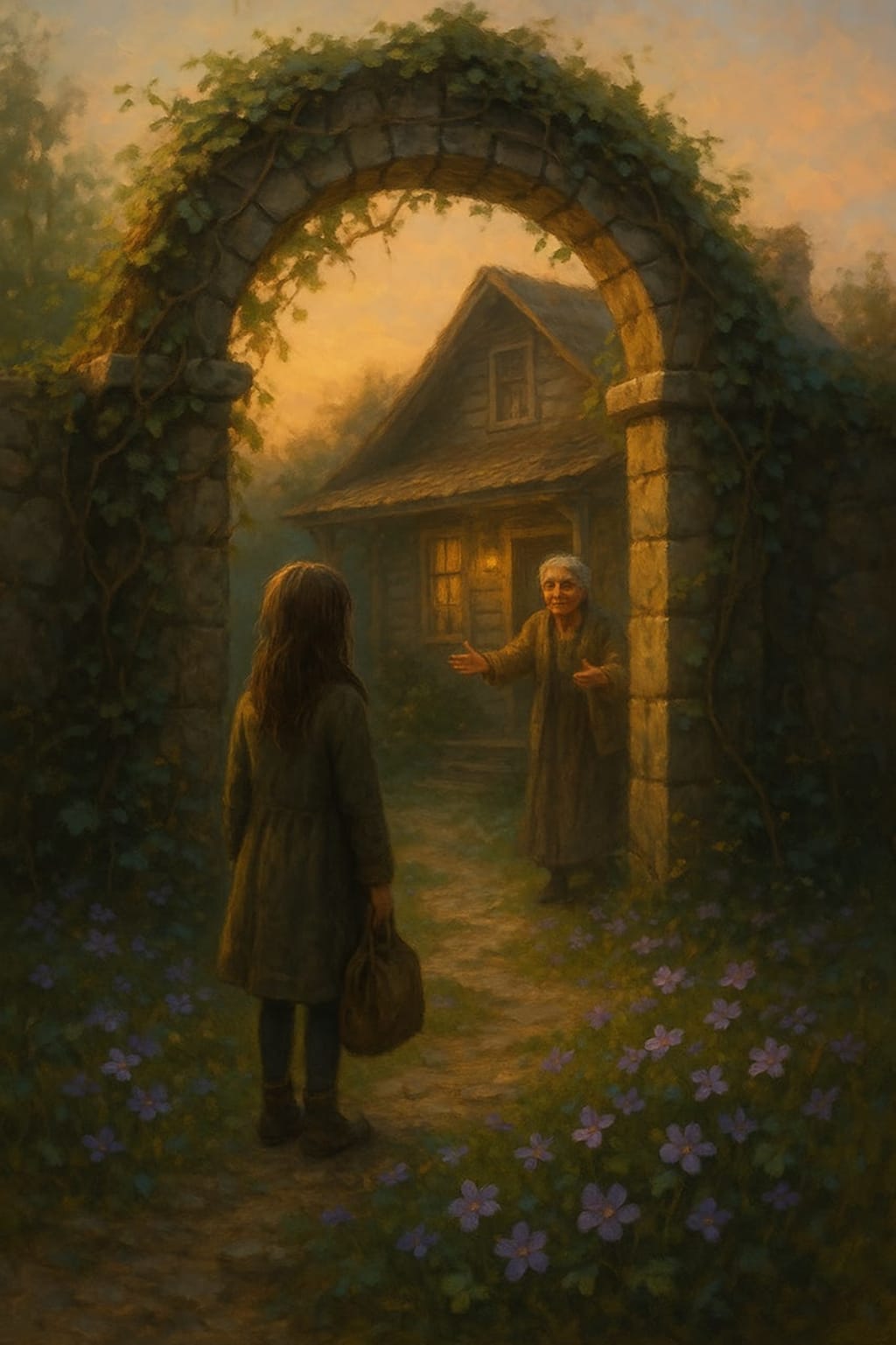
Weeks later, she arrived at the edge of the village of Eldergrove, nestled between hills and thick woods. It was a quiet place, untouched by time. As she wandered the outskirts, her feet seemed to move of their own accord. She found herself on a narrow path lined with overgrown trees. And then she saw them—violets.
They grew in a scatter beneath a crumbling stone archway, half-swallowed by ivy. Behind it lay a house, modest and leaning with age. Her breath caught. She stepped through the gate.
An elderly woman stood on the porch, her eyes clouded but sharp.
“I knew you’d come,” the woman said softly.
Amara froze. “Who are you?”
The woman smiled, tears forming in her weathered eyes. “I’m your grandmother, child. They told me you were gone. They said… your mother didn’t make it.”
Amara’s voice came out cracked and uncertain. “My mother?”
“She died the night she tried to protect you—from the man who took everything. He told the world you were dead too. But I never believed it.”
The words hit like waves—washing over her, dragging pieces of herself to the surface she didn’t know were lost. Her grandmother took a shaky step forward and reached out.
Amara hesitated. Then, slowly, she placed her hand in hers.
Inside the house, everything smelled of lavender and old paper. Her grandmother showed her a chest full of journals and letters—pieces of a family history stolen by violence and silence.
That night, Amara lay in a real bed for the first time in her memory. She held the photograph in her hand again. Now, the faces had names. Her mother, Leona. Herself, barely three. She pressed the necklace to her chest, listening to the quiet hum of the house around her.
She still didn't speak much—but now, she didn’t have to. The silence no longer felt empty. It was full of stories waiting to be told, of memories waiting to return.
Amara had followed the whispers of her past—and finally, they had led her home.
About the Creator
Keep reading
More stories from writers in Fiction and other communities.
Choose Your Own Adventure: St Helena Station
*****Preface***** I have been obsessed with Choose Your Own Adventure stories since I was a kid. I credit them with my love of reading and writing. I've been struggling to get my own kids to embrace words the same way I have but they love video games and our occasional Dungeon's and Dragon's game... which gave me an idea. I'll write an interactive story. So far its working; my middle son loves it and can't wait for the next section to come out.
By Sandor Szabo7 days ago in Fiction
The Midnight Delivery
Tariq worked the night shift at the courier office, delivering parcels to sleepy neighborhoods while the city slumbered. The office was quiet, filled only with the hum of fluorescent lights and the occasional beeping of scanners. He enjoyed the solitude; the rhythm of driving through empty streets allowed him to think, plan, and forget the noise of his day-to-day life. That night, he had finished the usual deliveries when a supervisor handed him one last package. It was small, wrapped in plain brown paper with no return address, and simply labeled: “Do Not Open Until Midnight.” Tariq frowned. The office clock read 11:45 PM, and curiosity stirred in him. He had been trained not to tamper with parcels, but the label felt strangely personal, almost like a warning.
By Sudais Zakwanabout 9 hours ago in Fiction
📢 Raise Your Voice Thread: 02/05/2026
Our “Raise Your Voice Threads” are hosted most alternating Thursdays at 12PM ET to offer creators more avenues to uncover exceptional stories on Vocal. As we are continuously searching for fresh creators and inspiring stories, this thread provides an opportunity to exchange and discuss the stories that have moved and motivated us on Vocal.
By Raise Your Voice by Vocal6 days ago in Resources


Comments
There are no comments for this story
Be the first to respond and start the conversation.