
Whispers of the Himalayas
Whispers of the Himalayas: Confronting the Shadows Within


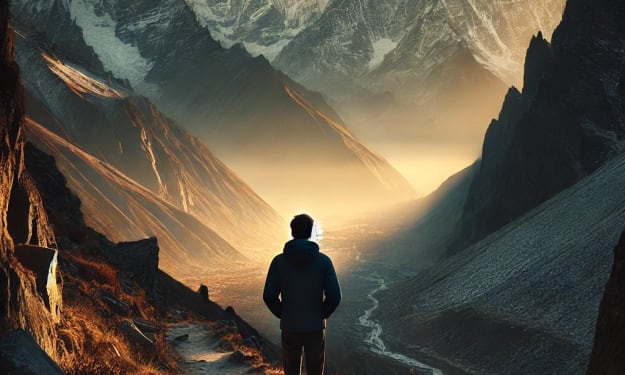
The wind howled through the narrow valley, carrying with it a chill that seemed to claw at Rahul’s bones. He pulled his shawl tighter around his shoulders as he stood at the edge of the cliff, peering into the endless expanse of mountains that rose and fell like ancient waves, frozen in time. Somewhere, far below, the village of Kalpa was wrapped in mist, obscured by the thick veil of fog that always seemed to hover over the Himalayas at dusk.
"They say the ghosts live in the mist," Rahul whispered to himself, his words quickly lost to the wind.
And yet, he was here.
His grandfather had once warned him about this place, about the strange things people saw and heard in these mountains. The old man’s voice echoed in Rahul’s mind: “You must never call them, never try to see them. The spirits of the mountains do not forgive those who seek them.”
But here he stood, waiting. A part of him hoped it was all nonsense—just old village superstition. But another part, buried deep within, trembled at the thought of what might happen if it wasn’t.
He had come here to forget, to escape the mess his life had become. The debts, the ruined relationships, the relentless pressure to be someone he wasn’t. In the solitude of the mountains, he had hoped to find peace. But the mountains, with their cold silence and eerie stillness, only amplified the noise in his head.
And then the stories started. The villagers spoke in hushed tones about the ghosts—those who wandered the mountains, lost in the fog, never truly gone. They spoke of the woman who cried in the night, of the shadowy figures that appeared on the trails only to disappear the moment you turned away.
"They’re not real," Rahul muttered, but the words didn’t comfort him.
The wind picked up again, and with it, a sound. A low, distant hum that seemed to rise from the very depths of the valley. Rahul’s breath caught in his throat. He had heard this sound before—the locals called it the song of the lost. They said it was the voices of those who had died in the mountains, calling out to the living, luring them into the mist.
Don’t listen. Don’t follow.
But the song grew louder. And then it dawned on him—he wasn’t alone.
He turned, his heart pounding in his chest. At first, there was nothing but the swirling fog, dancing around him like a living thing. But then, out of the mist, a figure emerged. It was a woman, dressed in the traditional woolen attire of the mountain folk, her face pale and ghostly in the fading light.
For a moment, Rahul thought she might be real—just a villager lost in the fog like him. But as she stepped closer, he saw her eyes. Hollow. Empty. Not a trace of life within them.
And then it dawned on him.
He had been waiting for something to happen, but now that it was happening, he wanted nothing more than to run. But his feet felt rooted to the ground, as if the earth itself was holding him in place. The woman stopped a few feet away, her head tilted to one side as if examining him.
She knows I’m afraid.
He wanted to speak, to ask her what she wanted, but his voice failed him. The only sound was the wind and that terrible, haunting hum that seemed to come from everywhere at once.
As the woman drew closer, memories flooded Rahul’s mind. The guilt of all the people he had wronged—his friends, his family, the woman he had left without explanation. The debts he had run from. The shame he had buried beneath layers of denial.
Is this why you’ve come? the wind seemed to whisper. To be judged?
He squeezed his eyes shut, willing the apparition to disappear, but when he opened them, she was still there. And now, another figure had joined her—a man, tall and broad, his face twisted in pain. Then another, a child, her eyes wide and sad. More and more figures emerged from the mist, surrounding him.
They were all staring at him, silent, accusing.
He didn’t know how long he stood there, trembling, his heart pounding in his chest. But then, something changed. The figures didn’t move closer; they didn’t reach for him. Instead, they just stood there, watching.
It dawned on him then—their suffering wasn’t his. These ghosts weren’t here to punish him for his mistakes. They were just… lost. Trapped in the endless cycle of death and longing, unable to move on.
For a moment, Rahul’s fear faded, replaced by something else—pity.
“They’re not here for me,” he whispered, more to himself than to the ghosts.
The figures stood still, the fog swirling around them, and for the first time since his arrival, Rahul felt a strange sense of calm. He wasn’t here to atone for his sins, nor to be judged. The mountains were indifferent to his struggles, just as they were indifferent to these lost souls.
But even as the realization settled over him, a new question arose.
What should I do?
The figures remained silent, their eyes vacant, offering no answers. And yet, the decision lay before him—he could walk away, leave them to their eternal wandering, or he could stay, try to help, though he knew not how.
The wind howled again, and in its wail, he thought he heard a faint cry, almost a plea. He looked back at the woman, her hollow eyes staring into his soul.
“I’m sorry,” he whispered, and then turned, walking back into the fog, leaving the ghosts of the Himalayas behind.
Or at least, that’s what he thought.
As he reached the edge of the cliff once more, he heard it—a soft voice, faint but unmistakable.
“Don’t leave us.”
He froze, the weight of the plea pressing down on him like the mist itself. Could he really just walk away? Could he abandon them, these lost souls, as easily as he had abandoned everything else in his life?
And then, it dawned on him.
Maybe this was why he had come to the mountains—not to escape, but to face what he had spent so long running from. The ghosts were not his enemies, but mirrors, reflecting the parts of himself he had refused to acknowledge.
Taking a deep breath, Rahul turned back toward the mist.
The next morning, the villagers found him at the edge of the cliff, staring into the fog. He didn’t speak of what he had seen, but the look in his eyes told them enough.
Some say the Himalayas are home to spirits. Others believe they are a place of reflection, where the living confront their deepest fears.
For Rahul, they were both.
But whether the ghosts had forgiven him, or whether he had forgiven himself—that remained a mystery.
About the Creator
Rajesh Dhiman (Rajesh)
Rajesh Dhiman is a seasoned full-stack developer and mentor with over 12 years of experience, specializing in scalable web apps, API design, and cloud services. He focuses on delivering high-impact solutions.
Keep reading
More stories from Rajesh Dhiman (Rajesh) and writers in Fiction and other communities.
The Silent March: A Stranger’s Quest for Redemption in the Himalayas
Remi stood at the edge of the Himalayas, unsure of why he came. His life was a mess, full of regrets and mistakes. The towering mountains, silent and strong, seemed like the only place where he might find peace. Maybe here, in this endless wilderness, he could finally escape the guilt that had followed him for years.
By Rajesh Dhiman (Rajesh)about a year ago in Fiction
Miss Persephone's Manual to a Seemingly Ordinary Life
Miss Persephone was found at the dining table, her blue eyes swollen, her tears arriving and retreating like the tides of the ocean. Earlier that day, her family had visited her in the retirement home where she had lived for eight years. It was her eightieth birthday.
By Imola Tóth5 days ago in Fiction
Coming of Age
Over the last five years, life in the Bay State seemed to be in a constant state of turmoil. Tariffs on glass, lead and several other items were responded to by the colonists with boycotts. Unrest grew to a fevered pitch until, on March 5th, 1770, the Boston Massacre occurred. Three years later, a group of men dressed as Native Americans boarded a ship and tossed its cargo of tea into Boston Harbor. Their action was dubbed the Boston Tea Party. It was easy to see how a fourteen-year-old boy who lived twenty miles from the big city could be easily confused by the state of the world.
By Mark Gagnon5 days ago in Fiction
Center Stage with Paul Stewart
*** I'm keen to republish the interviews I did for my series with Vocal creators. It's been a few years and I thought it might be nice to revisit these wonderful conversations. I'll be releasing them one at a time for a few weeks/months.
By Heather Hubler5 days ago in Interview



Comments
There are no comments for this story
Be the first to respond and start the conversation.