
Whispers Beneath the Mango Trees
A sunrise tale of harmony, nature, and quiet wonder.
The First Light of Mango Grove
In the gentle warmth of dawn, the first light of the sun crept across the horizon, spilling gold over the lush, dew-drenched fields. The scent of mango blossoms floated on the morning breeze, soft and sweet, stirring the peaceful landscape awake. It was the time when even the birds hesitated to chirp, reverent of the stillness that hovered over the land like a sacred prayer.
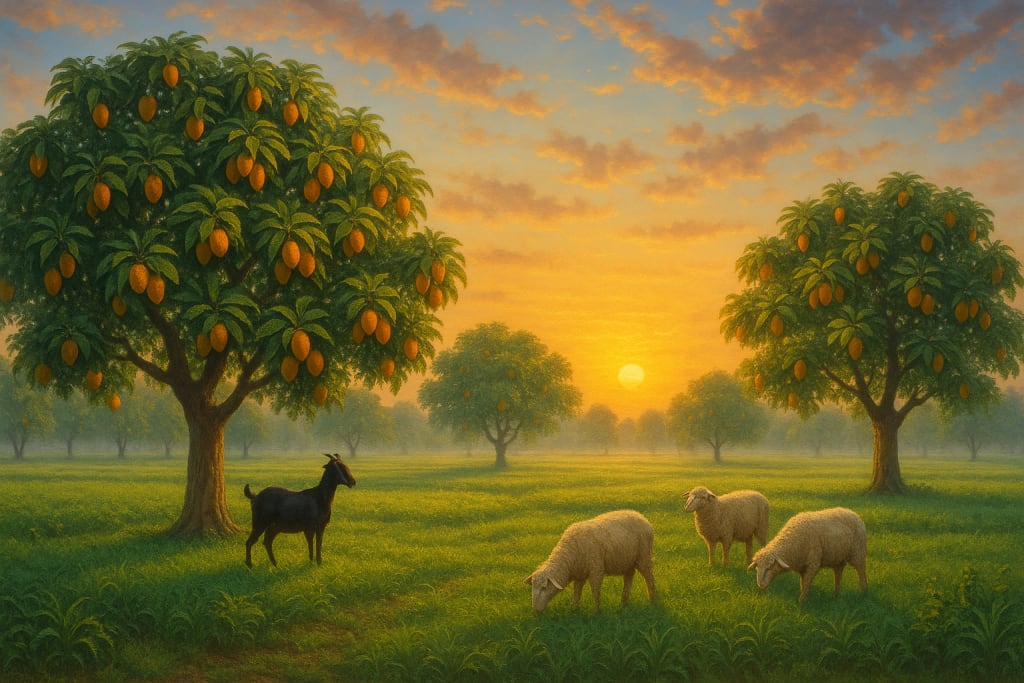
In the heart of the grove stood four ancient mango trees, gnarled and strong, their boughs heavy with ripe fruit. The trees had seen many seasons, their roots deep in the earth, their canopies offering shelter to everything beneath them—from insects to children to the occasional wanderer who had lost his way and found peace among their shade.
A young goat named Bhura stood under the largest tree, his dark brown coat almost blending into the shadowy green around him. Bhura was a curious creature, known in the village for escaping pens and wandering freely. He often sought the grove before anyone else stirred, drawn by the silence, the smell of mangoes, and something deeper—a sense of belonging.
Nearby, three sheep grazed in the quiet grace that only animals seem to possess. They moved slowly, their heads bowed to the earth, mouths methodically tugging at tufts of fresh grass. One of them, the eldest ewe named Meera, would occasionally lift her head to watch the sunrise, her eyes reflecting the golden sky. She had lambed many times, seen many seasons, and now found joy in the quiet moments of the morning.
High above, a koel called out, her song lilting and pure, as though she too were moved by the beauty unfolding below. The sky transitioned from shades of lavender and indigo to hues of orange and soft pink. Mist clung low to the ground, reluctant to let go, wrapping the fields in a silver veil.
The grove was on the outskirts of a small village where time still moved slowly, where people rose with the sun and rested when the stars appeared. The villagers often said the mango trees were sacred. Legends told of a hermit who once meditated beneath them and vanished into light. Others claimed the trees whispered at night, especially when the moon was full.
Ravi, a boy of ten, believed those stories. Every morning, he snuck out before his parents woke, taking the narrow path that led from his backyard through a small stream and into the grove. He would sit at the base of the oldest tree and listen—not for whispers exactly, but for the stories the breeze might carry.
That morning was no different. He arrived barefoot, his shirt loose, hair ruffled by sleep. He carried in his hand a small wooden flute, carved by his grandfather. As Bhura glanced at him and flicked his ears, Ravi offered a soft smile and a mango he had saved from the day before.
Bhura took the fruit gently, crunching with satisfaction. Ravi leaned against the trunk, feeling the bark press into his back, solid and cool. He brought the flute to his lips and began to play. The notes drifted over the field, delicate as spider silk, weaving themselves through leaves, around hooves, and across the sleepy morning.
The sheep paused their grazing. Even the koel fell quiet.
Ravi's melody was one he had never heard but felt he always knew. It rose with the sun, a celebration of light, life, and the beauty of now. As the sun climbed higher, its light fell full on the grove, illuminating each mango like a golden lantern.
Soon, other sounds joined the song—the distant clatter of pots in the village, a rooster’s belated crow, the creak of a cart wheel. Morning was beginning in earnest, and with it, the magic of dawn began to fade.
But for a few more minutes, Ravi, Bhura, and the sheep remained wrapped in a world untouched by time. It was in these minutes that Ravi imagined he understood the trees. They had watched generations pass, heard laughter, weeping, silence. They had stood through storms, basked in sunshine, and still offered fruit and shelter without complaint.
He finished his tune and let the flute rest in his lap. Bhura had lain down beside him, content. Meera and the others stood close, as if drawn not just to the boy’s music, but to the moment itself.
Ravi knew he would have to leave soon, to return home before his mother discovered his absence. But a part of him never truly left the grove. He carried its peace within him—through chores, through school, through years to come.
Long after te trees bore their last mango, long after Ravi became a man, he would still return. Sometimes with his own children, sometimes alone. And even when age took his strength, he would sit beneath those trees, eyes closed, and remember the song, the goat, the sheep, and the golden light of a perfect morning.
For there are places that never leave us, no matter how far we go.
About the Creator
Keep reading
More stories from Mukhtiar Ahmad and writers in Fiction and other communities.
Camel and Lion Learn Peace
Once upon a time in a vast golden desert, where the sun painted the sand in shimmering waves, there lived a proud lion named Zor. Zor was known as the king of the grasslands, but as drought spread across his home, he wandered deep into the desert in search of water and food.
By Mukhtiar Ahmad10 months ago in Fiction



Comments
There are no comments for this story
Be the first to respond and start the conversation.