
Where the Music Stopped, We Started
A violinist searching for her lost rhythm finds more than harmony in a sunlit street full of strangers.

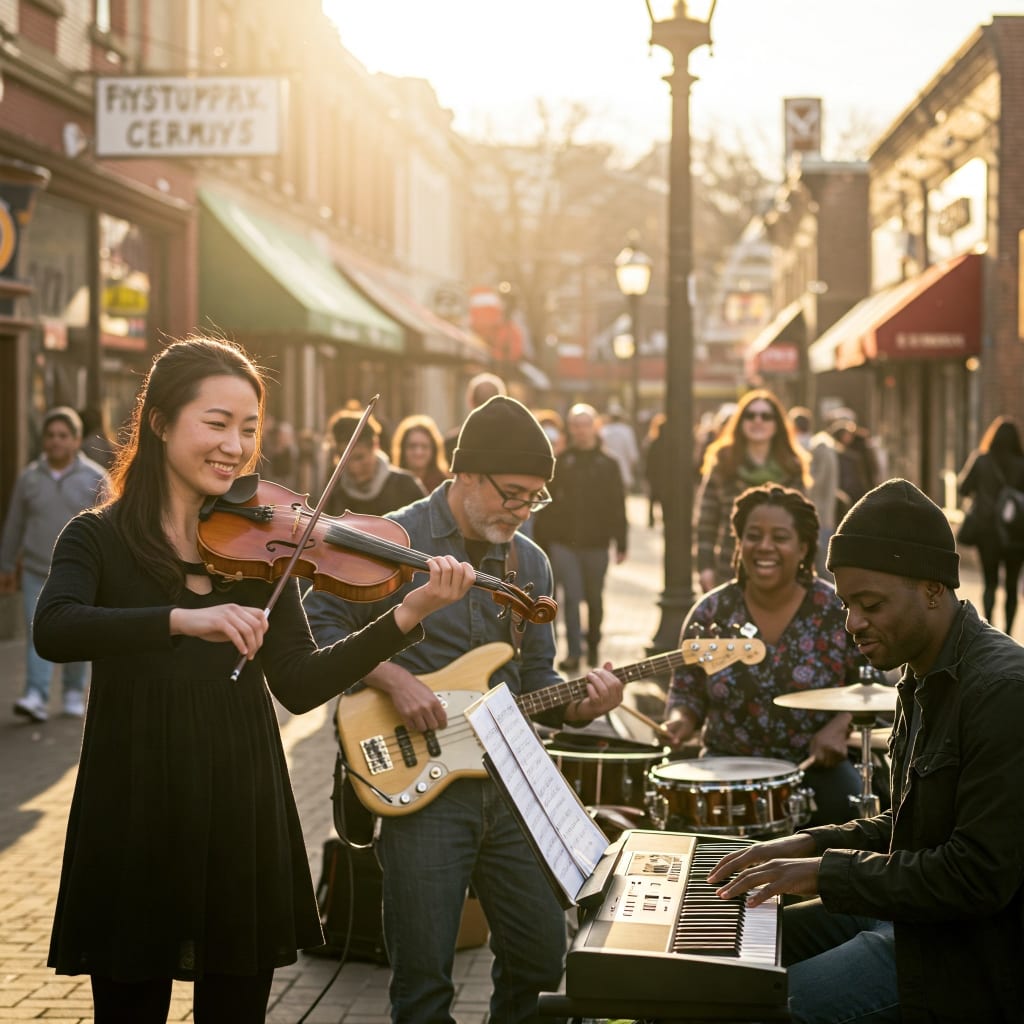
The sun hit the cobblestones just right that afternoon, spilling gold over the street like something sacred. Shops buzzed, dogs barked, children weaved between legs and tables, and above it all, music floated—bright, bold, and utterly unexpected.
Leah hadn’t meant to stop.
She was just passing through.
A borrowed violin case hung from her shoulder. She hadn’t touched the strings in months, maybe longer. Her fingers still remembered, but her heart hadn’t followed since the night she walked off stage mid-concert in Berlin. Since the silence that followed had become louder than any applause ever had.
She was in town visiting her aunt, a layover between what had been and what might come next. Her plan was simple: no plans. Just coffee, long walks, and maybe—maybe—listening to someone else play.
But then she heard them.
A quartet in the middle of the street. Drums, keys, bass, and a woman with a violin that sang more than it played. It wasn’t a polished sound. It was raw. Joyful. Real.
And Leah stopped.
Not because she meant to.
Because something inside her paused before she could argue.
The drummer laughed mid-beat.
The pianist closed his eyes during a solo.
The bassist nodded in time, occasionally locking eyes with strangers and smiling like he knew a secret.
And the violinist—she was something else. Her black dress caught the sun, and her bow danced like it was chasing something just out of reach. Leah felt it in her throat, in her spine. A pulse she thought she’d lost.
She stood there for one song.
Then another.
Then five.
A few people clapped between songs, dropped change into an open case. A little girl danced nearby, off-beat but entirely free. Leah watched it all, hands clenched in her coat pockets.
At the end of a song, the violinist caught her eye.
Smiled.
And gestured—simple, welcoming, no pressure.
“Wanna play?”
Leah hesitated. Her breath caught. She shook her head, half-apology, half-reflex.
The violinist shrugged gently and turned back to the music.
But the offer stayed.
Like a melody unfinished.
That night, Leah lay in her aunt’s spare room, staring at the ceiling. The violin case rested at the foot of her bed. Unopened.
Her fingers itched.
She pulled it toward her.
Snapped open the latches.
The varnish still gleamed. The strings were slightly out of tune. She tightened the bow, rosined it slowly, deliberately.
And then, in the quiet of that small room, she played one note.
It quivered.
She played another.
And then a scale. Slower than she used to, but steadier than she expected.
Tears blurred her vision as the final note rang out.
She played again.
And again.
Until her hands stopped shaking.
The next day, she went back.
Same street. Same sunlight. Same crowd—though maybe a few different faces.
The band was setting up. The drummer tapping gently on the snare. The bassist tuning slowly. The pianist, humming to himself.
Leah waited until the violinist noticed her.
Wordlessly, she held up her case.
The violinist grinned. “About time.”
They didn’t rehearse. They didn’t need to.
They just played.
The first note was a gamble.
The second, a risk.
But by the third, Leah wasn’t thinking anymore. Her body took over. Her bow moved in rhythm with the keys, the bass, the gentle heartbeat of the drums. She watched the faces in the crowd light up. She saw someone recording with their phone. She saw a man close his eyes and sigh like he’d been holding his breath for days.
She didn’t just hear the music. She was the music.
She played until her fingertips stung. Until the melody carried her into something that felt like remembering how to breathe.
And when the song ended, the street clapped. Not wildly. Not theatrically.
But sincerely.
The violinist clinked her bow against Leah’s and whispered, “You still got it.”
Leah smiled, heart pounding.
“Maybe I never lost it.”
That week, she came back every day.
Sometimes she played.
Sometimes she just listened.
The band took breaks at the café nearby, sipping espresso and arguing about key changes. Leah laughed more than she had in a year. She learned the drummer’s name was Joy, which fit perfectly. The pianist, Theo, had once toured with a soul singer in South Africa. The bassist, Malik, taught music to kids on the weekends. The violinist, Hana, had never trained formally—she played by ear, by instinct, by heart.
They began to feel like more than musicians. Like anchors. Like proof that community could form anywhere a song started.
“Everyone’s got a thing that makes them whole,” Hana said one day. “For me, it’s this.”
She tapped her violin.
“And for you?”
Leah looked at her own instrument.
“For a long time, it was this,” she said softly.
“And now?”
Leah shrugged.
“I’m finding out.”
Hana smiled. “That’s the good part.”
On Saturday, the city hosted an open street festival.
Vendors lined the sidewalks. The air smelled like roasted almonds and caramel. Streamers crisscrossed above, casting dancing shadows over the crowd. Kids held balloons. Strangers leaned out of apartment windows, waving at the performers below.
The band was given a real stage this time.
Leah almost didn’t go.
She told herself it was just another gig.
But deep down, she was afraid. Afraid the magic would vanish once it was expected. Once people watched too closely.
Hana sensed it.
“You know,” she said backstage, “sometimes music doesn’t need to be perfect. It just needs to be honest.”
Leah nodded.
And stepped out into the light.
They opened with a cover.
Something familiar, comforting.
Then an original piece—Hana called it Rewind. It had a melancholy intro that built into something that soared.
Leah played the solo.
Her hands didn’t shake.
She closed her eyes and played like she used to, before stages and critics and pressure. She played like a kid in a room with no audience. Like someone in love with sound.
The applause after was louder than she expected.
She caught her aunt in the crowd, eyes wide with pride.
She caught herself—smiling.
Truly smiling.
Afterward, the band hugged her. Theo ruffled her hair. Joy called her “Maestra.” Malik bowed dramatically.
She felt light.
Like something had finally left her.
After the show, a teenager approached her.
“Hey,” he said. “I didn’t know violin could sound like that.”
Leah laughed. “Neither did I.”
He held up his phone. “You got a name or something? A page?”
She paused.
Then took his phone and typed: @LeahPlaysAgain
It was a name she’d made on a whim.
Now, it felt like a promise.
That night, she didn’t practice. She didn’t rehearse. She just sat by the window, violin on her lap, watching the stars come out over the rooftops.
And she played.
Not for a crowd.
Not for redemption.
Just for the music.
For the sunlight on cobblestones.
For a girl who danced off-beat in the street.
For the strangers who became bandmates.
And for herself.
And for the first time in what felt like forever—
It was enough.
About the Creator
Alpha Cortex
As Alpha Cortex, I live for the rhythm of language and the magic of story. I chase tales that linger long after the last line, from raw emotion to boundless imagination. Let's get lost in stories worth remembering.
Keep reading
More stories from Alpha Cortex and writers in Fiction and other communities.
The Last Letter She Never Sent
The rain was light but steady, soaking into cobblestones that had seen centuries pass. It was the kind of rain that blurred the edges of everything—buildings, thoughts, memories. Elena walked slowly through the narrow streets of the old quarter, her hands tucked deep into the pockets of her gray wool coat. A scarf with fading floral prints hugged her neck, and her red hair, damp at the edges, clung to her skin.
By Alpha Cortex11 months ago in Fiction




Comments
There are no comments for this story
Be the first to respond and start the conversation.