
WHEN THE TIDES LEARNED OUR NAMES
A quiet future shaped by rising seas, stubborn hope, and what we choose to save


By the time the ocean reached the fifth step of the old courthouse, no one bothered arguing whether the flooding was temporary anymore. Harborreach had become a city that survived not through denial, but through adaptation so gradual it felt like habit. Streets were re-mapped according to tidal charts. Homes wore stilts like sensible shoes. Boats replaced buses, and children learned to swim before they learned to read. The water didn’t arrive violently—it came patiently, season by season, salt creeping into foundations and memories alike. People still argued about the weather out of reflex, but they planned their lives around it now, checking sea forecasts the way their grandparents once checked calendars.
Mara Solis lived in what used to be the third floor of an apartment building and was now, functionally, the first. Her windows looked out over a canal where traffic lights blinked uselessly beneath the surface, their colors refracted into wavering ghosts. She worked as a tide archivist—an unglamorous job that involved recording shoreline movement, salinity levels, and infrastructure loss in a database no one pretended would stop the sea. The archive wasn’t about prevention anymore. It was about remembering what had been lost, and understanding what could still be lived with.
________________________________________
Mara’s grandmother’s house stood at the edge of the old district, stubborn and tilting, its foundation reinforced again and again until it resembled a patchwork of eras. The house had survived storms, evacuations, and three government buyout offers. It should have been abandoned years ago, but Mara couldn’t bring herself to let it go. Not because it was safe—nothing was—but because it was known. Every crack in the wall told a story. Every water stain marked a season that had been endured.
Inside, the house smelled faintly of salt and citrus cleaner. Sand collected in corners no matter how often Mara swept. On the back porch, wind chimes made from scavenged shell fragments sang softly whenever the tide shifted. From there, she could see the mangrove barriers—bio-engineered forests grown not for beauty, but survival—holding the water back inch by inch. They were imperfect, but they were alive, and that counted for something.
At night, Mara dreamed of maps changing shape beneath her fingers, coastlines breathing in and out like lungs. She woke with the quiet fear that one day, she would misjudge the tide—and the house would finally decide it had stayed long enough.
________________________________________
The first sign of real trouble didn’t come with alarms or breaking news. It arrived as data. Numbers drifting outside historical patterns. Salinity spikes too sudden to be seasonal. Micro-die-offs in shellfish that suggested something deeper than warming water. Mara flagged the anomalies, sent reports, and waited.
Weeks passed.
Then the fish disappeared.
Not gradually. Not migrating. Gone. The canals emptied, water turning strangely clear and unsettlingly still. The mangroves began to yellow despite adequate nutrients. People noticed then—not with panic, but with the uneasy awareness that the system they depended on was changing again.
A closed-door meeting was held. Officials spoke carefully, using words like transition and rebalancing. Mara sat in the back, staring at the projected models. The truth sat between the lines: a massive offshore current shift—accelerated by melting polar inputs—was altering the region faster than adaptation plans could keep up.
Harborreach wasn’t drowning.
It was being quietly starved.
________________________________________
Evacuation incentives returned, packaged more attractively this time. Relocation credits. Priority housing inland. Promises of stability. Many took them. Entire neighborhoods thinned out, their absence more noticeable than their presence had ever been. Empty houses made the water feel closer.
Mara considered leaving. She ran the numbers like everyone else. Her skills were transferable. Her records digitized. There were cities farther inland that still believed in permanence.
But then she thought of the archive—not the data, but the stories buried within it. The fishermen who learned to farm kelp. The engineers who turned flooded highways into reef corridors. The teachers who held classes on rooftops and refused to call it temporary.
Climate change had been framed as catastrophe for so long that survival itself felt radical.
Instead of leaving, Mara proposed a new project: community-based adaptive zones, small enough to evolve quickly, designed not to resist the sea but to partner with it. Floating gardens. Mobile energy platforms. Tidal food systems.
She didn’t expect approval.
She got reluctant permission.
________________________________________
The first floating garden was ugly. No one denied it. It bobbed awkwardly, its recycled plastic pontoons mismatched, its plant beds uneven. But it grew food. Not much, at first, but enough to prove possibility. Then came another. And another.
Children helped plant salt-tolerant vegetables. Elders advised on moon cycles they remembered from childhood. Scientists took notes while neighbors brought lunch. The gardens moved with the tides, rising and falling without complaint, absorbing carbon, cooling the water, feeding people.
The fish returned slowly—not the same species, not in the same numbers—but life adapted, as it always did when given room. The water darkened again, rich and active.
No one called it a solution.
They called it a practice.
________________________________________

When the storm came, it was named like all the others, politely and without imagination. Forecasts predicted damage but not devastation. They were wrong.
The surge overtopped barriers that had held for years. Wind tore through rooftops. Power grids failed. The sea didn’t rage—it claimed, steadily and without apology.
Mara rode it out in her grandmother’s house, water rising to the windowsills, heart pounding with each structural groan. She thought, briefly, that this was the moment everything ended—not dramatically, but conclusively.
But morning came.
The house still stood, damaged but intact. The gardens had scattered but not sunk. Neighbors emerged wet and exhausted and immediately began checking on one another.
No one waited for instructions.
They rebuilt, not to what had been, but to what had been proven to work.
________________________________________
Years later, Harborreach looked nothing like the city it had been—and everything like a place that had chosen to continue. Floating neighborhoods replaced streets. Buildings breathed with the tide. Food came from water as often as land. Life was slower, more deliberate, less certain—but it was lived.
Mara still archived the changes, now with help from apprentices who had never known a stable coastline and didn’t miss it. The archive was no longer a record of loss alone. It was a manual for persistence.
Sometimes visitors came from inland cities, curious and cautious. They asked if living this way felt like surrender.
Mara smiled, thinking of the house, the gardens, the people who stayed.
“No,” she said. “It feels like listening.”
________________________________________
On quiet evenings, Mara sat on the porch and watched the water move through the city, unbothered by human categories. The sea did not hate them. It did not forgive them. It simply responded to physics and heat and time.
The future, she understood now, was not something you reached.
It was something you practiced every day, with humility, creativity, and care.
And as long as someone was willing to do that—somewhere—the story wasn’t over.
________________________________________
THE END
About the Creator
Alisher Jumayev
Creative and Professional Writing Skill & Experience. The aim is to give spiritual, impressive, and emotional stories for readers.
Keep reading
More stories from Alisher Jumayev and writers in Fiction and other communities.
THE TEAPOT THAT KNEW MY NAME
Willowfen was the kind of village that forgot the meaning of hurry long before I was born. It sat between a river that sang softly to itself and a meadow that smelled of honey even in winter, stitched together by cobblestone lanes worn smooth by centuries of unimportant footsteps. Nothing legendary had ever happened there—no dragons, no chosen heroes, no prophecies scribbled in fading ink. Instead, Willowfen specialized in the ordinary miracles: bread that rose perfectly every morning, lamplight that glowed a little warmer when someone walked home alone, and gossip that traveled faster than the wind but never meant any harm. It was the sort of place where people waved even if they didn’t know your name, and somehow, by the end of the week, they did.
By Alisher Jumayev3 months ago in Fiction
Cassian-13
High Dominion Calendar date: day 106 of the year 237 The night’s humidity stressed every pressure point of Cassian-13’s enhancements, especially his right shoulder. Maybe the clouds would burst. That might help. As would upgrades. But hunters at the end of their lifecycle received standard policy rejections regardless of the requests. Assholes.
By Jean-François Lamothe5 days ago in Fiction
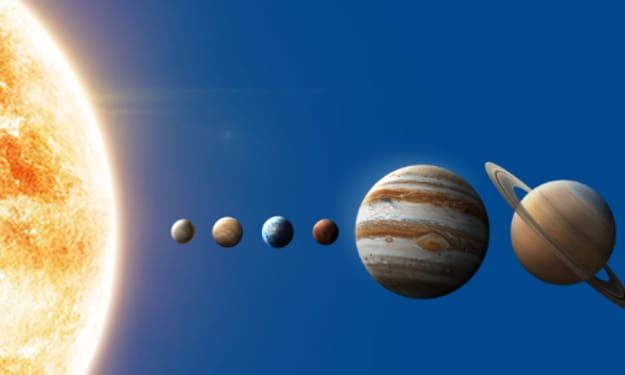
A Planetary Alignment will coincide with Mercury Retrograde
Double phenomena in the heavens Some people say in jest that the planets have aligned in their favor when life works the way they desire. Were you aware that there are seasons when things do line up in the heavens? There will be a planetary alignment AKA a planet parade, on February 28, 2026.
By Cheryl E Preston5 days ago in FYI


Comments
There are no comments for this story
Be the first to respond and start the conversation.