
When the Sirens Stopped
Trapped in a war-torn city, their love was the only thing left unbroken.

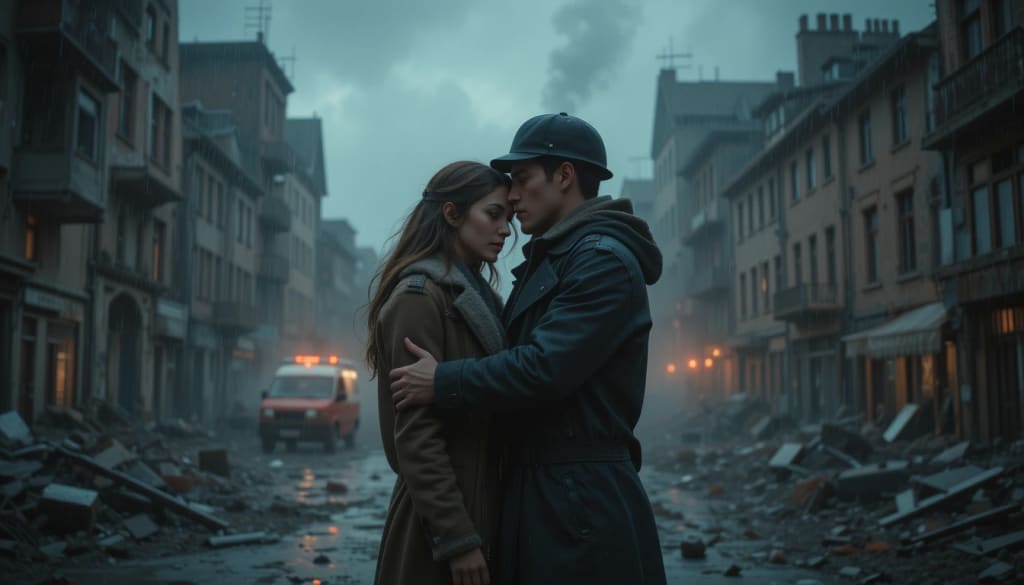
When the Sirens Stopped
Written by Noor Khan
The air smelled like smoke, and the sky never turned blue anymore. In a shattered corner of Eastern Ukraine, just miles from the frontlines, 22-year-old Lena clutched her backpack tighter and glanced over at Amir. Dust clung to his eyelashes, and his hands trembled as he checked the half-broken radio for updates. The sirens had stopped two days ago, but no one knew whether that meant safety — or silence before the storm.
Lena had grown up in Luhansk. She was a university student when the war escalated again, studying literature and dreaming of teaching. Amir was a foreign volunteer medic, half-Ukrainian, half-Turkish, who had arrived to help civilians. Their paths crossed during an airstrike at the local hospital. Amid chaos, their eyes met. She was bleeding from her arm; he wrapped it with a torn shirt and whispered, “You’ll be okay.”
She wasn’t. Nothing was. But she followed him anyway.
They had been hiding together for eleven days in a collapsed train station basement with no heating, little food, and one flickering flashlight. The city above them was rubble — bones of what once was home. But in that underground darkness, something quietly bloomed.
“Do you still think we’ll make it out?” Lena asked one night, her voice barely a whisper.
Amir looked at her and smiled faintly. “I don’t think. I believe.”
That was Amir. A man of belief. Belief in survival, belief in hope, belief in her.
Every few hours, they took turns peeking through a shattered concrete crack above the stairs. Drones still buzzed in the sky. Gunfire echoed like thunder. They scribbled poetry on the back of ration wrappers just to feel human.
Then came the twelfth night.
They heard footsteps. Loud. Unhurried. Foreign. Amir held his breath and slowly turned off the flashlight. Lena pressed her back to the cold wall, her heartbeat louder than any bomb. The footsteps passed. Then returned.
“Russian patrol?” Amir whispered. She nodded silently.
They had no weapons. No way to run. Just each other.
Suddenly, the footsteps stopped. A voice called out in broken Ukrainian, “We know someone is here. Come out.”
Amir grabbed Lena’s hand.
“No,” she whispered. “They’ll shoot.”
“We can’t stay. We’re out of food. If they find us here, it’s worse.”
“But…”
“If anything happens—remember your name. And that I love you.”
She wanted to scream. Instead, she kissed his forehead, and they stood up together.
But fate is strange.
As they reached the top of the stairs, a sudden blast rocked the building. Dust rained from the ceiling. The patrol scattered. A nearby apartment tower had been hit — not them. Using the confusion, Amir pulled Lena through a broken side tunnel he had spotted days ago but never dared to use.
They ran. Through collapsed corridors. Through narrow alleys lined with burnt-out cars. Through snow dusted with ash.
That night, they reached an abandoned Red Cross outpost. It had no doors, no staff, and no medicine. But it had maps. And a working radio.
Amir managed to call an NGO in Poland using an old frequency. “Two survivors. One injured. Near checkpoint Bravo 9. Need extraction.”
They waited 48 hours in the broken building, feeding on crackers and hope. Finally, a drone hovered above, dropping a flare. Minutes later, a black van appeared from the west — silent, fast, foreign-plated.
They were rescued.
💬 Why This Story Matters
Lena and Amir now live in Warsaw. She teaches Ukrainian refugee children; he volunteers at a trauma clinic. They still write poems on the backs of receipts. They say war took everything — except what mattered most.
Love in a dangerous place is not romance. It's survival. It's staying when everything says to run. It's sharing silence in a room full of fear. It’s believing in life when death is outside your door.
Their story never made headlines.
But somewhere, in a city still broken, a wall stands with faded graffiti:
“The sirens stopped — but we didn’t.”
About the Creator
Keep reading
More stories from Moonlit Letters and writers in Fiction and other communities.
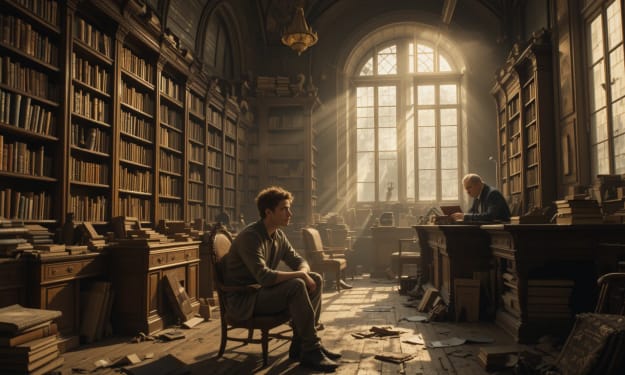
The Librarian's Apprentice
The Librarian's Apprentice Written by Noor Muhammad In a quiet seaside town in Portugal, far from Lisbon’s buzz and the glamour of tourist trails, lived a boy named Luca. He was the son of a fisherman who rarely returned home dry and a mother who worked at a local diner, wiping tables and dreams at the same time.
By Moonlit Letters8 months ago in Fiction
Becca
"Everything is so... flat." Denille said stupidly as she looked around her new neighborhood. She looked around at the muted desert where even the smallest sign of life seemed to have given up. The plant life was shrubs that were half cooked by the heat and where there should have been a lawn, a mess of white rocks laid glistening in the sun. Even the sky looked stretched thin, like the sun had ironed it smooth. She’d moved from Riverside, where at least there were hills, but here in Barstow, everything felt baked and brittle.
By Sara Wilson6 days ago in Fiction
A More Human Vocal
When we launched Vocal nearly a decade ago, the world was a very different place. LLMs did not exist, and stories were created one at a time by people sitting down to write, revise, and share something personal. Many of our assumptions about publishing, trust, and participation were built for a world where effort and output were inseparable.
By Justin @ Vocal7 days ago in Resources



Comments
There are no comments for this story
Be the first to respond and start the conversation.