
When the Moon Forgot to Rise
The night the world waited for light that never came.
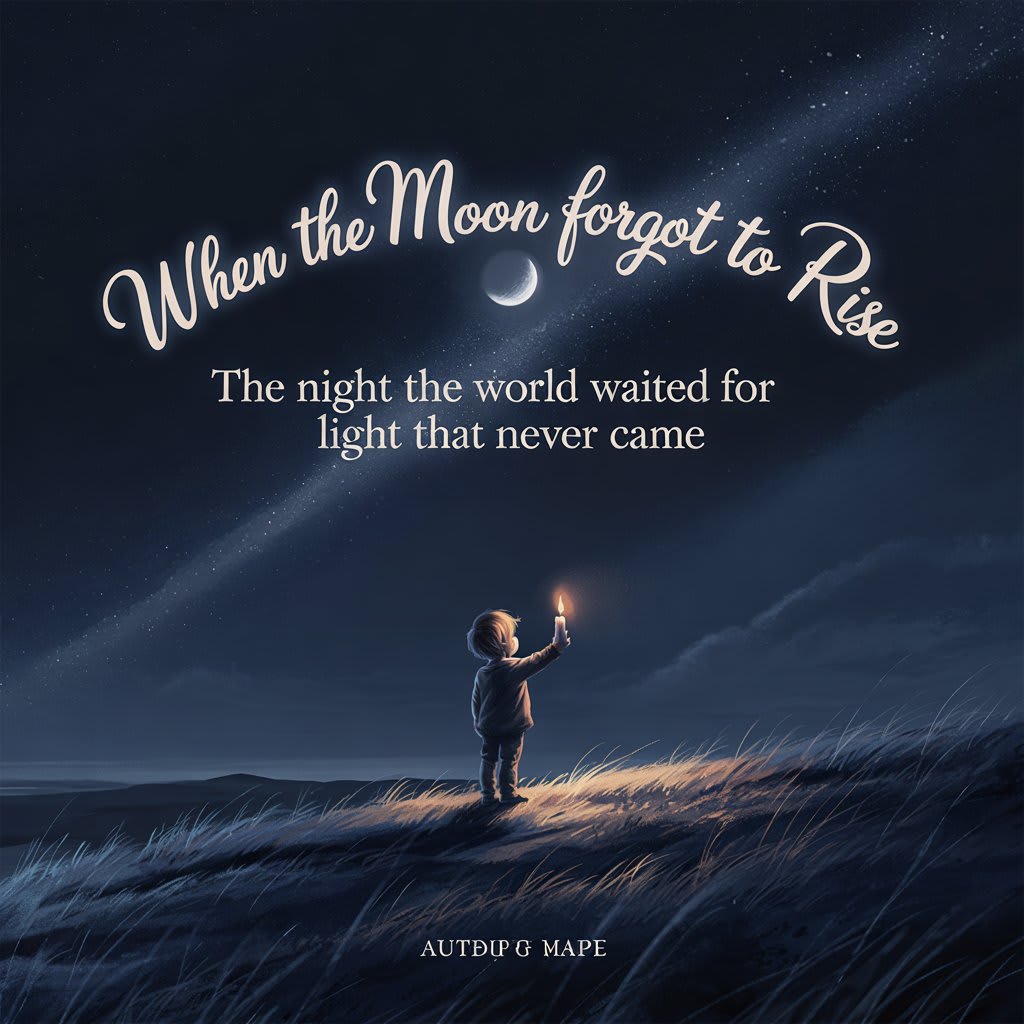
Certainly! Here's a **revised version of the story**, now with exactly **620 words** while keeping it immersive, atmospheric, and emotionally engaging:
---
**Title: *When the Moon Forgot to Rise***
**Subtitle: *The night the world waited for light that never came.***
---
No one noticed it at first.
The sun dipped below the horizon, as it always did, bleeding golden light across a sky slowly turning lavender. Children were called in from front yards. Porch lights flicked on. Lovers pulled sweaters tighter on evening walks.
And still—no moon.
At 7:41 PM, an astronomer in Chile rechecked his calculations. Lunar rise: 7:26 PM. Elevation angle: 14°. Clear skies. No interference. But the moon was not where it should have been. His telescope saw only stars.
At 8:02 PM, a tweet went viral:
> “Is it just me or is it *extra dark* tonight? Like... darker than dark?”
By 8:20 PM, it was everywhere.
People stepped outside and looked up, squinting. Some assumed clouds. Others said it was a trick of the eye, that the moon was there—just hiding, or in shadow. But it wasn’t.
The moon was gone.
---
In a third-story apartment in Bucharest, an old woman lit a candle and sat by her window, whispering a prayer she hadn’t said in thirty years. The absence reminded her of war. Of blackouts. Of nights that stretched too long. The shape of something wrong, and no one brave enough to say it out loud.
In Tokyo, a night photographer stared into his camera’s viewfinder, stunned. His long-exposure shots were useless. The light balance—off. The sky—a gaping hole. Even his memories of moonlight began to feel suspect.
In a field outside Nairobi, schoolchildren gathered, laughing nervously. “Maybe the moon is behind the clouds,” one said. “Maybe it’s just late,” said another. But no one laughed when the sky, deeper and deeper in its darkness, seemed to press down on them, heavy as regret.
---
By midnight, the news anchors stopped pretending it was atmospheric. Something had happened. No scientist, no historian, no astronomer could explain it.
The moon was not in orbit. It hadn’t eclipsed. It hadn’t disintegrated. It was simply—gone.
People did strange things in the dark.
They lit bonfires on beaches and rooftops. Some sang. Some prayed. Some screamed. A few broke into museums to sit beside old paintings, wanting to be near beauty in case this was the end.
In Paris, a violinist stood on a balcony and played Debussy’s “Clair de Lune” until her fingers bled. No one asked her to stop.
In New York, the skyline felt unfamiliar. The city that never slept suddenly looked like it was holding its breath.
---
At 3:14 AM, a child in Iceland asked, “Did it fall?”
“What?” her mother asked.
“The moon. Did it fall down?”
The woman blinked and couldn’t answer. Somewhere deep in her chest, something small and ancient believed the child might be right.
---
At 4:46 AM, the tides shifted. Not dramatically. Just enough to be wrong. Boats strained against their docks. Whales beached themselves. The sea whispered its disapproval in a language older than time.
People stayed awake, unable to sleep in a world without moonlight. Shadows didn’t move the way they used to. Dreams refused to come. And when they did, they were cold, silverless things.
---
And then—at dawn—the sun returned.
Brilliant, unapologetic, and blinding.
People cheered. Birds began to sing. Cars moved again. Normalcy, however thin, resumed.
But something had changed.
Every eye turned skyward that evening. The world held its breath.
The moon did not rise again.
---
And every night since, the dark has deepened.
We wait—not for the light, but for what it might mean that it has gone.
About the Creator
Lightning Never Strikes Twice
The distant rumble, the sudden deluge, the crescendo of sound, the flash of light, the explosive energy — it never gets old. I became an amateur storm chaser about two years ago. My wife, Cindy suggested it. Sort of. She said, "Alex, you know this cancer is killing me. I've come to terms with that, but you're smothering me. Go join a band, write a book, or become a storm chaser, for all I care. I love you, but you need a hobby."
By Julie Lacksonen6 days ago in Fiction
Crystal Banaba
“Emergency landing requested!” Rachel repeated in a shaky voice. Peering down through thick clouds, she saw an island that seemed to have popped up out of nowhere. It even had its own airstrip! Was she hallucinating, coming out of the storm that nearly split her Cessna? Or was she dead already, with her mind projecting an island that shouldn’t be here?
By Lana V Lynxabout 17 hours ago in Fiction
Guard Your Battery
Why are some people so attractive just by standing there? It’s not because they are "likable," but because they don’t need everyone to like them. I realized later that truly charismatic people allow themselves to be criticized, but they never criticize themselves. They never try to please the world; instead, the world stops to watch them.
By Emily Chan - Life and love sharing2 days ago in Poets


Comments (1)
Ye first part hata daitay ager Ai say banaya hay