
When the Forest Forgot Its Name: A Whisper Lost in the Trees
A hauntingly beautiful fantasy story about a girl who helps a forgotten forest remember its name. When the Forest Forgot Its Name explores memory, nature, and the quiet magic of connection.

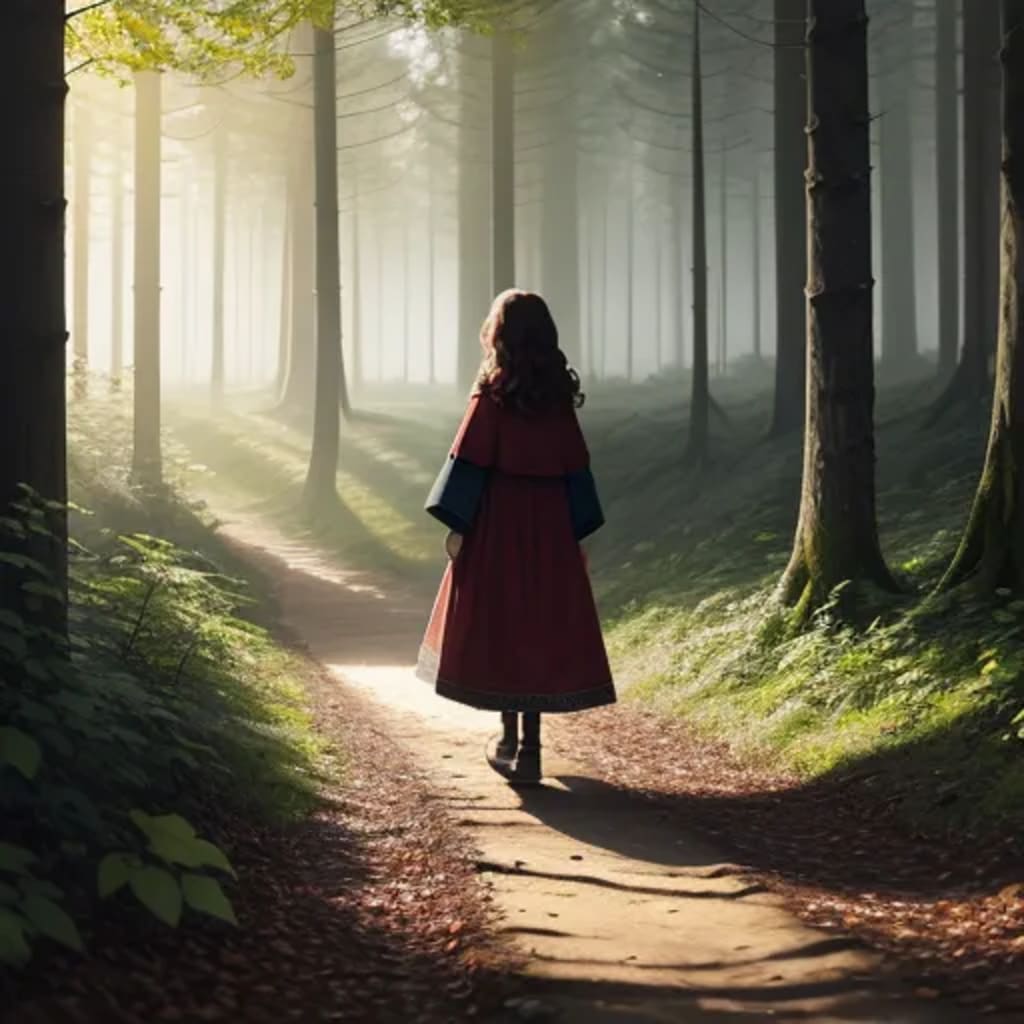
There are places the world forgets forests untouched by footsteps, where the air feels older than memory. In one such forest, silence was not emptiness but remembrance. The wind carried songs that no one could name, and every shadow hid a story waiting to be found.
This is the tale of Eira, a young wanderer who entered a forest that had lost its name. What she discovered was not only a mystery older than time but a truth about love, grief, and belonging that reshaped her soul forever.
As day melted into dusk, Eira would learn that even the quietest places remember us if we remember them.
The Girl Who Listened to Silence:
Eira had always felt out of place in her village. People called her “the quiet one,” but it wasn’t shyness that kept her silent it was listening. She heard things others ignored: the hum beneath river stones, the sigh of an old oak when rain touched its roots.
Her grandmother once told her, “The forest speaks to those who listen.” That memory was all she carried when she left home, following a faded path that no map dared to mark.
At the forest’s edge, a signpost stood, broken and weathered. No letters remained. The place had forgotten its name.
Still, something within Eira stirred a pull, gentle yet unshakable. She stepped inside.
The Forest Without a Name:
The first thing Eira noticed was the light. It wasn’t sunlight exactly more like a shimmer that shifted between gold and silver, as if the trees themselves were breathing.
Every leaf looked alive. Moss glowed faintly, guiding her deeper. But as she walked, she realized something was missing.
There were no birds.
No rustling of animals.
Only the whisper of wind through branches.
Then came the sound soft at first, like humming. It seemed to echo from every direction. Eira followed it until she reached a clearing.
In the center stood a single tree, massive and ancient. Its bark was pale and cracked, its leaves translucent like glass. And beneath it, carved into the earth, were symbols spirals, eyes, and strange marks that shimmered faintly.
When Eira touched the tree’s roots, a voice filled her mind.
The Tree That Remembered:
“Do you know my name?” the voice asked.
Eira gasped and pulled her hand back. The forest around her darkened, though no clouds crossed the sky.
“I I don’t,” she whispered.
“Then remember it for me,” the voice said.
The words sank into her chest like seeds. She felt warmth spreading through her, followed by a flood of images ancient rivers, moonlight on untouched snow, laughter echoing through green valleys.
For a moment, Eira wasn’t herself. She was the forest. She could feel every root, every drop of dew, every fading memory.
Then it was gone.
The forest fell silent again.
Echoes of What Once Was:
Over the next days, Eira explored deeper. The forest seemed endless, looping in strange patterns. She’d mark trees to track her path, only to find her marks gone the next morning.
But the forest wasn’t trying to trap her. It was testing her.
She began to dream each night visions of people dancing beneath starlight, of temples grown over by vines, of a name whispered like a prayer: Elaren.
When she awoke, she’d hear fragments of voices on the wind, as though the forest’s memories were bleeding into her own.
And always, she returned to the pale tree in the clearing. Each time, its roots glowed brighter when she came near.
The Keeper of Forgotten Things:
On the seventh day, Eira met him a figure cloaked in green, with eyes like amber fire.
“You shouldn’t be here,” he said, though his tone wasn’t unkind.
“I came to remember,” she replied.
He studied her. “Most who come here forget. You wish to remember?”
“Yes. The forest asked me to.”
The man smiled sadly. “Then it has chosen you.”
He introduced himself as Kael, the Keeper of Forgotten Things. He explained that the forest once had a name a sacred bond between nature and people. But when humans stopped speaking it, the name dissolved. Without its name, the forest began to fade.
“The more it is forgotten,” Kael said, “the more it forgets itself.”
Eira felt something tighten in her chest. “Can I help it remember?”
He looked at her long and hard. “Only if you give something in return.”
The Price of Memory:
Kael led Eira to a pool of still water, clear as glass. Reflected in it was not her face, but scenes from her life her village, her grandmother’s smile, her loneliness.
“To give the forest its name,” Kael said, “you must offer a memory it can keep forever.”
Eira hesitated. “Which one?”
“The one that defines you.”
She thought of her grandmother’s stories, of long nights spent staring at stars and wondering if she’d ever belong.
Slowly, she knelt and placed her hand over the water. “If I forget this,” she whispered, “will it remember me?”
Kael nodded. “Always.”
Eira closed her eyes. The water rippled and then she felt something leave her, gentle as breath.
When she opened her eyes, she could no longer recall her grandmother’s face.
But the forest shone brighter.
The Name Remembered:
The next morning, the forest felt alive again. Birds sang for the first time, and flowers burst from the ground in waves of color.
Eira hurried to the pale tree. Its leaves now gleamed gold.
“You remembered me,” the voice said, stronger now.
And in that moment, the name returned to her clear as dawn.
Elaren.
The forest’s true name.
Light spread through the branches, racing across the horizon. Every shadow lifted, and for a brief second, Eira felt the heartbeat of the earth itself.
She fell to her knees, weeping not from sorrow, but from awe.
The Forest’s Gift:
When the light faded, Kael appeared once more.
“It remembers now,” he said softly. “And so do you.”
Eira touched her chest. “But I gave it my memory.”
He smiled. “It kept your pain, not your love. Love never leaves it only changes shape.”
Then he turned and vanished into mist.
Eira stood in the clearing, the forest’s name echoing inside her like a song. She knew it would never fade again.
When she returned to her village, people said her eyes looked different wiser, as if they carried light from another world.
And when she told them of Elaren, they listened.
The forest would never be forgotten again.
The Legacy of Elaren:
Years later, children of the village would walk to the forest’s edge and whisper its name. Trees grew taller, rivers clearer. The village thrived in harmony with the woods, honoring the place that had once forgotten itself.
Eira became a storyteller, known far and wide as “The Girl Who Remembered the Forest.”
But when she looked toward the horizon and saw sunlight threading through the trees, she didn’t see magic or mystery she saw memory.
Because the truth was simple:
Everything alive only asks to be remembered.
Conclusion: The Song That Never Dies
“When the Forest Forgot Its Name” is not just a fantasy tale it’s a reflection of what we lose when we stop listening. Eira’s journey reminds us that connection, whether with people or places, is kept alive by remembrance.
In every forest, every memory, every dream there lies a name waiting to be spoken again.
And when we remember it, we remember ourselves.
About the Creator
Zeenat Chauhan
I’m Zeenat Chauhan, a passionate writer who believes in the power of words to inform, inspire, and connect. I love sharing daily informational stories that open doors to new ideas, perspectives, and knowledge.
Keep reading
More stories from Zeenat Chauhan and writers in Fiction and other communities.
Bomb Scare
It was 2027, and the world never thought it would happen. A missle hit the United States, but it wasn't where they had anticipated. A little town in the northeast was hit by a missile strike, they didn't know why, and they didn't know exactly where it hit, but they did know it was a coastal community, somewhere between Maine and Delaware.
By Gregory Payton5 days ago in Fiction
The House at the End of the Street
As the sun went down, the town closed. Mothers called their children in from playing while stores locked their doors. Customers made last minute purchases before hurrying home themselves. A stranger walking through town would notice that people averted their eyes, only glancing up to check how low the sun was.
By Reb Kreyling4 days ago in Fiction
Worth the Wait: Puerto Viejo, Costa Rica
Beach bumming in a small Caribbean beach town sounded like a perfect way to end our 6-month trip through Mexico and Central America. Or so we thought. The foul, fishy stench of rotten seaweed hit our nostrils as we stepped from the cramped bus and looked out at a rather depressing, empty, and underwhelming black sand beach. It was pouring with rain, and we had to quickly fish out our ponchos. We thought, this couldn’t be it, could it?
By Sh*t Happens - Lost Girl Travel4 days ago in Wander




Comments
There are no comments for this story
Be the first to respond and start the conversation.