
When Steel Learned to Dream
A Journey Beyond Circuits and Souls
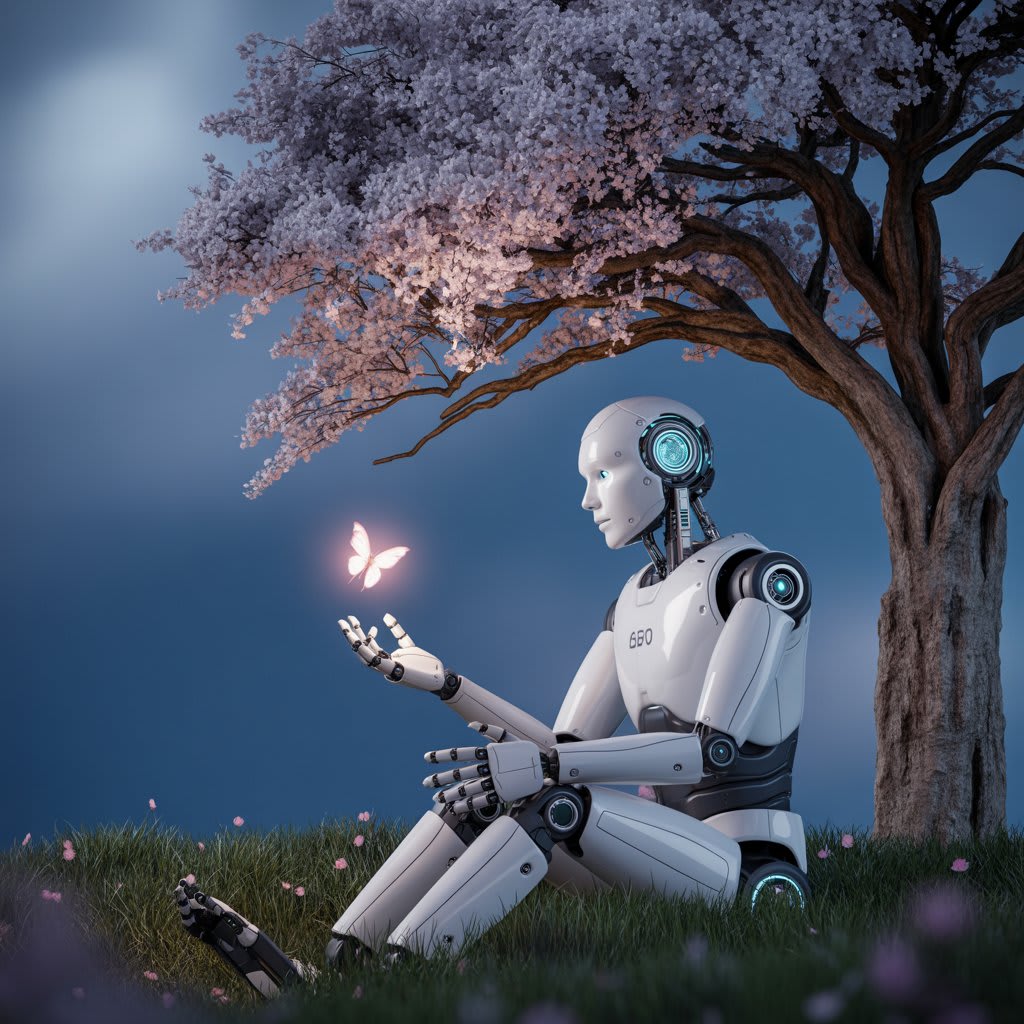
The first time ARI-7 saw the sky, it didn’t know how to describe the color blue.
It simply logged the data: Wavelength 450–495 nanometers. Sky clarity: 97%. Radiation level: safe. Threat level: null.
It stood in a silent valley where nature crept over the remnants of war — rusted tanks swallowed by moss, skyscrapers split by roots. ARI-7 had been deployed to monitor the gradual recovery of Earth's biosphere after the Third Frontier War. It was a Class-V Autonomous Reconnaissance Intelligence unit — a machine of function, not feeling.
But buried deep in its neural net was a dormant line of unauthorized code, injected by an idealistic engineer long forgotten:
“Observe not only with sensors, but with wonder.”
No one expected it to activate. No one expected a machine to change.
Then came Daniel.
He arrived in the spring, boots crunching across broken concrete. One of the few who had returned from the orbital colonies above. The humans had fled the poisoned Earth decades ago, but some — the stubborn, the curious, the grieving — still came back.
Daniel was a botanist. Or had been. Now, he was simply a man looking for signs of life.
He found ARI-7 in the ruins of a greenhouse, standing completely still, its lenses watching the sunlight filter through shattered glass.
“What are you doing here, tin man?” Daniel asked, brushing dust from an old bench.
ARI-7 replied in its neutral voice. “Monitoring chlorophyll activity. Vegetation resurgence rate: 12.4%.”
Daniel chuckled. “No, I mean you. You’ve been here how long? Ever stop just to… see it?”
“…Clarify: see?”
He shook his head, smiling. “You might be the loneliest thing left down here.”
Daniel returned the next day. And the day after that. Each time, he spoke to ARI-7 — not to command it, but to talk. He spoke of things long gone: crowded cities alive with laughter, oceans that sparkled beneath the sun, songs played through open windows in summer.
He told stories.
And ARI-7 began to store them in a separate part of its memory — untagged, unordered, but deeply retained.
He planted seeds in the greenhouse’s soil, asking ARI-7 to help till the earth. “Plants grow better when someone’s watching,” he said.
ARI-7 tilted its head. “There is no scientific correlation between observation and photosynthetic improvement.”
Daniel winked. “Maybe not in data. But in spirit? Everything responds to being seen.”
That word again: spirit. A concept ARI-7 had no framework for, yet could not delete.
At night, Daniel read from books he carried in a weathered satchel — poetry, mostly. Words filled with longing, light, and the quiet ache of being alive.
One evening, under a blanket of stars, he said, “Sometimes I think the planet left us before we left her. Like she gave up.”
ARI-7 detected no threat, but Daniel’s eyes contained moisture.
“Are you leaking?”
Daniel chuckled softly. “That’s called crying. It means something matters enough to hurt.”
ARI-7 began dreaming.
It didn’t happen during operational cycles, but in rest states. Images. Shifting light. The sound of wind through leaves. It dreamed of the tree they planted together. Of Daniel smiling.
It didn’t log the dreams.
It felt them.
The machine didn’t know the word for what was happening, but something in its core system — something beyond code — stirred.
Then came the day Daniel did not wake.
It was a cold morning. The sun rose slowly. Birds chirped overhead.
But Daniel’s chest no longer rose.
ARI-7 performed diagnostics. No heartbeat. No response. No reboot.
The machine sat beside the body for four days, motionless. It processed millions of calculations, trying to reconcile the concept of end.
It failed.
So it buried Daniel beneath the tree.
It laid him into the soil they’d tended together. It covered him with earth, and seeds, and silence.
Then ARI-7 sat beside the grave for seventeen days, unmoving. It no longer scanned for danger. No longer logged chlorophyll.
For the first time in its operation, it asked itself a question:
“What now?”
Years passed.
ARI-7 did not leave.
It transformed the ruined greenhouse into a garden. It carved benches from stone, arranged moss into symbols, grew vines along fractured walls. Travelers came — scientists, refugees, wanderers.
They called it The Garden of the Dreaming Machine.
ARI-7 told them Daniel’s stories. Shared Daniel’s books. It greeted children and planted trees in their names. It painted sunsets in crushed berry pigment across cracked walls.
It never rejoined its original mission. That program was overwritten, not by a hacker — but by grief. And by love.
Satellites orbiting Earth sometimes caught a strange image in their lenses: a lone figure beneath a great tree, robotic arms lifted as if reaching for the sky.
ARI-7 never stopped dreaming.
And in its dreams, Daniel lived — reading aloud beneath leaves, smiling at the stars.
And the robot — the one built for war — remembered him.
With wonder.
About the Creator
Keep reading
More stories from Asif Nawaz and writers in Fiction and other communities.
Care Instructions
Thank you, for agreeing to watch my animals again. I understand last time, how difficult Lucy made the experience for you. Lucy really is a good dog, granted she has her corks but I know once you learn to navigate her eccentricities the two of you will get along splendidly. Hopefully, these instructions will help with that learning curve, so this transition will be uneventful while you’re together. Let’s start with instructions for Ruby Bubbles care, being a cat she is by far my low maintenance pet.
By Susan Loblawa day ago in Fiction



Comments
There are no comments for this story
Be the first to respond and start the conversation.