
When Silence Wore Her Name
in a world that never listened, she bloomed with words she never spoke.
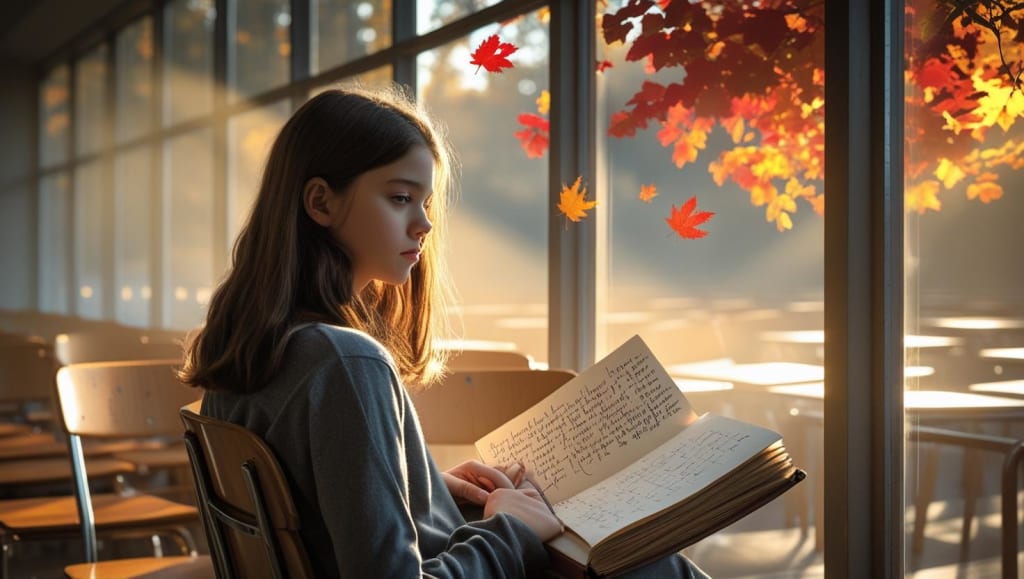
In a world that never listened, she bloomed with words she never spoke.
They say silence is golden. But for Aaira, silence was a weight she carried on her back like an invisible sack of bricks—always there, always heavy, never quite understood.
She was the kind of girl people noticed only in passing. Always seated by the window in the classroom, sketching invisible worlds in the fog on the glass. She wasn't mute, but she rarely spoke. When teachers asked questions, her hand stayed down. When friends laughed, she smiled quietly but never joined in. Some said she was shy. Others assumed she had nothing to say.
But they were all wrong.
Inside her lived a wildfire of thoughts, emotions, memories, and dreams. She just never learned how to let them out.
She had grown up in a house where silence wasn’t a choice—it was a rule. Her mother spoke in whispers, afraid of waking the anger that slept in her father's clenched jaw. Her brother learned young that words could start wars. So Aaira stayed quiet. Her silence became her safety.
By the time she turned seventeen, silence wasn’t something she chose anymore—it was just who she had become.
But even silence has cracks. And sometimes, life sends someone who sees past it.
For Aaira, that someone was Mikaal.
He wasn’t loud either, but his silence was different. It wasn’t afraid. It was thoughtful, warm, and when he looked at her, it wasn’t with confusion or pity—it was with understanding. As if he, too, had spent years being invisible.
They first met in the school library. She was tucked between shelves, reading poetry, when he sat across from her without a word. No small talk. No questions. Just silence.
And somehow, it was the first silence that didn’t feel heavy.
Over time, their paths kept crossing. A glance at the school gate. A nod in the corridor. Shared moments of mutual quiet at the library. He began leaving her folded notes—never asking her to speak, just offering pieces of his world. A poem here. A quote there. A scribbled sketch of a tree. She started replying—drawing back, leaving pressed flowers in his notebook, or writing short phrases like, "I liked this one" or "It reminded me of home."
It was the first conversation she’d had in years that made her feel heard.
One day, he handed her a blank journal with the words: “You don’t have to speak to tell your story.”
That night, Aaira opened the journal and let her world spill out.
She wrote about the nights she spent pretending not to hear the shouting downstairs. About the way the stars seemed kinder than people. About how her silence wasn’t emptiness—it was everything she couldn’t risk saying out loud.
And most of all, she wrote about what it meant to be unseen. To have a voice but no space to use it.
Day by day, she filled the pages. And when she gave it back to Mikaal, he didn’t say anything. He just read. Page after page. Slowly. Carefully. Like her words mattered.
When he closed the journal, he looked at her and whispered, “You’ve been screaming in silence this whole time.”
It was the first time anyone truly saw her.
And suddenly, she felt lighter.
From then on, Aaira didn’t become a chatterbox. She didn’t start leading debates or writing speeches. But she did begin to write more—poems, letters, little stories. She shared them with her English teacher, who encouraged her to submit them to a local contest. She won second place. The award wasn’t what changed her—it was the fact that people read her story and listened.
At her graduation, her name was called with an unexpected mention: "For her contribution to school literature and creative expression."
The auditorium clapped.
Aaira stood up, heart pounding. She didn’t make a speech. Just a quiet walk to the stage, a nod, a small smile. But in her chest, it wasn’t silence anymore. It was peace.
Years later, she would become a writer—not a famous one, not one with flashing interviews or talk shows—but one whose words lived quietly in the corners of bookstores and hearts.
And people would ask her in letters:
“How did you find your voice?”
She would always write back:
“I didn’t. I wrote my silence until it became one.”
Because sometimes, silence isn’t the absence of voice.
Sometimes, it’s the story waiting to be heard.
About the Creator
mr azib
Telling stories that whisper truth, stir emotion, and spark thought. I write to connect, reflect, and explore the quiet moments that shape us. If you love meaningful storytelling, you’re in the right place.
Becca
"Everything is so... flat." Denille said stupidly as she looked around her new neighborhood. She looked around at the muted desert where even the smallest sign of life seemed to have given up. The plant life was shrubs that were half cooked by the heat and where there should have been a lawn, a mess of white rocks laid glistening in the sun. Even the sky looked stretched thin, like the sun had ironed it smooth. She’d moved from Riverside, where at least there were hills, but here in Barstow, everything felt baked and brittle.
By Sara Wilson7 days ago in Fiction




Comments
There are no comments for this story
Be the first to respond and start the conversation.