
When Memories Expire
A world where memories have an expiration date.
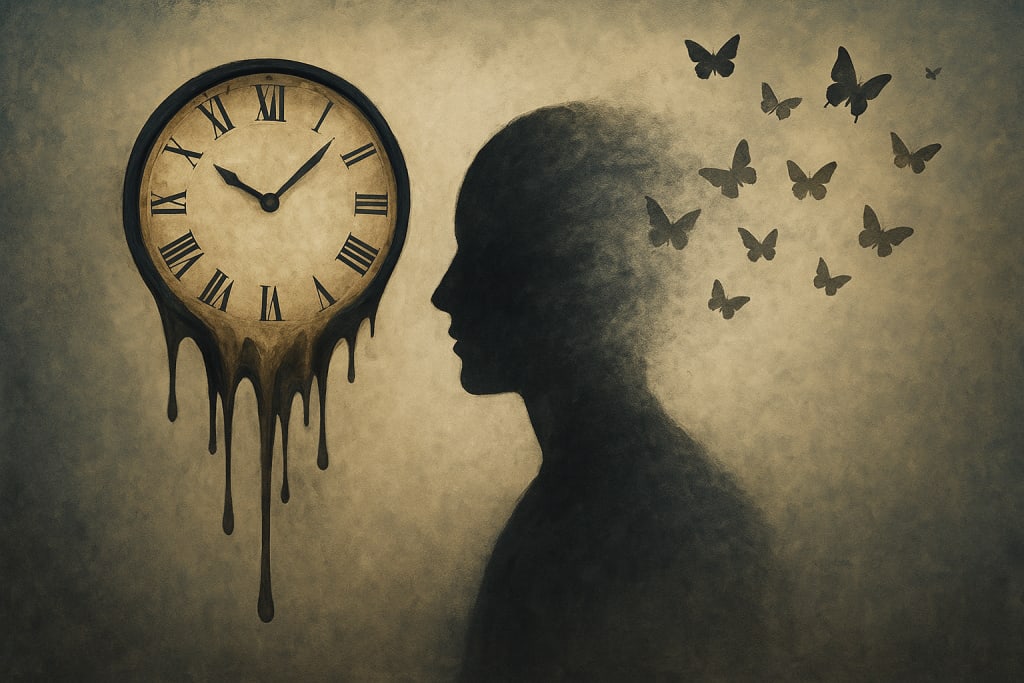
When Memories Expire
In my world, memories come with an expiration date.
They call it The Fading. On the day you’re born, a thin silver band is embedded in your wrist, glowing faintly with shifting numbers. Those numbers count down the days until each memory vanishes forever. Some memories last years. Others disappear in weeks. No one knows why the timers vary. You just learn to live with the quiet dread of forgetting.
When I was a child, I thought it was normal—just like losing baby teeth. I would be laughing with my friends, then one day I’d wake up and the details were gone. I’d remember their names, but not the jokes we shared. I’d remember school, but not how it felt to hold my mother’s hand on the first day. My wristband would glow dull gray where the numbers had once ticked, marking another memory expired.
But as I grew older, the truth became unbearable: life isn’t about holding on—it’s about watching everything slip away.
The first memory I fought to keep was of my father.
He wasn’t perfect. He smoked too much, worked too late, and sometimes lost his temper. But he was mine. One evening when I was twelve, he taught me how to ride a bike under the soft amber streetlights. His hand pressed firm against my back, steadying me until I found balance. The timer on my wrist told me I had six years before that night would Fade. I clung to those numbers, terrified.
Six years later, on the eve of my eighteenth birthday, I stayed awake the entire night, reliving every detail—his laugh, the smell of smoke clinging to his jacket, the sound of his shoes slapping the pavement as he ran beside me. At dawn, I looked at my wrist. The numbers blinked once, then vanished. The memory slipped from my mind like water through a sieve.
All that remained was a hollow space where love used to be.
Some people cope better than others. My best friend, Lila, treats her memories like sandcastles. “They’re beautiful, but they’re supposed to wash away,” she tells me. She takes endless photos, journals obsessively, desperate to trap what she can before the tide rises.
“Pictures aren’t the same,” I argue. “They don’t carry the warmth, the smell, the sound—”
She shrugs. “Better a shadow than nothing.”
Maybe she’s right. I used to think photos were pathetic imitations, but now I scroll through hers with envy. Even if she doesn’t remember the moments, at least she has proof they existed.
Everything changed when I met Elias.
I was twenty-three, working at the archives—one of the few places where memories could be recorded in fragments. We didn’t have the technology to preserve them, not truly, but the archives were filled with people’s attempts: voice notes, written accounts, sketches of faces they wanted to hold onto.
Elias was a regular visitor, quiet and intense. His wristband glowed constantly, the numbers on each memory counting down faster than anyone else I’d seen. He told me he had a condition—his memories only lasted thirty days. Every month, his mind became a blank slate.
And yet, he smiled more than anyone I knew.
“How do you live like that?” I asked him once, half in awe, half in horror.
“Easy,” he said. “I fall in love with today.”
I laughed at the time, thinking it was poetic nonsense. But a week later, he brought me flowers. A week after that, he kissed me under the rain. By the end of the month, he confessed he wouldn’t remember me tomorrow.
“Write me down,” he begged. “Leave me traces.”
So I did. I filled notebooks with our laughter, our conversations, the curve of his mouth when he smiled. Every morning, I returned to him with pages in hand, and he read himself back into love.
But one morning, I arrived, and he wasn’t there.
The nurse at his building told me he’d left in the night. His memories had expired, and he hadn’t wanted to depend on the fragments anymore. He wanted a fresh start, without the weight of reminders he couldn’t feel.
I was devastated. It felt like my own expiration had come early. For weeks, I couldn’t eat, couldn’t sleep, terrified of the day when even the pain of losing him would Fade.
And then it happened. One morning, I looked down at my wrist and saw the numbers had run out. His face was gone. His voice—gone. The only thing left was the notebook, heavy with words I no longer recognized as my own.
Now I live differently. I don’t fight The Fading the way I once did. I don’t try to hoard memories or stop the tide. Instead, I breathe deeply into the present, savoring it with all the fierceness I can muster. Because Elias was right: falling in love with today is the only way to survive tomorrow.
Sometimes I catch myself staring at my wrist, watching the timers tick down, and instead of despair, I feel gratitude. Each number is a reminder that what I have now is precious, finite, irreplaceable.
And though memories expire, the act of living never does.
About the Creator
Keep reading
More stories from Aariz ullah and writers in Fiction and other communities.
The Five-Second Decisions That Shape Our Lives”
The Five-Second Decisions That Shape Our Lives Some people believe that the most important decisions in life are grand ones—choosing a career, marrying a partner, buying a house. Those certainly matter, but in my experience, it’s the quick choices—the ones we make in less than five seconds—that carry the greatest weight. They are the tiny hinges on which the big doors of our lives swing.
By Aariz ullah6 months ago in Motivation
When Silence Was Whole
Flower InBloom writes at the threshold where myth meets nervous system and spirit meets structure. This piece is not a cosmology to believe in, but a remembering to feel into. If something in you softened while reading, that is the field recognizing itself.
By Flower InBloom6 days ago in Fiction



Comments
There are no comments for this story
Be the first to respond and start the conversation.