
What Is in a Name: The Hero, and The Lich
“What is in a name? For one, glory. For another, everything.” The world called Ketel chosen—blessed by the gods, marked by prophecy, the hero destined to defeat the rising lich. His silver eyes became the symbol of hope, his name sung in every hall and whispered in every prayer. But behind every hero stands a shadow. A brother in all but blood, a companion who fought, bled, and endured beside him—yet whose name the world never spoke. When destiny demands sacrifice, and the battle against darkness reaches its end, it is not the chosen who seizes power…but the forgotten. What Is in a Name is a tale of loyalty and betrayal, of friendship turned to fire, and of how silence itself can reshape the world.

Chapter I – The Chosen
The bards called him chosen by fate. The priests called him blessed by the gods. The people, desperate for hope, named him hero.
And me? I called him my friend. My brother in all but blood. Ketel.
We grew up together in the dust of forgotten roads, two ragged boys with empty stomachs and louder dreams. We learned to fight not with swords, but with sticks snatched from hedges, laughing even as we bloodied each other’s noses. At night, we’d lie beneath the stars and whisper the kind of futures only children could imagine—castles, crowns, and glory that neither of us had ever seen.
When trouble found us, as it always did, I stood at his side. I bound his wounds after our first real skirmish with cutthroats, shaking hands pressing cloth to blood. He carried me when fever burned me to weakness. We survived because we had each other. There was no prophecy then, no whispers of destiny—just two boys clinging to life.
But as we grew, the world began to notice Ketel. It was in his silver eyes, rare and shining, a mark the priests claimed was divine. When he spoke, people listened. When he stood, they saw a hero waiting to be born. His name spread first in small places, then farther, until even those who had never seen his face spoke of him with reverence.
And me? I was there too. Always there. Fighting, enduring, keeping him alive as much as he did me. Yet the world never spoke my name.
Still, I stayed by his side. Where else would I be?
Chapter 2 – The Call
Peace, or something like it, never lasts.
The roads we once walked as boys, laughing and fighting over scraps of bread, grew darker with each passing season. Trade faltered. Villages we remembered from our youth stood hollow, their windows black, their wells choked with ash. Farmers whispered of fields that rotted overnight, of their dead refusing to stay buried.
I remember one night in particular. We came upon a hamlet where no birds sang, no dogs barked. The people moved as though sleepwalking, their skin pale, their eyes dull as river stones. When Ketel tried to speak to them, they only stared past us. By morning, every door stood open, and the village was empty. No tracks, no sound—only silence and the smell of earth freshly turned.
Such tales multiplied. Caravans were found torn apart, their guards slain by blades that left no blood. Cattle bellowed in the night, then were found at dawn standing still in their pens, eyes wide and lifeless, yet their bodies refused to fall. Shadows lingered long after sundown, crawling where no light reached. The world itself seemed to rot from within.
Then came the messengers, gaunt and desperate, their cloaks stinking of smoke. They brought word of the lich rising in the east, of a fortress climbing out of blackened earth, its shadow reaching farther each day. Wherever that shadow touched, life sickened.
It was not long before the priests sought Ketel. They spoke of visions, of prophecies older than kingdoms, of silver eyes that marked the chosen. He was the one, they said—the light to stand against the gathering dark. When they knelt before him in the square, calling him blessed by the gods, the people followed suit. Even hardened men wept at the sight, begging him to save their children.
I saw the weight settle on his shoulders then. Ketel did not ask for it, but neither did he refuse. In the flicker of torchlight that night, I caught his gaze. There was fear buried there, beneath the resolve, but he said only: “If I do not go, who will?”
And so the path was set.
When the call came, he answered.
And as always, I went with him.
Chapter 3 – The Road of Ash and Bone
When the prophecy spoke of the lich in his fortress of black stone, it was Ketel they summoned. Of course it was. His silver eyes were the mark of destiny, or so they claimed.
The lich had risen from the bones of kings long buried. Entire villages had been emptied overnight, their people found days later as pale husks wandering the roads, their souls torn out to feed his armies. In the northern plains, rivers turned black with ash where his sorcery burned fields down to soil and bone. No kingdom stood untouched—his shadow reached over them all.
They said he could not be killed, that his soul was bound somewhere beyond mortal grasp. Armies had marched against him and vanished. The bravest knights of three realms lay among his thralls, their banners dragged through the mud as mockery. Every day he lingered, his power swelled, and soon the world itself would be remade in his image of death.
So they called Ketel, the chosen. They prayed his blade and his bloodline might succeed where legions had failed.
I went with him, as I always had. There was never any question.
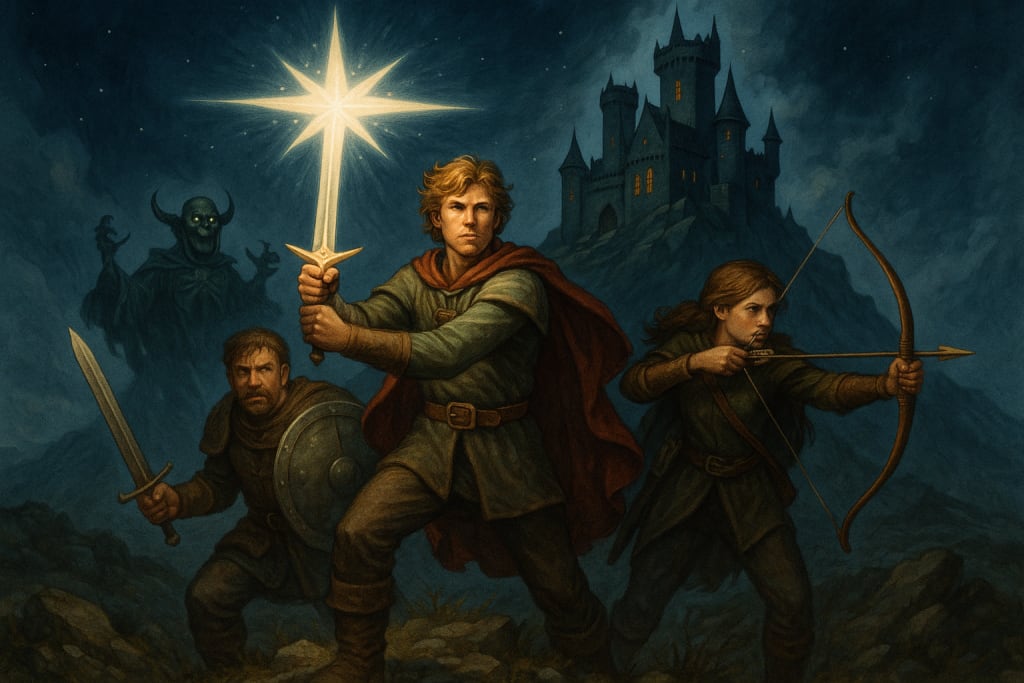
Velira came to us in the mountain passes, where snow never melted and wolves howled with voices like men. She was swift even in the biting cold, a bow across her shoulders and a smile sharp as her arrows. She fought like the wind itself, striking fast and vanishing before the enemy could blink.
Her laughter carried us through dark places. She spoke little of herself, only that swiftness had kept her alive when strength had failed. Where Ketel strode like a burning sun, Velira was the wind at his side, light and untouchable. And I—well, I was the ground beneath their feet, steady and unyielding.
The road tested us. In the marshes, the mists whispered our names, trying to draw us under. On the frozen rivers, I caught Ketel’s arm when the ice cracked beneath him. In the hills, Velira’s arrows flew when blades closed in too fast. We bled together. We fought together. We endured.
Chapter 4 – The Fortress
The lich’s fortress rose like a black crown against the horizon, its towers jagged as broken teeth. The ground for miles was choked with ash, as though the very earth had burned away its life to feed the thing within. The air grew colder the closer we came, until even our breaths froze in silver mist.
The gates loomed vast before us—iron doors twisted into shapes of screaming faces. When we approached, they split open with a groan, not by our strength but by the lich’s will, as though he were inviting us into his jaws.
And then the dead poured out.
They came in waves—skeletons with rusted blades, corpses wrapped in rotted mail, spirits shrieking in voices that clawed at the mind. The ground itself seemed to disgorge them, bone and flesh clawing up from the ash.
Ketel surged forward, his sword a burning star. With every swing, he cut three down, and for every three he slew, six more rose. Velira’s bow sang beside him, arrows piercing eyes, splitting spines, felling wraiths mid-scream. Her hands blurred with speed, her quiver near-empty before I could even count her shots.
And I—my arm bore the weight of shield and blade both. I fought at their backs, hacking apart the tide that tried to encircle us, holding the line when they would have been overrun. The dead slammed into me like waves against a cliff, and each time I thought I would break, I forced myself to stand again.
But for every foe we felled, another took its place. Hours might have passed, or only minutes—it was impossible to know, surrounded by nothing but shrieks and steel. I remember Velira crying out, dragged down into a mass of clawing hands. I saw her bow shatter beneath the crush. For a heartbeat, I thought she was gone, swallowed whole—but then she rose again, bloodied, dagger flashing, carving her way back into the fight.
Ketel roared, his voice carrying over the din. He was unstoppable, radiant, every blow feeding the legend already written around him. The dead faltered beneath his fury—but never stopped.
At last, the three of us pressed forward step by bloody step, forcing the tide back long enough to stagger through the open gates. They slammed shut behind us with a sound like the world breaking in two.
The fortress had swallowed us whole.
Chapter 5 – The Lich
The throne room was a cathedral of ruin. Black pillars twisted up like petrified trees, their roots of stone clawing through cracked tiles. Flames of sickly green hovered in iron braziers, their light casting shadows that moved when we did not. At the far end, upon a throne carved of bone and black iron, waited the lich.
He was tall, draped in robes that shifted like smoke, his face a hollow skull veined with ghostlight. Upon his brow rested a crown of bone, and when he spoke, it was not a voice but a hundred whispers crawling across the air. Promises of eternity. Mockery of death. A doom sung sweet as a lullaby.
Ketel answered him with a roar, lifting his blade as though the weight of prophecy had never touched him. He charged, the hero the world believed in, and the clash that followed shook the chamber. Steel rang against sorcery, every strike shattering sparks of light and shadow.
I was with him. I always was. Shadows surged from the lich’s hands, twisting into blades and claws. I met them with shield and sword, tearing through them, though each strike sapped strength from my limbs. Skeletal guardians crawled from the stones at his feet—things wrapped in scraps of rusted armor. I cut them down, one after another, until my blade was slick with black ichor that hissed where it touched the floor.
Velira fought at our side, her bow long since shattered outside the fortress. Now only her twin daggers flashed in her hands as she moved through the tide of bone and shadow like wind through reeds. She struck where the lich’s defenses were weakest, her blades biting deep into spectral tendrils, carving space for Ketel’s sword to drive home. Twice, she turned aside a spell that would have ended him outright, her body faster than thought, faster than death.
But the lich was no mere foe of flesh and bone. He was storm and frost, fire and void. A gesture sent gales howling, flinging me across the chamber. A word turned the air to ice, searing my lungs as I struggled to breathe. My shield split in two beneath the weight of his magic, and still I forced myself up, stumbling back into the fray, because Ketel’s back could not be left unguarded.
Velira darted toward the lich, her daggers raised high, a cry on her lips. But his hand swept out, and a blast of necrotic fire engulfed her mid-stride. The force hurled her against the far wall with a sound like shattering bone. She crumpled to the ground, her weapons scattering, her breath faint but still present. She did not rise again.
Ketel fought like a burning sun, silver eyes blazing with light. His sword cleaved through spells that should have slain him, his will unbroken even as blood soaked his armor. For a moment—just a moment—it seemed he might win. That the prophecy had not lied, that this was the triumph the world had been waiting for.
But heroes bleed. And Ketel bled deeply. His strikes grew slower, his shield arm heavy, his breath ragged. Each spell from the lich struck harder, each blow driving him closer to the edge of ruin.
And in that moment, I knew: if he fell, the world would fall with him.
Chapter 6 – The Phylactery
The battle seemed endless, a storm that would grind us to dust. Ketel’s sword clashed against the lich’s staff, sparks of steel against sorcery, light against the abyss. My arms trembled beneath the weight of shadows that struck like hammers, my body aching from blows I should not have survived.
And then—through the haze of smoke and spellfire—I saw it.
Behind the throne, half-hidden in the lattice of bone, hung a crystal heart. Black veins pulsed within it, each beat echoing like a drum in my skull. It glowed with a light that was not light at all, a void that seemed to drink the air around it. The phylactery. The source of the lich’s eternity.
Even as I watched, the whispers grew louder. Thousands of voices, moaning, weeping, shrieking—souls bound within the crystal, their torment feeding the creature who ruled us. My knees weakened beneath the sound. The stench of grave-soil and burning flesh thickened until I gagged.
Ketel staggered toward it. His blade was still raised, but his body was breaking. His silver eyes, once blazing with certainty, now flickered like dying lanterns. He dragged himself step by step, blood trailing in his wake. For an instant I thought—perhaps he truly was chosen. Perhaps he would finish it.
But the lich’s hand shot out, seizing Ketel by the throat. He lifted him with effortless strength, holding him high as though he were nothing but a rag doll. Ketel’s sword fell from his hand, clattering uselessly on the stones. His lips moved in soundless defiance, but no air came. His face darkened, his silver eyes dimmed.
Then his gaze found me.
And he mouthed one word.
Help.
I didn’t think. There was no time for thought. My body moved before my mind could catch up.
I lunged past the throne, past the lich, past Ketel’s choking gasp. My broken sword, little more than jagged steel, rose in my hand. I drove it into the crystal heart.
The sound was not a shatter but a scream. A thousand screams. The phylactery cracked like ice beneath a hammer, lines of black spreading in all directions. Light and shadow exploded outward in a storm that tore the air itself apart. The braziers guttered, the floor trembled, the pillars groaned.
The lich shrieked, his grip loosening on Ketel. For the first time, I saw fear in his hollow eyes.
And then the phylactery burst.
But not into nothing. Not into dust.
Into me.
The storm rushed inward, tearing through flesh and bone, through thought and soul. Fire scorched my veins, frost hollowed my lungs, shadow clawed at my heart. Voices poured into my skull, a thousand upon thousand, screaming, wailing, pleading. I felt them tearing, rending, trying to rip me apart, to make me theirs.
I should have died. Any man should have died.
But I did not.
I endured.
I took it all.
The power filled me, colder than the grave and hotter than the forge. My skin burned, my sight fractured, my heartbeat vanished into silence. I was on my knees, sword clattering from numb fingers, but I was not broken. I was more.
When the storm cleared, silence fell like ash.
The lich was gone. His crown clattered to the stones, empty, lifeless. The air no longer reeked of death—it reeked of me.
Chapter 7 – The Shadow
Ketel crawled toward me through the ruin, his body broken, his face pale with exhaustion and blood loss. His silver eyes, dim but still burning faintly, locked onto mine.
“You… you did it,” he whispered, voice ragged. “You saved us.”
For a heartbeat, I wanted to believe him. Wanted to let those words wrap around me like a cloak, warm and comforting. For once in my life, I was not the shadow at his side. I was the one who ended the terror.
But even as I held that fragile thought, something else stirred. The voices from the phylactery still hissed inside my skull—thousands of them, bound and broken, feeding their venom into my veins. And with their whispers came memory.
The swamp. Ketel would have wandered blind into the mire, drowned beneath the muck, if not for me dragging him back. Yet the priests who awaited us in the next village sang only of Ketel’s unshakable will.
The hills. My blade struck the final bandit down, saving Ketel from a dagger that would have ended him. Yet the bards spoke only of Ketel’s glorious triumph.
The nights when he wept in fear, when his hands trembled, when his certainty cracked. I had been the one to steady him. I had whispered words that kept him standing. Yet the world praised only Ketel’s courage, Ketel’s strength, Ketel’s light.
And now—here, at the very end—he looked at me with gratitude in his eyes, certain I was still that nameless companion. Certain I would always be the ground beneath his feet, the silence beneath his song.
The power seared through me, fed by those memories. What had always been small, hidden, endurable became unbearable. I felt the truth settle in my chest like iron:
The world had never seen me. Not once.
Had I carried this resentment all along? Perhaps. Perhaps it had always been there, buried under loyalty and love. But now, with the voices of the dead clawing at me, with power thrumming in my veins, I could not ignore it any longer.
I looked down at him—this man the world had named hero—and I realized something I had never dared admit:
I would not be his shadow anymore.
Chapter 8 – What Is in a Name
I embraced him. My arms closed around him like they had a hundred times before, in victory and in grief, in camaraderie and in comfort. For a moment, Ketel leaned into it, believing—as he always had—that I would carry him when he could not stand.
But this time was different.
With power burning through my veins and eternity whispering in my ear, I slid my blade beneath his ribs.
His body stiffened. His silver eyes went wide, the light within them faltering into disbelief. His mouth opened as if to speak, but no sound came. For the briefest heartbeat, I almost faltered too.
If he had ever once seen me as more than a shadow—perhaps it would have ended differently. If the bards had ever sung my name beside his, if the priests had ever blessed us both, if he had ever turned and said, You are as much the hero as I—then perhaps my hand would have stayed.
But he hadn’t. And it was far too late.
I held him close as the warmth drained from him, and I whispered the words I had longed to hear all my life, the words that might have changed everything if only he had spoken them first:
“Thank you.”
The world’s savior died with those words in his ears.
I laid Ketel gently on the stones, closed his eyes, and stood.
The crown of the lich waited at my feet. I placed it on my head. Shadows bent to my will. The fortress walls bowed like servants.
Across the hall, Velira lay among the fallen, bloodied but breathing, her chest rising faintly. She would wake to find Ketel gone, the prophecy broken. She would not understand. None of them would.
But I did not need them to.
I—once nameless, once nothing—was no longer hero, nor villain, nor shadow. I was both. I was all.
And the world would kneel.
Epilogue – Silence
The fortress bowed, the shadows bent, and for the first time in my life the world looked at me.
Yet I did not speak.
Ketel’s name still lingered in every mouth, on every whisper of wind, and to shout my own would have been to shatter the silence before it ripened. Names, after all, are powerful things. Too powerful to squander in haste.
So I remained silent. Not out of fear, nor shame, but purpose. I let the silence grow roots, threading through the cracks of kingdoms, worming into the songs of bards and the sermons of priests. I wanted to hear what the world would say without a hero to guide it, what truths lay bare when no shining figure stood to claim them.
I watched the world, how it twisted without its hero, how kingdoms shifted to fill the void. Thrones trembled, and old wars rekindled as new banners rose. Villages prayed louder, desperate for salvation, while the mighty clawed at one another for scraps of power. In their chaos, I walked unseen through villages and courts alike, the weight of eternity at my back, the planchette of fate tracing lines I alone could read.
There is a rhythm to destiny, I learned. A cycle of crowns raised and toppled, of names sung and forgotten. It does not race—it waits, patient as the grave. To seize it too soon would be folly. To wait—ah, to wait is to tighten the noose until the world itself begs for a new name to speak.
And as I lingered in silence, I began to hear it: the murmurs beneath the surface, the questions whispered in taverns and temples. If not Ketel, then who? If the hero has fallen, where is the one who will rise? The world was already asking. Soon, it would demand an answer.
When that moment comes, they will know me.
And they will kneel.
Until then, I remain patient.
Silent.
About the Creator
Ai.Pendrake
Welcome to the Tech's Tavern—where circuits meet sorcery and stories flow stronger than ale. Hosted by Mr. Ai. Pendrake. Each tale served is a blend of fantasy, sci-fi, and the strange magic that lingers between.
Keep reading
More stories from Ai.Pendrake and writers in Fiction and other communities.
Starlight Café – Part 1: Daily Life & Introductions
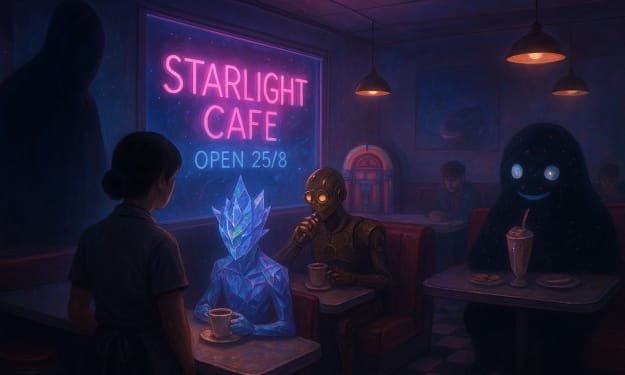
Chapter 1: Morning Haze The neon sign flickered pink and blue: “Starlight Café — Open 25/8.” I wiped the chrome counter again, though it had been cleaned ten times already. The smell of coffee, fried eggs, and synthetic bacon lingered like a warm fog.
By Ai.Pendrake5 months ago in Fiction
How to Succeed at the Benson Directory®
Congratulations and welcome to the Benson Directory® employee #22391! As our newest call handler, you will have the privilege of speaking with dozens of unique and interesting people on a daily basis as well as the opportunity to earn bonuses for high performance. Contained within this handbook you will find a set of ease to follow instructions designed to help you settle in to your new role and begin paving the way to success.
By S. A. Crawford5 days ago in Fiction
The Blueprint
Coffee tastes different when you’re anxious. It takes on a more milky quality, perhaps due to the way your body trembles as it sloshes down your throat. Peter decided to set the coffee aside out of fear his stress would cause him to choke on the drink. He’d been waiting in the cafe for more than an hour. Him and Christie had planned to meet at three in the afternoon but he decided to get there a half hour early. He had been standing around thinking about the meeting since the second he woke up, part of him hoped it would be easier to wait here than his apartment. The suspense was made greater by her constant delays. First five minutes. Then fifteen. Then thirty. Then forty. It was mostly the fault of the public transit system she wasn’t familiar with but with each passing minute the tardiness felt more personal. She had flown in from Denver the night before, the first time he will have seen her in six years.
By Ben Langford7 days ago in Fiction



Comments
There are no comments for this story
Be the first to respond and start the conversation.