
Perhaps she’s pulling over to the side of the road for no reason at all. The trance of driving along midwestern highways, interrupted by the same serendipitous mannerisms with which she had directed the vehicle east towards the city. The way the muscles in her hands flick on the blinker while also turning the wheel slightly: was there actually any kind of direction sent down from the mental penthouse? Procrastination that is entirely corporeal. Which her mind had categorized so immediately as no reason at all. While easing the vehicle into the dusty shoulder of the two-lane highway.
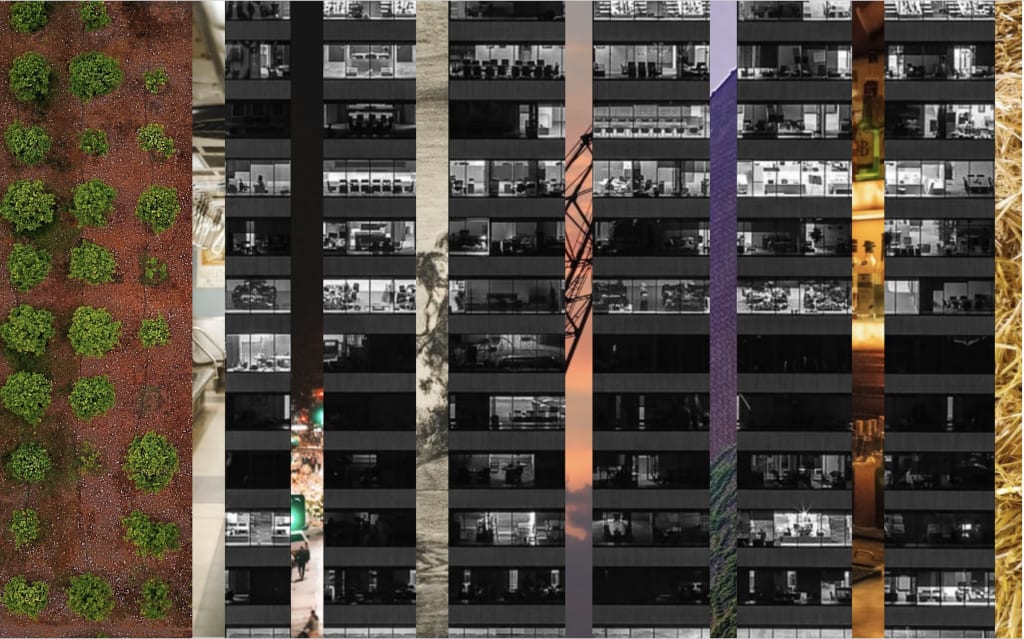
This particular stretch of the road, though. Not an hour ago and not ten miles farther, but right here. Hasn’t she always been curious about the arrangement of orchards? She’s just been driving past acres of prairie sludge, barns so ugly and metallic it looked as if the skyscrapers on the horizon had coughed them up (not the other way around!), and, now, here was an orchard. A reprieve of trees. Their steady, incremental placement. She considers what it is about the context they’ve been freed from (or still cling to dearly) that’s so unsettling. Is it the trees themselves—pears, by the oblong looks of it—whose uniformity, replication, and curtailment feels uncanny, as if they are there only to approximate a synthetic approach to beauty, built by multiplication instead of contrast? No, that’s not it, not exactly: it’s the spaces between them, rather, the long stretches of grass under which invisible roots have ostensibly been subjected to that same urban logic of confinement. Grids of space divvied up just so, whose flat surface is now flush with the sides of the road and perforated accordingly. There’s a sense of gravity to the resultant lanes, whose placement in her vision all feels so excruciatingly incidental. Why did they lift themselves out of the ground at this non-juncture, pull her vision and then her muscles (and then whatever was left) over to the side of this road just to divide up the horizon into fat slices? (The third, actual reason—that they’re there to produce pears that are plucked into boxes shipped on the same roads into the city to feed someone in rooms she will never enter thirty stories up whose workday becomes synecdochic of the gravity she’s already paid attention, that grander mass of metal capital falling upward into the sky until pieces of it begin to fall off like fruit from a tree—all of this bores her.)
So she stands there unsure about the horizon. And unsure about its own incidence: the word horizon being tripled syllabic magic for a slippery local phenomenon, contingent upon the height of the place you stand, the terrain. The weather. Clouds had finally floated back to the northwest, leaving the late afternoon sky. Nice of the sun to spotlight the scene like this from above and behind her. Perhaps she remained pulled over to slow her movement towards its focal point, whose buildings grew up and out and around presumably for her sake—to add to the visual spectacle, silhouetted and tiny upon the crease of the sky. (A mere seed compared to the urban trees to come, maybe?) Driving into the city, let alone going inside any of its buildings, was always so uneventful by comparison. In some ways she’s glad her son had not chased his own tail into a cubicle, up the tree of some nondescript post-collegiate marketing position that she would ask him about tactfully, choosing things to recall for subsequent conversations, subsequent questions. The corporate snakeskin of those spaces bled their meaning dry, and she wondered how susceptible he’d be, if he were to spend all his time there. Susceptible to a rich inner life, that is. Though she can hardly lay claim to that these days. (Would the gargantuan cityscapes of tomorrow—yikes—creep up in neat orchard rows, or was she already staring down a more natural conclusion of frenetic experimentation with the hard materials of property that would itself eventually be erased, sanded down, organized into manifold titanic bureaucracies, concentric layers of wrought chrome littered with doorways and windows, brass canals and light fixtures and acres of multicolored wiring, impossible complexity swelling out into space, tectonic swaths of metropolitanism arcing above and below each other whose grand design prevents the sort of accidents—and their eventual confluence—that create idols, groves, monuments, barns or lighthouses or banks or skyscrapers, in the first place, those impossible places with which she, anyone, might refuse to enter and thus rely upon while orienting her own pendulum swing to and fro, places that do no actually exist, strictly speaking?) Her son had just taken another job at another restaurant, recently, and she considers getting back in the car, resuming the trip to see him, to hear about it, so that she can better see it.
These days she finds it almost painfully vivid to listen to him talk about his uncertainties, to relive the nervousness of her own twenties vicariously. As if she’s watching things happen to him that she has already retroactively categorized as mistakes, wrong turns on the drive. Staying a bit too long at another restaurant gig—hell, a bit too long with another girl, probably. But the trick of it was there was no proper way to name these things for him, no proper way to determine if they would or would not lead somewhere he would like to be. And yet, their lives were composed of, and so, articulated as, logistics, goals, habits, rituals—small talk—accidents. (A future without those greater accidents—of engineering, economics, construction, culture—those fundamentally improper uses of capital, directed exclusively towards some kind of valueless aestheticism—what does progress itself even look like, speaking literally, in terms of physical space, how)—several leaves come loose from one of the pear trees, float down to the ground—(how silly, really, to imagine living outside of that fundamental pull between where they used to be and where they are going.)
Yes, she should get back in the car and drive into the city and pick up the small talk: her friends, his job, how he was feeling off on his own, who she’d seen in town, what they were both watching, whether it was good, whether it was really good, things put off, things done begrudgingly, what they’d noticed en route between routines. (Between nostalgia and anticipation.) Often they both were simply busy, tired from the weight of the workday, and these intervals clogged their conversation, prevented access to a through-line of talk that felt more honest even though it wasn’t. The deeper stuff. About the ways in which they were similar, different, progressing, not. Banalities. Buildings, characters. Things they've learned. The light and clutter of a unique day, or how—(anticipation is lighter than nostalgia, since humans experience time logarithmically, that is, each subsequent day is a smaller percentage of one’s spent time)—how he used to want to study architecture, used to lie on the ground in the house she had driven away from, drawing buildings and birds-eye views of city blocks on graph paper with stencils and graphite, reclined while whole fictional places spilled into the room. She doesn’t know, or care, what she used to want to do, because the moments in which life actually seems to have happened, fully, acutely, the alleged realizations of those dreams—they are always behind or ahead of her. There is no side of the road. (Between what is done and what’s deferred, each—) Between such destinations. (—each day is that much smaller, and since the greater trajectory is directionless, arbitrary, incidental, at least she can find comfort in the palpable acceleration of it all while pondering the notion of starting over.)
She would like to talk about this with him. But she keeps the trees and buildings fixed in her vision while it grows dark, stuck inside for a little longer.
About the Creator
S. J. R.
Based in Chicago, submitting sporadically.


Comments
There are no comments for this story
Be the first to respond and start the conversation.