
What is 3I/ATLAS — and are aliens invading Earth?
The space visitor that “stopped, turned, and vanished” — why NASA isn’t freaking out, and what viral posts are leaving out.
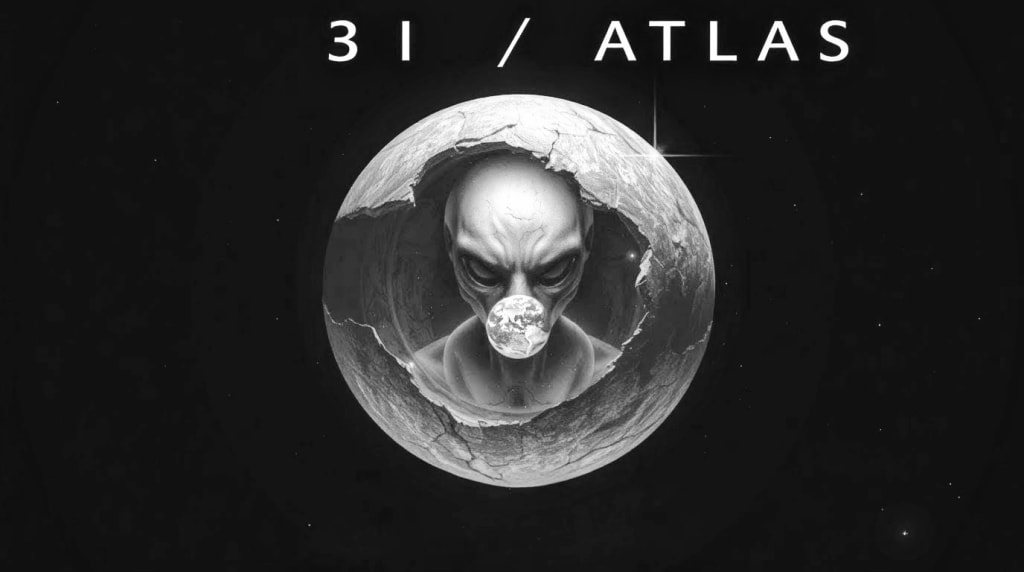
You’ve probably watched a clip: a bright dot in the sky that seems to pause, roll back a little, then flash like metal. Headlines leap from that single frame: “It stopped in space,” “it reversed course,” “governments encrypted alien signals.” Those stories travel fast. But startling captions aren’t the same as evidence. Let’s sit under the same sky and untangle what really happened — without turning curiosity into panic.
At its core, 3I/ATLAS is a comet discovered by the ATLAS survey. Comets are ancient bundles of ice, dust, and rock that become active when sunlight warms them. That activity creates jets of gas and dust, forming a fuzzy coma and often a tail. Those jets behave like tiny thrusters; they can push the nucleus and nudge the orbit. That kind of motion looks dramatic in a short video, but it is a natural, measurable effect — not a clever maneuver.
Why do people suspect a spacecraft? Humans are pattern-seeking animals; we instinctively look for agency. An abrupt brightening, a change in trajectory, or a weird radio blip feels like intention. Add viral videos, selective frames, and commentators who prefer the eerie over the accurate, and a simple, explainable phenomenon becomes a conspiracy overnight.
Let’s address the most common claims with clear language and compassion for anyone who felt alarmed.
Claim: It "braked" and reversed — obvious piloting.
Truth: Outgassing jets produce reactive forces. Over days or weeks those forces change the path just enough to alarm an observer watching a handful of frames. That’s orbital mechanics, not piloting.
Claim: Its flashes are metallic reflections — proof of an artificial hull.
Truth: Comet surfaces are patchy and reflective properties change when fresh ice or dust is exposed. Sunlight striking different materials and the viewing angle can create mirror-like glints. A gleam is dramatic — it is not a certificate of alien engineering.
Claim: Radio signals were recorded and encrypted by powers who hid the news.
Truth: Space is noisy with many natural radio sources; Earth is noisy with human transmissions. Interpreting radio data requires careful calibration, cross-checking, and replication. When something unusual appears, scientists share data and test independently. Extraordinary assertions must rest on reproducible evidence — which, so far, is absent in the public record.
Claim: This is a scouting probe ahead of an invasion.
Truth: That is a hypothesis without supporting evidence. If an extraterrestrial civilization sent a probe with hostile intent, we should expect repeated, unambiguous signatures across multiple telescopes and instruments. Single ambiguous clips multiplied by rumor are not proof of an invasion.
Why do NASA and other institutions sound calm? Because scientific practice favors verification over spectacle. Agencies validate observations, run models, and consult international partners before making high-stakes public claims. That method appears slow compared to a viral post, but it prevents false alarms.
There’s a social truth here, too: fear spreads faster than facts. In the dark, with a dramatic image, our minds leap to the worst. Social platforms reward certainty and emotion; science tolerates ambiguity. That makes science less shareable in the moment, but ultimately more reliable.
So what should you do when you see the next “alien” post? Pause. Save the clip. Check reputable sources — observatory bulletins, scientists with clear credentials, peer-reviewed summaries. Ask whether multiple, independent teams confirmed the same phenomenon. Demand data over dramatic captions.
Don’t mistake skepticism for dismissal. Curiosity drives discovery; skepticism guards us from being fooled. Treat 3I/ATLAS as the marvel it likely is: a messy, living visitor from the outer solar system that will teach us about materials and dynamics from places beyond our neighborhood. It isn’t, by current evidence, a spy craft from an invading fleet.
Remember how comets frightened people centuries ago as omens? Today we have instruments and networks that turn fear into data. Every odd behavior is a clue: jets reveal interior structure, brightenings map composition, and subtle orbital nudges teach dynamics. If you want to help, save timestamps and location, report observations to recognized observatories or astronomy groups, and avoid amplifying claims without sources. Ask for names, data links, and independent confirmations before you repost. Stay curious.
About the Creator
Wellova
I am [Wellova], a horror writer who finds fear in silence and shadows. My stories reveal unseen presences, whispers in the dark, and secrets buried deep—reminding readers that fear is never far, sometimes just behind a door left unopened.
Pandora’s Burden
“My brother warned me to not accept gifts from the one who commissioned you,” said Epimetheus to the woman clad in silvery raiments standing at the entrance to the temple. Her silver tiara and the silver rings on her fingers and toes glinted in the firelight cast by torches set on either side of the doorway. Lingering in the shadows, beyond the reach of the flames as she was, he could not tell what she held in her hands. At first what appeared to be a box was perhaps a funerary urn, or maybe merely an apple.
By J. Otis Haas2 days ago in Fiction


Comments
There are no comments for this story
Be the first to respond and start the conversation.