
What if you could journey through the enigmatic depths of a black hole?
Journey to the Center of a Black Hole
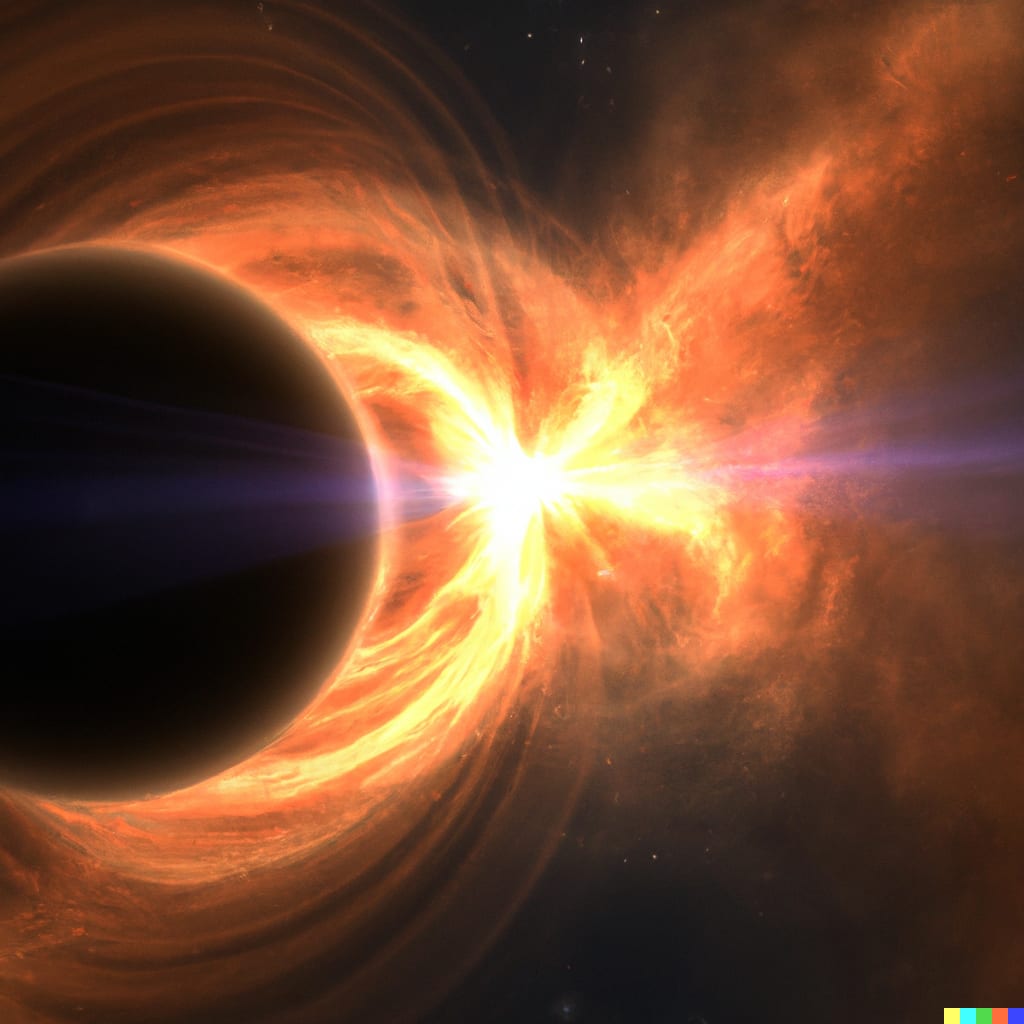
What if you could journey through the enigmatic depths of a black hole? These cosmic marvels, known for their voracious appetite, devouring everything that dares to cross their event horizon, have baffled scientists and astronomers for ages. But what if there was more to these dark behemoths than meets the eye?
To understand a black hole, imagine it as an immensely dense object, packed with mass, so much so that it warps space-time around it. At its heart lies a singularity, an infinitesimally tiny point where all matter is crushed. The more mass crammed into this singularity, the stronger the gravitational pull becomes. Black holes have an event horizon, a point of no return. Once you cross this threshold, there's no escaping its grip, unless, of course, you could travel at the speed of light.
Entering a black hole, you'd be subjected to extreme gravitational forces that could turn you into a cosmic spaghetti, stretching you to your limits. But what if, by some twist of fate, you encountered a charged black hole with an unimaginable surprise? Inside, you'd find not just one event horizon, but two, and within them, a one-way wormhole connecting it to a white hole.
White holes, the antithesis of black holes, don't consume matter; instead, they expel it outward. However, nothing can enter a white hole. If you were to pass through the wormhole before the black hole's gravity shredded you to pieces, you'd embark on a mind-bending journey.
As you plunged deeper into the charged black hole, you'd witness a breathtaking sight of stars twisted around a dark abyss. But before you could relish the view, gravity would seize you, stretching you like an elastic band. But thanks to the wormhole, you'd survive this excruciating process.
Between the two event horizons, a curious illusion would play tricks on your eyes, as the black hole appeared to grow and shrink alternatively. This relativistic beaming effect would make your journey even more surreal. Passing the inner horizon, a sudden burst of blinding light would overwhelm you, reflecting the history of the entire Universe.
Yet, your odyssey was far from over. The wormhole would teeter on the brink of collapse due to the immense gravitational forces, putting your life in jeopardy. As you passed through the second event horizon, you'd be treated to another burst of light, but this time, it would reveal glimpses of the Universe's future.
Finally, you'd emerge from the white hole, leaving our known Universe behind. Entering an entirely new realm, you'd face a myriad of possibilities. This parallel Universe could operate on entirely different laws of physics, gravity might behave differently, and the fundamental particles of matter could be entirely distinct.
Your journey through the black hole would be an unparalleled adventure, a once-in-a-lifetime exploration of cosmic wonders. But beware, in this new Universe, danger could lurk, and returning home might be impossible. Nevertheless, as the intrepid traveler who dared to traverse a black hole, you'd be forever remembered as the first to venture into the great unknown.
- These are just a few of the many fascinating facts about black holes. These mysterious objects continue to be a source of wonder and speculation for scientists and laypeople alike. Who knows what other secrets they may hold?
- Black holes are so dense that a single teaspoon of matter from a black hole would weigh billions of tons on Earth.
- The event horizon of a black hole is the point of no return. Once you cross it, there's no escaping the black hole's gravity.
- The smallest black holes are about the size of an atom, while the largest black holes are billions of times the mass of the sun.
- Black holes are thought to be the remnants of dead stars.
- Black holes can emit radiation, which is called Hawking radiation.
- Black holes may be gateways to other universes.
About the Creator
Keep reading
More stories from ANUJ KUMAR and writers in Fiction and other communities.
🅼🅸🅳🅽🅸🅶🅷🆃 🆂🅽🅰🅲🅺🆂
"It's 10 in Tuscon! We all know what that means... It's Time for Midnight Snacks with your man, Gerald Gee! Ready to spend the night together? Me too! I'm full of snacks and can't wait to regurgitate them all back into your hungry ears. Crack a brew! Pop some corn! Anything to get ready for one hell of a show where the talk maybe cheap but the words cut deep...
By Lamar Wiggins3 days ago in Fiction
What are we doing here?
"Will you just talk to me?" Mark begged, as his ceiling fan completed lazy, insistent revolutions. He watched as a fly— he couldn’t say when it had arrived— performed small frantic circles in the air before settling on the nightstand beside him. It groomed its front legs. Such fastidiousness in something so fundamentally unclean.
By Sandor Szabo7 days ago in Fiction


Comments
There are no comments for this story
Be the first to respond and start the conversation.