
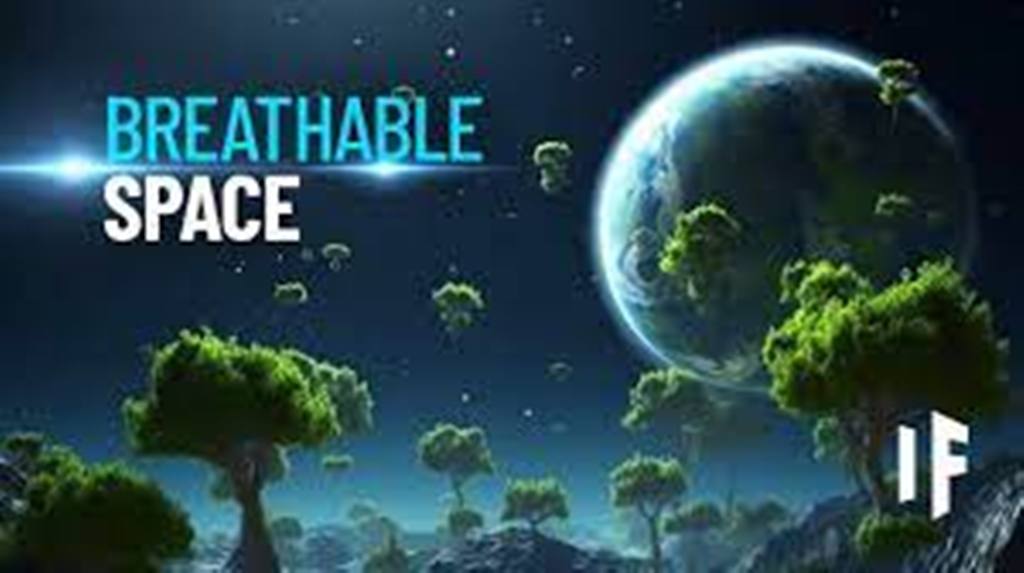
Imagine being on a routine Space Walk when your helmet unexpectedly becomes loose. Instead of suffocating, you find yourself breathing in fresh cosmic air. But what would happen if outer space was breathable? Would the breathable atmosphere reach far and wide? Why would space suddenly become so loud? And could this lead to the destruction of the entire solar system?
On Earth, our atmosphere consists of 78% nitrogen, 21% oxygen, and trace amounts of other gases. However, beyond the approximately 10,000 kilometers that the Earth's atmosphere extends, molecular oxygen becomes rare. In space, oxygen atoms combine with space dust and react with hydrogen atoms to form water ice instead of molecular oxygen.
But let's imagine a scenario where breathable air exists all the way to the edges of the heliosphere, which is the boundary where the Sun's gravity is less dominant compared to other stars. Would this expansive atmosphere allow us to travel anywhere in space and breathe like we do on Earth?
If outer space became breathable, there would be significant changes. One notable change would be the ability to hear sounds in space. In the vacuum of space, sound cannot travel due to the lack of molecules to carry sound waves. However, in a space atmosphere, sound waves could travel great distances, enabling us to hear the Sun and other planets. The Sun, constantly vibrating at different frequencies, would be incredibly loud, even at the great distance between it and the Earth's surface. It would reach our ears at a volume of 125 decibels, comparable to thousands of police sirens.
However, the newfound atmosphere in space would also bring substantial challenges. In the vacuum of space, there is no friction, allowing planets and moons to orbit the Sun without losing speed. But with the introduction of air particles, the planets would start colliding with them at high speeds. The Earth, for instance, would experience the same fate as asteroids entering our atmosphere, heating up and burning. The resulting friction would leave the Earth's surface scorched.
Furthermore, the moon's orbit would gradually slow down until it comes to a complete stop, pulled closer by Earth's gravity. This would ultimately lead to a catastrophic collision between the Earth and the moon. The impact would tear the Earth apart, resulting in the destruction of the entire planet.
The rest of the solar system would also suffer from the newfound atmosphere. With such a vast amount of air, our solar system could potentially collapse into a black hole. This is because the mass of the air would be significant, especially considering the heliosphere's radius spanning 90 astronomical units. If all that mass compressed towards the Sun due to its gravitational pull, the solar system would become increasingly dense. In this scenario, if all the air compressed into a space about 80% of the Earth's diameter, a black hole would be formed. This black hole would be approximately 1,200 times more massive than the supermassive black hole in the center of the Milky Way.
At this point, it's unlikely that anyone would survive, including you and me. It's probably for the best because if we were still alive, we would witness the collision of these two gravitational monsters. But that's a story for another time.
In summary, if outer space were breathable, it would have profound consequences. While it may offer the ability to hear sounds in space, the introduction of an atmosphere would lead to planetary collisions, the destruction of the Earth, and the potential transformation of our solar system into a black hole.
About the Creator
Minu Singh
My name is Minu Singh, and I am delighted to share my passion for writing an articles . As an avid writer, I aim to engage and captivate my readers, taking them on a journey of knowledge, inspiration, and thought-provoking perspectives.
Keep reading
More stories from Minu Singh and writers in Fiction and other communities.
"The Quantum Quandary: A Leap into Uncharted Realities"
In a world teeming with technological marvels and scientific breakthroughs, humanity finds itself on the precipice of a quantum revolution. As the boundaries of conventional reality blur, a new era dawns—one where the possibilities seem both infinite and unfathomable.
By Minu Singh3 years ago in Fiction
The Devil's Cut
“Comrade, finally you’re awake.” The voice was smooth, sensual. A flickering incandescent bar was all that lit the white, sterile room. All Vladimir remembered was everything going black. He tried to move his arms and found them strapped to the gurney.
By Matthew J. Fromm3 days ago in Fiction
The Hollow Hunt
Every year, the small town of Willowcreek hosted its beloved Easter egg hunt in the sprawling meadow near the woods. Families would gather, baskets in hand, to search for the brightly colored eggs hidden among the grass and trees. It was a cherished tradition, a wholesome event that brought the community together. But this year, something was different.
By V-Ink Storiesabout 23 hours ago in Fiction


Comments
There are no comments for this story
Be the first to respond and start the conversation.