
What If Columbus Hadn’t Discovered America?
Europe Without the “New World”

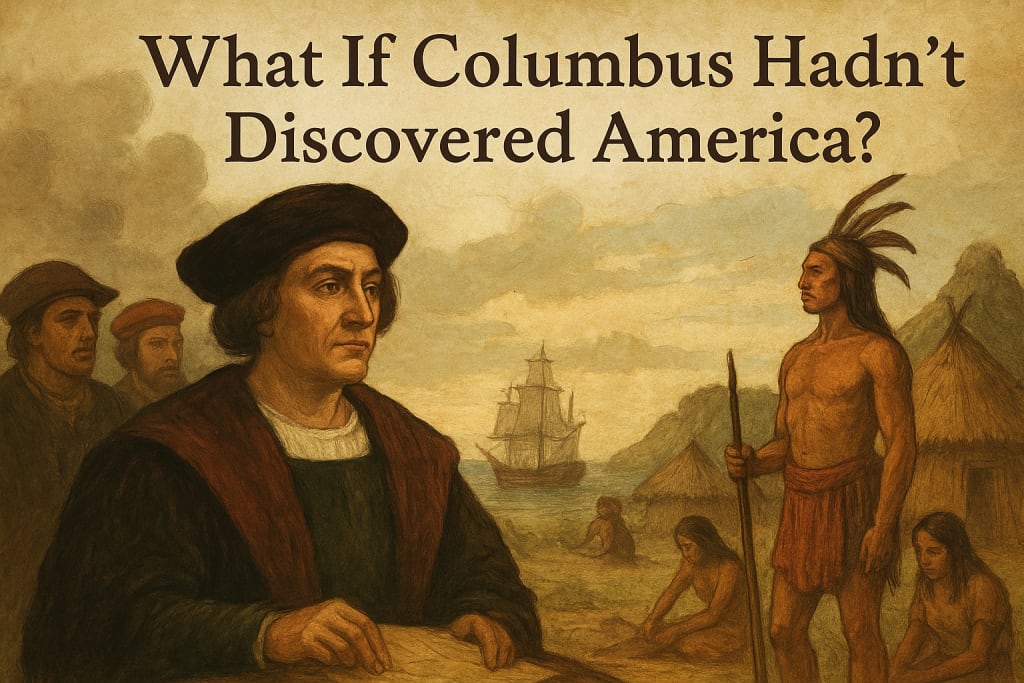
Human history is filled with turning points — those moments when a single decision, event, or discovery changes the course of the world forever. One of the most important of these moments was, without a doubt, the year 1492, when Christopher Columbus reached the shores of the New World, opening an entirely new chapter in global history.
But let us imagine, for a moment, that this journey never happened — or that it failed. What would have happened if Columbus had not discovered America?
1. Europe Without the “New World” – A Continent Trapped Within Old Borders
Before 1492, Europe was already vibrant and restless. Great kingdoms were competing for power, trade with the East was immensely profitable, and the Renaissance was transforming the European mindset. Yet, the lack of direct routes to Asia was a major problem. The overland path to the East, controlled by the Ottoman Empire, was both dangerous and expensive. Finding a sea route to the wealthy Indies was the dream of every monarch.
If Columbus had not embarked on his expedition, Europe would likely have continued searching for alternative routes to Asia. The Portuguese, already exploring the African coast, would have maintained a decisive advantage. Vasco da Gama — or another Portuguese navigator — would probably have discovered the sea route to India (as he indeed did in 1498), securing Portugal’s maritime dominance for much longer. Without the discovery of America, Portugal might have remained the world’s leading trading empire.
2. The Fate of Indigenous Peoples – Another Destiny for Another Continent
One of the most tragic chapters in American history concerns the fate of its indigenous peoples. Following the Europeans’ arrival, millions of Native Americans died from diseases brought from Europe, warfare, and forced colonization.
If Columbus had not discovered America, these civilizations — Aztec, Maya, Inca, and many others — might have had the chance to continue evolving without foreign interference.
These societies were far from primitive, as was once believed. The Aztecs and Incas had complex governments, impressive architecture, advanced agriculture, and rich cultural traditions. In an alternate world, without Columbus, these civilizations might have continued to innovate and perhaps even made contact with other continents on their own terms. Humanity would have inherited a far greater cultural diversity, and the global balance of power would have been completely different.
3. The Wealth of the Americas – Gold, Silver, and a Delayed Economic Revolution
The discovery of America brought Europe unimaginable wealth. Massive quantities of gold and silver extracted from South American mines transformed the economies of Spain and Portugal and contributed to the birth of early capitalism.
Without these resources, Europe’s economic development would have been much slower.
The Industrial Revolution might have been delayed by decades or even centuries. The lack of raw materials, precious metals, and new markets would have restricted Europe’s economic expansion. At the same time, the transatlantic slave trade — one of history’s darkest consequences of colonization — might never have occurred, giving Africa a completely different historical path.
4. America Discovered Later – Who Would Have Been the “New Columbus”?
Historians generally agree that the New World would eventually have been discovered. Advances in navigation, scientific curiosity, and Europe’s desire for expansion made it inevitable. The real question is: who would have been the one to make that discovery?
There are theories that northern explorers like the Vikings, led by Leif Erikson, had already reached North America centuries earlier — but never colonized it. In an alternate timeline, perhaps the English, French, or Dutch would have discovered America in the 16th or 17th century. Colonization would then have taken a very different shape — more commercial, more organized, and perhaps less violent.
If the English had been the first, for instance, the colonies might have been based more on trade and development rather than resource extraction and indigenous exploitation. America could have become a model of cultural coexistence instead of a battlefield for gold and power.
5. Religion, Culture, and Science – Another Face of Globalization
The discovery of America accelerated globalization and the spread of Christianity. Catholic missions, funded by Spain and Portugal, converted millions to the new faith. Without this contact, Christianity would likely have remained mostly a Eurasian religion. Meanwhile, native spiritual systems would have survived, enriching humanity’s spiritual diversity.
On the other hand, European science would have evolved differently. Without the flora, fauna, and resources of the Americas, botany, medicine, and geography would have developed more slowly. The scientific curiosity that fueled the Enlightenment was often sparked by the wonders of the newly discovered world — unknown plants, exotic animals, and unfamiliar peoples. Without America, the great scientific revolutions of the 17th and 18th centuries might have been postponed.
6. A World Without the United States – Major Geopolitical Consequences
Perhaps the most dramatic change would be the absence of the United States. Without the discovery and colonization of America, there would have been no American Revolution — and no modern concept of democracy as we know it today. The world would have lacked one of its most influential nations.
Without the USA, the global balance of power would be entirely different. Europe would likely have continued to dominate world affairs, and the great struggles for colonies might have centered on Asia and Africa instead. The British Empire could have become even stronger, or perhaps Russia would have expanded its influence to the Pacific.
Without America, World War II might have ended differently — and the Cold War, in its current form, might never have existed.
7.A World Without the American Dream
The discovery and colonization of America profoundly shaped global culture. American music, cinema, literature, and art became universal references. Without this influence, the world would have remained anchored in European traditions. Paris, London, and Rome would have continued as the main cultural capitals, and concepts like individual freedom, personal ambition, and social mobility — embodied by the “American Dream” — might never have become global ideals.
In a world without America, collective and traditional values would likely have remained dominant. Individualism, innovation, and economic freedom — key elements of the American spirit — would have taken much longer to spread across the globe.
8. Between Myth and Reality
If Columbus had not discovered America, human history would have been profoundly different. Europe would have remained isolated for longer; economic and scientific progress would have been slower; and today’s geopolitical balance would be unrecognizable. Yet, the discovery of America was not an isolated event but rather the result of an inevitable human drive — curiosity and expansion. Even without Columbus, someone else would eventually have taken that leap.
History cannot be rewritten, but we can learn from it. Columbus’s journey brought both progress and tragedy. It opened new horizons, but it also destroyed entire civilizations. Perhaps the most important lesson is that every great discovery comes at a price.
And the question is not only “What if Columbus hadn’t discovered America?”, but also “What have we learned, as humanity, from the fact that he did?”
About the Creator
Nyku Blondu
📚 I enjoy exploring a wide range of topics – from personal reflections and inspiration to culture, art, and everyday life.
✍️ I believe in the power of words to connect people and awaken emotions.
Keep reading
More stories from Nyku Blondu and writers in Fiction and other communities.
The Last Voice Message from Her
I hadn’t touched her phone in months. It sat there on the nightstand, battery dead, like something sacred and forbidden. Sometimes I looked at it the way one looks at an artifact — a time capsule holding everything I couldn’t bear to face.
By Nyku Blondu5 months ago in Fiction
Bomb Scare
It was 2027, and the world never thought it would happen. A missle hit the United States, but it wasn't where they had anticipated. A little town in the northeast was hit by a missile strike, they didn't know why, and they didn't know exactly where it hit, but they did know it was a coastal community, somewhere between Maine and Delaware.
By Gregory Payton7 days ago in Fiction
A Toast to Love… and Selective Memory
Everyone, please join me in toasting Claire and Nathan. Claire, you’ve always been the family’s golden girl, smart, kind, and impossibly patient, if a little naive. Nathan, you lucky man, you’ve won the jackpot. I still remember the night you told me, eyes shining, “She’s the one I’ve been looking for my whole life.” Of course, that was six months before you met Claire, but hey, let's not quibble over details. Love rewrites history, doesn’t it? May your story be the version you tell your grandchildren, the polished, approved one. To the beautiful lie we all choose to believe. Cheers!
By Diane Foster2 days ago in Fiction




Comments
There are no comments for this story
Be the first to respond and start the conversation.