

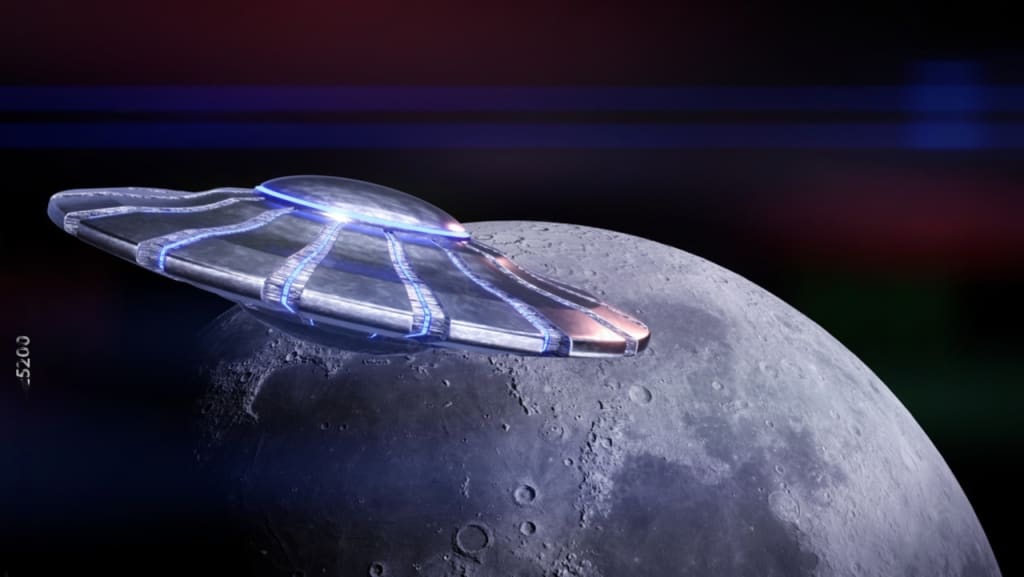
What if the moon was more than just a lifeless rock? Concealed beneath its radiant glow, there could be an alien civilization lurking in the shadows. When did this extraterrestrial life come into existence on the moon, and what would these lunar inhabitants require to sustain themselves? This is another what if and here's what would unfold if aliens actually lived on the moon.
Before Galileo's telescope revolutionized our understanding, the moon was merely a bright and shiny object in the night sky. Despite advancements, the moon's origins still remain shrouded in mystery. Some scientists hypothesize that approximately 4.5 billion years ago, a fragment broke off from Earth due to a cataclysmic collision with another celestial body. Over time, the debris coalesced, giving birth to the moon as we know it.
The historic moon landing in 1969, besides inspiring humanity to aspire to the stars, also made this celestial body tangible to people worldwide. However, our visit was brief, leaving room for the possibility that the astronauts may have missed something significant up there.
If we overlooked signs of life, it wouldn't be the first time humans have disregarded the bigger picture. Let's be honest—climate change is an undeniable reality, and its consequences are only worsening. The warming temperatures and rising sea levels contribute to the severity of deadly hurricanes. Since 2020, a dozen insurance companies in Florida have gone bankrupt, leaving policyholders uncertain about receiving aid for post-storm recovery.
What can be done? Presently, the most practical approach is to limit the damage at home through initiatives like the Inflation Reduction Act. This legislation allocates over nine billion dollars to provide rebates covering up to 100% of the cost for installing energy-efficient technologies such as solar panels, battery storage, and heat pumps. It also imposes penalties on methane leaks and introduces royalties on oil and gas extraction, pressuring major polluters like the fossil fuel industry. Failing to take concerted action now may render our planet as barren as the moon.
Living on the lunar surface is a harsh endeavor. Without an atmosphere, there is no shielding from the sun's radiation, nor a means to retain oxygen on the ground. However, it's possible that conditions were different in the past. Following the breakaway from Earth, microscopic life forms, such as cyanobacteria, might have survived in this inhospitable environment. This theory, known as panspermia, suggests that life can be transferred through meteoroids, asteroids, or even spacecraft. Considering the moon's position within the habitable zone, billions of years ago, it could have harbored fresh water and experienced volcanic activity that released the necessary gases to sustain life.
So, why isn't there life on the moon now? Well, who's to say there isn't? During the existence of these conditions, the moon could have nurtured life for hundreds of millions of years before humans even emerged on Earth. While dinosaurs roamed our planet, the moon might have been teeming with life forms far stranger than those behemoths.
Unlike Earth, the moon's magnetic field is significantly weaker. Over millions of years, solar winds would have stripped away any atmosphere it once possessed. Without atmospheric protection, surface-dwelling life would have had to adapt to survive the sun's intense rays. On Earth, melanin in our skin shields us from harmful ultraviolet radiation. However, instead of developing darker skin tones, moon aliens might have evolved different pigments, such as carotenoids found in vegetables like carrots. These organic pigments contain cells that protect against skin cancer. Therefore, these extraterrestrial beings may possess tough, orange-hued skin that resists the dangerous UV rays enveloping them.
The differences don't end there. With the moon's gravity only one-sixth that of Earth's, these aliens could navigate by jumping or gliding. But without an atmosphere to retain oxygen on the surface, what would these creatures breathe? Even with an atmosphere one-hundredth as thin as ours, life could still exist. Recent discoveries have revealed the existence of parasites that can survive without oxygen. Over millions of years, these moon aliens might have evolved to live without the need for respiration as we understand it.
While surface-dwelling life could exhibit an array of diversity, the same cannot be said for lunar oceans—assuming they exist. The average depth of Earth's oceans is around 3.7 kilometers, whereas the lunar seas would have a mere depth of one kilometer. Consequently, these waters would be relatively barren.
If life did exist on the moon, how would it have impacted our history? If these aliens had evolved prior to humanity, they might have visited our planet before we ever set foot on the moon. Alternatively, if they had arrived after the space race, the escalating tensions of the Cold War might never have transpired. Instead, humans would have united in fear of an invasion by a more advanced life form. Global militaries would have deployed countermeasures to assess the potential threats posed by these extraterrestrial visitors. Scientists and politicians would strive to establish communication, while the general populace would brace for the worst.
Sharing our corner of the solar system with a vastly superior civilization could be overwhelming. However, it would present a choice between peaceful coexistence and all-out war. Considering the advanced nature of these aliens, a peaceful resolution would likely be more beneficial. Perhaps over time, our two species could even merge and become one.
Now, if we were to take it to the extreme and consider interbreeding with an alien, well, that's a story for another intriguing "What If" episode.
About the Creator
Keep reading
More stories from Kingtricks and writers in Fiction and other communities.
What If You Drank Only Water for the Rest of Your Life?
Have you ever come across the concept of water fasting? It's a unique fasting approach that involves restricting your diet to solely water consumption, excluding any other forms of food. While most people who engage in water fasting limit it to a maximum of 72 hours, let's delve into the hypothetical scenario of practicing this for the entirety of your life. Would you be able to sustain yourself on water alone? Well, the answer is far from affirmative.
By Kingtricks3 years ago in Fiction
The Last Glitch Walker
Ethan Ward had always been a geek—proudly, unapologetically, and fiercely. While other kids in his Birmingham neighborhood played football in the streets, Ethan was inside building his first computer from scrap parts his uncle gave him. By the time he turned twenty-five, he had a full-time remote job, three monitors on his desk, a collection of retro consoles, and a habit of drinking more energy drinks than water. His friends joked that he lived more online than in reality. And they were mostly right.
By Iazaz hussain6 days ago in Fiction




Comments
There are no comments for this story
Be the first to respond and start the conversation.