
What Happy Feels Like
The sky above, the wind below...

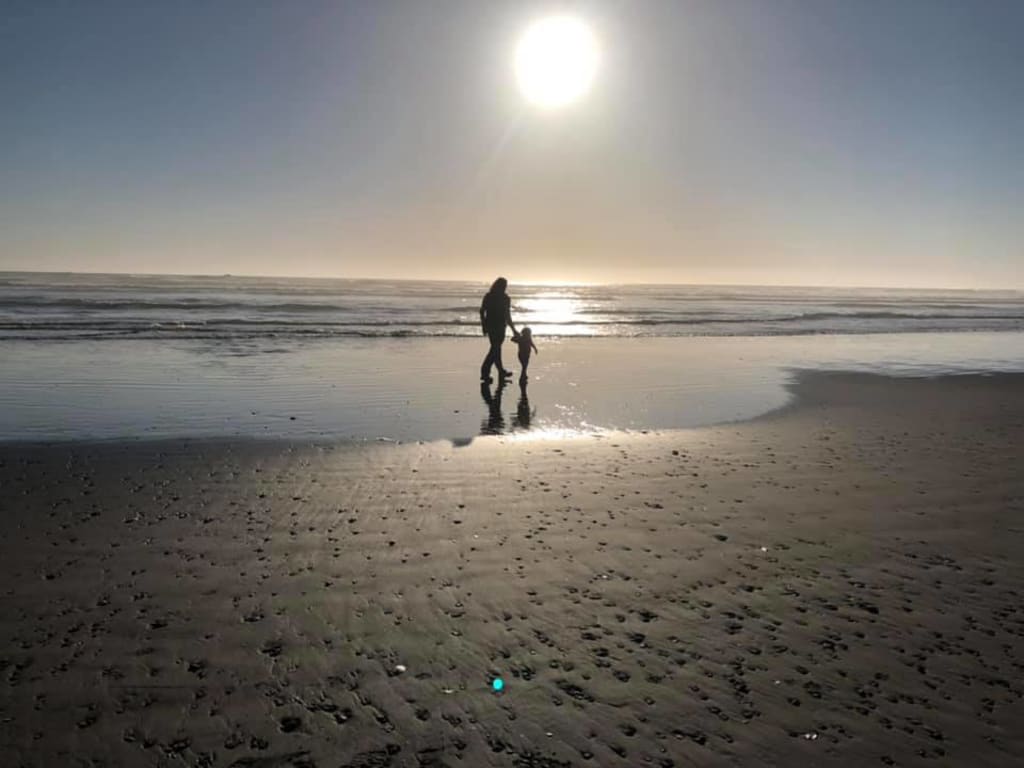
Oscar does not speak often about his childhood. When asked about his family, he often shrugs or changes the subject. It’s not so much that he is ashamed. He just realizes that people don’t really want to know the truth. They don’t care much about his story, and he doesn’t really have the answers to the things they want to hear.
Why did your mom abandon you?
Why were you never adopted?
What’s wrong with you?
Growing up in foster care, it wasn’t all bad. There are some good memories. And the bad isn’t worth sharing. But mostly, the reason why he doesn’t like to share these experiences it because of the way it makes him feel physically.
His back begins to tighten. His throat constricts. His skin literally tingles, and a deep pressure returns to his belly.
The first time he felt this way he was about six years old. Or maybe it was seven. It all blurs together. He told his Foster Mom at the time… Miss Tonya? Or maybe it was the nurse at school. Either way, he remembers sitting on the cold table, letting his feet bounce off the hard surface as he waited. The doctor poked and pressed on his belly. Made him breathe in and out. Pressed and prodded some more before saying that there was nothing wrong with him.
“He is obviously in pain,” Tonya (or was it, Sonya?) told the doctor.
“It very well could be psychosomatic,” the doctor said, lowering his voice to a whisper before asking about his history. They would turn away from him and although he couldn’t hear the words, they gave him the look that he would grow to hate. Pity.
This aching feeling stayed with him for most of his life. And the doctor was right. It was psychosomatic.
This is what it feels like when you long to be touched.
In foster care, touch was forbidden. Hugs were against the rules. This is obviously a rational measure to protect a child from sexual abuse. Give the control to the child, they say. Caregivers need to be cognizant of children who have experienced trauma and neglect.
Sure.
Yes.
But…
For the child who has fallen off his bike. Who was made fun of during school. Who is told that no one loves him and his mom gave him away. Who is still afraid of the dark. Who feels alone and all that he wants is a momentary embrace, a high five or fist bump does not suffice.
Oscar doesn’t remember much about living with the woman he thought was grandmother before he went into the system. Most of the memories have faded and he sometimes wonders if it might really be a dream, or a scene he saw in some movie. He can no longer remember her face, or many details of the house. But some memories still linger.
His would-be grandmother’s long and hearty laughter that would make her whole body shake. The smell of lilacs. The low groan of his assumed grandfather as she moved him from the wheelchair into his bed. Hot sausages with mustard. But most of all, her hugs.
Esmerelda would reach down and wrap her arms around his toddler frame and in one scoop, would lift him up pressing him gently into her large bosom. He would wrap one arm around her neck, the other around her body, nestling his head in the crook of her neck as she swayed from side to side, singing in his ear.
My Oscar, my love. The sky above, the wind below my Oscar. My Oscar, my love, the sun shines on, the rain falls on my Oscar. My Oscar, all my love and all my pain, my Oscar.
Sometimes she would hug him so tight he would almost lose his breath. But he did not panic, he would just whisper in her ear. “Too much love Gamma. Too much.”
She would gently release her squeeze, whispering, “Never too much my love. Put it in your pocket and save it for tomorrow.”
This feeling of complete warmth is the only safety he ever knew. For years, he tried unsuccessfully to recreate this sensation.
He’d lay in the center of a blanket, then roll until he was wrapped tightly like a burrito. He would take as many pillows as he could find and create a soft nest, and then bury himself into it. He hugged trees. Stuffed animals. There was some small relief, but none had the breath on the neck. The humming in the ear. The sway.
He finally accepted the fact that this would only remain a memory. Then the aching began.
Oscar doesn’t remember exactly when he went into foster care. He doesn’t remember them telling him what happened to Esmerelda. They must have, right? But he has no memory of it. One day he was watching Sesame Street on her plastic-covered couch, the next he is sitting on a pink-flowered carpet in a strange living room. Two pig-tailed girls stared at him from the doorway, whispering to each other.
Years later, he read in his file that his grandmother had a stroke. And she wasn’t his grandmother, just a kind neighbor who watched him when his mother disappeared. After the stroke, she went into an inpatient rehab facility, then died a month later. He was four years old.
The days blur together. The years blur. One family and then the next. Then a social worker would show up. He never recalled a reason mentioned. It was just time to go.
It was nothing to get upset about.
At a certain point along this journey, Oscar made peace with the fact that he needed to take care of himself. He developed his own guidelines for survival.
Wash your bowl.
Pour out the remaining milk carefully in the sink. Don’t spill.
Gently wipe the crumbs into your hand so they don’t fall on the floor.
Brush your teeth before they ask you to.
Nod occasionally when an adult is speaking to you. Even if you are not listening, this makes them feel heard and the conversation will end sooner.
Don’t talk back unless they ask you a direct question.
Take the bed closest to the window.
Say thank you after every meal.
Nod when they say you should be grateful.
Make friends with the dog.
Find the library in town and learn all the names of all the librarians.
Find the nosiest neighbor on the block and offer to mow their lawn. They will spread the word what a “nice young man” you are and soon you’ll have extra cash and a way to keep busy.
When he was 14, Oscar was helping a neighbor clean out his garage and found an old 10-speed. The frame looked in pretty good shape, but the seat was torn, axle cones were damaged, and the spokes were corroded. Oscar asked if he could buy it, but the neighbor just laughed and said he could take it and even threw in a bike pump, an old cable cutter, and some other tools.
Over the next few months, he slowly collected the parts needed to rebuild the bike. All the money he earned from mowing lawns and random yard work were saved.
Poppa Chris, his foster dad at the time, was so impressed by his dedication he offered to buy him a new bike, said it would probably be easier. Oscar politely declined.
He had a sense of purpose. This was his bike, the only thing not given to him, and it could not be taken away. If he could get just a few more gigs, he’d be able to buy the last parts needed.
The next day, the phone rang three times.
On that first ride, Oscar felt a freedom that he did not know was possible. He rode farther than he ever had, away from his residence, exploring the town he thought he knew. He rode until his legs burned with exhaustion, then pushed through, challenging himself to climb to the top of a hill that overlooked the city.
Scanning the view, he found the house that was currently his home. The school he was finally getting used to. This must be what happy feels like.
As he prepared to head back down, the hill seemed steeper than it appeared on the way up. He lightly squeezed his brakes as if he knew how to test them. Then he pushed off and headed down the hill.
He picked up speed faster than expected but kept his eyes ahead looking for rocks and potholes on the ground. Then something happened. The tension he had been carrying for so long slowly began to leave his body. His breath, that he always seemed to be holding, steadied and his jaw was no longer clenched. His shoulders dropped, the bend of his elbows softened, and his feet found a firm stance on his pedals. The wind that was previously at his back, whipped across the face and around his body.
He rode with ease, as the wind whispered in his ear, Oscar my love, the sky above, the wind below my Oscar.
This bike changed everything.
After a bit of convincing, Poppa Chris let him ride his bike to school. He began repairing other kids bikes and made new friends along the way. He found the larger library on the other side of town that not only had more computers but gave out passes to the museum.
He frequented the local bike shop so often, the owner, an old punk named Vic, eventually offered him a job.
When it was time to go to a new home—Poppa Chris had to relocate to Arizona, so he didn’t really have a choice—his new foster family lived close by. Same school, same job. After graduation, Vic offered Oscar the studio apartment above the shop. To stay in extended care, the apartment had to be approved by his social worker du jour and he barely slept until he got the okay. Having a job, a history of saving money, all these things helped in his favor.
The studio was small but perfect for him. There was a kitchenette with a two-burner stove, microwave, and half-fridge. By the window, there was a small table with two wooden chairs with chipped blue paint. In the opposite corner, a full-size futon, and a nightstand with stacks of books. There was no tub, but he only took showers so didn’t mind much. There was no TV, but Vic left him his old laptop so he could watch movies. He also had a turntable so he could bring all the records he wanted up from the shop. And it was close to the University and cheaper than the dorms.
Growing up being shuttled from home to home, the main complaint he had was how loud it was. He felt like a prisoner to the voices, creaking floors, and slamming doors that seemed to be constant. He longed for silence.
But now his favorite thing to do was sit and stare out the window of his apartment listening to the noises of the neighborhood. The random honk. Scattered laughter. Floating voices from the street below. The birds in the morning. There was no such thing as silence. The challenge is being quiet enough to hear the world around you.
People often asked if he was lonely living alone. But he found it comforting. No more pretending. No more waiting for someone to choose you. He had what he needed. A job. An apartment. Vic. A quiet place to read and study. Life was good.
Time went by quickly but no longer felt like a blur. He graduated with a degree in Computer Science and accepted a full-time job as a Software Developer at a start-up downtown. Vic let him keep the apartment even though he would no longer be working in the shop, but with his new salary he’d have no problem paying rent.
On his first day, Oscar decides to head out early for his morning commute. Although the rain has stopped, both the air and ground are cold and damp, as he whips down the bike path that cuts through the neighborhood.
As the bike path merges onto the street, he slows down but doesn’t completely stop, continuing in the designated bike lane. Cars and busses zip closely past him, but he keeps his pace around the curve and over the bridge. He signals, then carefully maneuvers into the left lane, and is joined by a few other cyclists as they wait for the light to turn green.
When the light changes, he swiftly pushes ahead of the other bikes, turning left. As he crosses the intersection, a car running the red light strikes him head-on. Oscar is thrown from his bike through the air.
All light is gone.
Streaks of blue, white, pink, and green zip past him as he floats in a current of moving light.
He tries gain some control by pushing his arms down beside him in a waving motion. This seems to help as he begins to level out. He repeats the motion again, reaching into the color light.
His speed seems to slow. He squints at what appears to be a figure moving toward him.
“Hello…” he tries to call out but only hears a hollow echo.
The figure moves closer. At first, he is relieved but then a sense of panic forms as he continues forward beyond his control. He flutters his legs like he’s treading water and waves his arms around him. As the figure moves closer, Oscar realizes it is making a steady stride. He stops fluttering and begins bobbing in one place. He tries to make a walking motion but can’t find traction. He pauses, tries to calm himself, then begins motioning his legs as if he’s riding a bike. He continues forward in a steady but controlled pace.
The figure is now in sight. Although he cannot make out his face, it’s clearly the shape of a man. Oscar hears a voice which seems to come from within. “Now you’ve got the hang of it. Keep moving toward the light.”
Oscar looks back over his shoulder, but the tunnel makes a sharp curve so he can longer see the figure. He continues forward, now upright, but growing more anxious as the lights dim.
Around the next curve, the current slows, and he can now stand. There is a glowing bright light up ahead and he can see other moving figures disappearing into the wall of light. He walks slowly and cautiously toward the source.
Behind him more figures are approaching. Oscar notices an older woman who seems to be struggling to get her footing. He moves toward her and offers her a hand.
“It’s okay. You can stand now.” Oscar is surprised by the sound of his own voice.
The elderly woman is wearing a yellow cotton gown and her long white hair is gathered in a single braid. As she takes his hand, Oscar swears he sees a tiny girl jumping rope on her illuminated palm. “Are you an angel?” she asks.
“Far from it.” Oscar laughs and helps her forward toward the light wall. As they get closer, they hear waves of motion and muted voices. The light is extremely bright yet not blinding. Soft and inviting, like a cumulus cloud, but shimmering like the static of a television screen.
Oscars pauses for a moment, but the woman drops his hand and walks through without hesitation. He follows her in and disappears in the light.
Oscar is startled to find himself standing in the middle of the saltwater flats surrounded by people. He looks behind him and realizes he is on the other side of the light wall.
He is no longer wearing his rain gear, just a white cotton shirt and jeans.
He looks down and he can see his bare feet through the shallow water in the bright white sand. He no longer appears to be glowing.
He scans the beach around him. A man and woman kiss passionately. Three men who appear to be brothers are hugging and singing and crying simultaneously. Twin sisters hold hands staring deep into their counterparts’ eyes.
Just ahead, he can see the old woman he assisted being comforted by a man as he guides her toward the shore. Her long hair, which now seems blonder with streaks of white, is no longer in a braid and flows in waves as she walks. She seems to be standing taller, no longer struggling to walk.
Oscar walks slowly toward the shore, confused, looking around, not sure what to do. He notices a tall man wearing a white kaftan scanning the beach, with a young woman standing behind him. She points in his direction.
Oscar looks behind him to see who she might be pointing out. As he looks back, the man is now waving to him over, and walking in his direction.
Reluctantly, he walks toward them.
Once in earshot, the man calls out “Hello, Oscar.”
About the Creator
Chelbeerocks
Storyteller living in the PNW. Video producer/designer by day, writer at all other waking moments.
Keep reading
More stories from Chelbeerocks and writers in Fiction and other communities.
P.S. I Love You
When I was a child I was an avid reader. I would ride my bike to the bookmobile and fill up the basket with as many books that would fit. After I read every book in that traveling mobile (my mother didn’t believe me at first but after pulling random books off the shelf to test me), she would drop me off at the library each weekend where I would stay for hours. I read thousands of books and remember these stories like old friends and the adventures feel as if they were my own journeys. There is one story that has always stuck with me, but I can’t remember the title of the book
By Chelbeerocks5 years ago in Fiction
The Path to Salvation
The late autumn evening air filled the monk's lungs, but it wasn't the season that chilled his bones. The heavy-handed presence of evil he had sensed upon entering the woods surrounding this mountain village had not bothered to conceal itself from him.
By Made in DNA7 days ago in Fiction


Comments
There are no comments for this story
Be the first to respond and start the conversation.