
Webb Telescope Reveals Astronomers Got It All Wrong About This Dying Planet
New findings flip a previous theory of a planet's end on its head.
Astronomers using NASA’s James Webb Space Telescope just gave a cosmic mystery a serious plot twist.
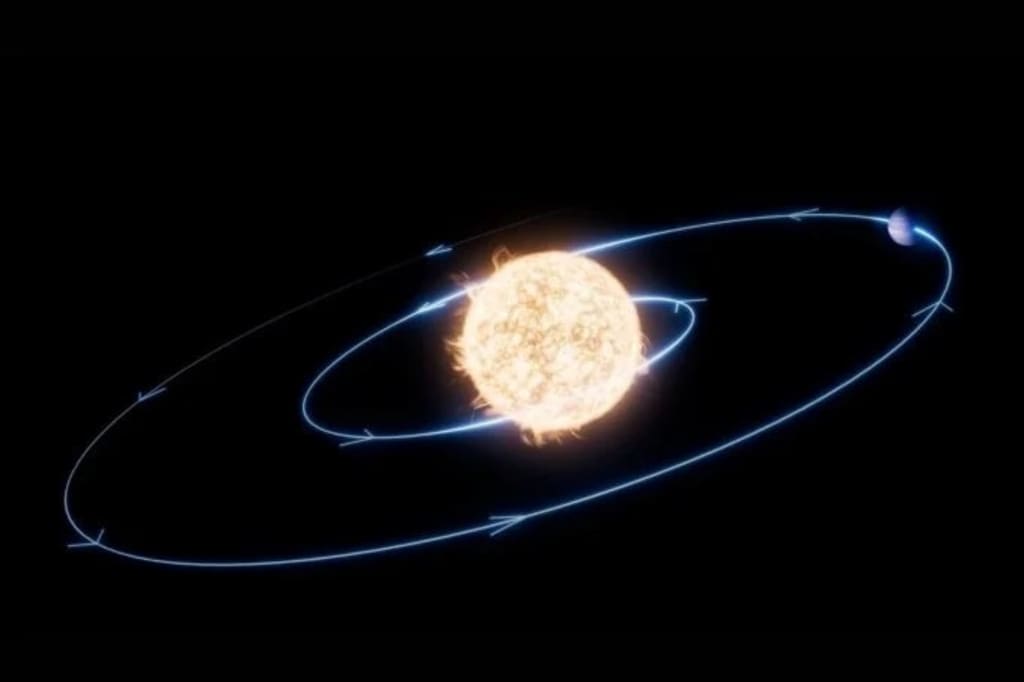
A sudden brightening from a star 12,000 light-years away was initially attributed to the star expanding into a red giant and engulfing a nearby planet, as is typical in some star systems.
But not this time. Webb’s perceptive infrared gaze, courtesy of its MIRI and NIRSpec instruments, peered deep into the dusty aftermath with its Mid-Infrared Instrument (MIRI) and Near-Infrared Spectrograph (NIRSpec) and found otherwise. ZTF SLRN-2020, the star, did not appear to be puffing up like a balloon. This indicates that the planet was not accidentally consumed by explosive stellar behavior. Instead, a slow orbital death spiral sealed the fate of the faraway world.
The unfortunate, roughly Jupiter-sized planet was too close to its host star to be comfortable, according to the new research, which was published today in The Astrophysical Journal. That orbit narrowed over many millions of years until the planet reached the star's atmosphere. The planet’s material began to “smear around the star,” according to study co-author Morgan MacLeod, an astrophysicist at the Harvard-Smithsonian Center for Astrophysics and MIT, in a Webb Space Telescope release. After that, a fiery faceplant into the star marked the end of the planet's story.
“Because this is such a novel event, we didn’t quite know what to expect when we decided to point this telescope in its direction,” said Ryan Lau, lead author of the paper and an astronomer at the National Science Foundation’s NOIRLab, in the same release. “With its high-resolution look in the infrared, we are learning valuable insights about the final fates of planetary systems, possibly including our own.”
When the planet’s material smeared onto ZTF SLRN-2020 it likely caused the dramatic brightening that caught astronomers’ attention.
The gnarly observation was made as part of one of Webb's Target of Opportunity programs, which were reserved for sudden cosmic oddities like supernovas or, it appears, planetary doom spirals. In fact, it is revising astronomers' account of the first star seen actively swallowing a planet. With next-gen telescopes like the Vera Rubin Observatory and Nancy Grace Roman Space Telescope gearing up, we’re likely to catch a lot more of these macabre stories of planetary ends.
About the Creator
Keep reading
More stories from Sajib Mridha and writers in Fiction and other communities.
Becca
"Everything is so... flat." Denille said stupidly as she looked around her new neighborhood. She looked around at the muted desert where even the smallest sign of life seemed to have given up. The plant life was shrubs that were half cooked by the heat and where there should have been a lawn, a mess of white rocks laid glistening in the sun. Even the sky looked stretched thin, like the sun had ironed it smooth. She’d moved from Riverside, where at least there were hills, but here in Barstow, everything felt baked and brittle.
By Sara Wilson4 days ago in Fiction
The Brave Little Fox Who Saved the Forest
Deep inside a vast green forest, where tall trees whispered secrets to the wind and crystal-clear streams sang gentle songs, lived a small red fox named Finn. Finn was smaller than most foxes, and many animals believed he was too weak to survive on his own.
By Rahman Khan2 days ago in Fiction


Comments
There are no comments for this story
Be the first to respond and start the conversation.