

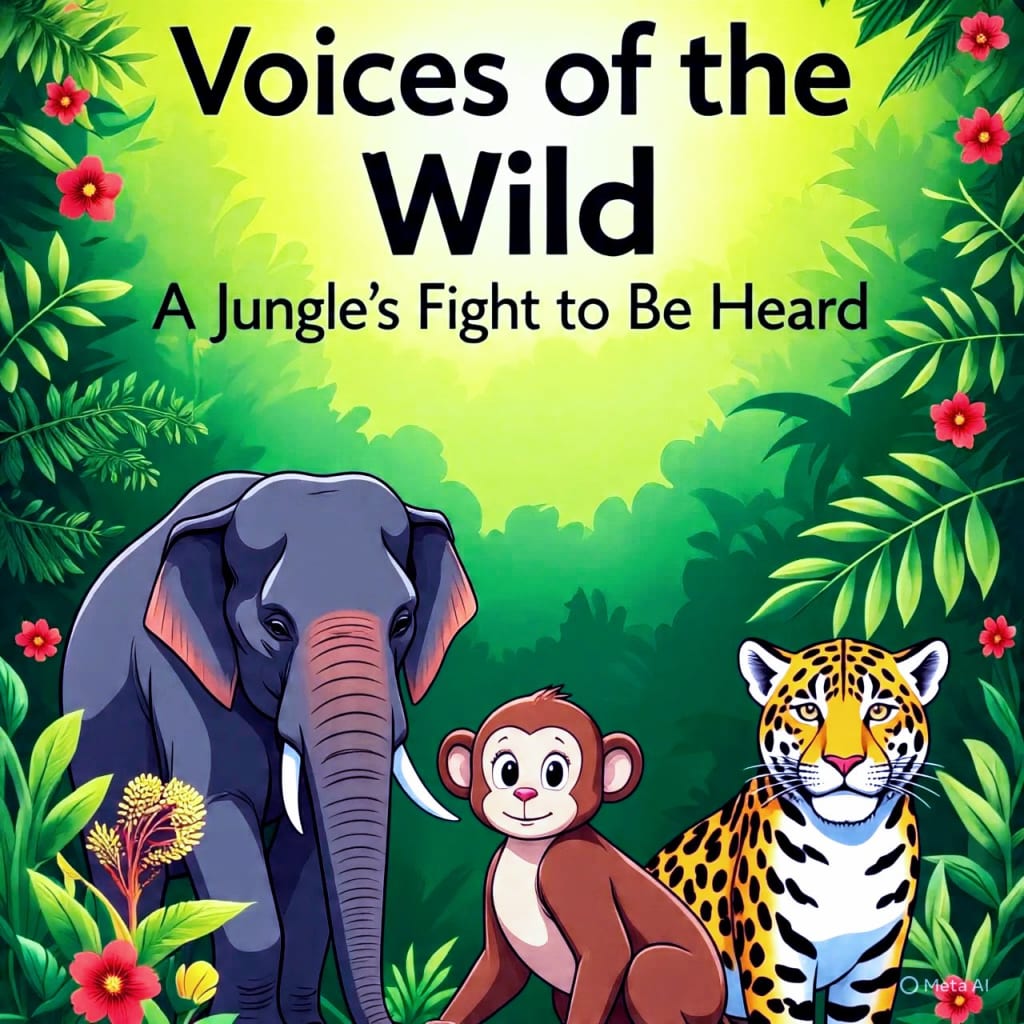
In the heart of the vast Emerald Jungle, where sunlight filtered through ancient trees and rivers whispered secrets to the wind, a different kind of revolution was unfolding. The animals had grown tired—not just of fleeing from traps or the distant crack of rifles, but of their silence in a world dominated by human voices.
And so, every week, beneath the twisted roots of the Grand Baobab Tree, the animals gathered.
It started with the elephants. Wise and deliberate, they recognized a pattern: the more the humans hunted, the fewer animals returned. And the more animals disappeared, the quieter the forest became. That silence was dangerous.
“We need a voice,” said Lumo, the eldest elephant, at the very first meeting. “Not just roars and howls—but a strategy, a media of our own.”
The animals were puzzled. Media? Voice?
That’s when Zara the parrot fluttered to the front, her feathers shimmering like green fire.
“We already have a media,” she said, tapping her beak. “Vocal media. Our words, our messages, our stories. They echo across trees and valleys. It’s time we use them wisely.”
Each species was assigned a role.
The Reporters:
The monkeys, curious and swift, were tasked with gathering information. They swung through trees, observing human paths, photographing traps with pebbles and sticks, and reporting back on hunting hotspots.
The Broadcasters:
The birds—especially parrots, hornbills, and drongos—formed a communication network, relaying news from one end of the jungle to another. They squawked warnings in code: “Humans near the southern river!” “Traps spotted near acacia ridge!”
The Editors:
The owls, with their ancient wisdom and quiet thought, listened to all sides during meetings and helped decide what information mattered most. They organized the jungle’s message.
The Public Relations Council:
The lions, wolves, and leopards—formerly fierce loners—agreed to unite for “image management.” Rather than being feared as beasts, they now shared tales of loss and survival. Cubs orphaned. Packs scattered. Their stories softened hearts—at least among the animals.
And lastly, there was Zara the parrot, who led the "Jungle Voice" — a weekly spoken bulletin aired from treetop to treetop, waterfall to hill. A jungle radio, spoken word.
---
Every Sunday at sunrise, Zara perched atop the Grand Baobab and began:
“Good morning, creatures of the Emerald! This week, we’ve moved three dens away from human paths, dodged two traps, and helped four injured friends recover. We continue our mission: not to fight humans, but to make them hear us, without bullets, without fear.”
The broadcasts worked.
The jungle grew alert, informed, and united. Traps were spotted and dismantled. Paths near poacher zones were avoided. When humans approached, coordinated noise—drums of hooves, squawks, howls—made the forest sound too alive, too aware, for easy hunting.
But still, the problem persisted. Some humans were too greedy. Too determined.
So the Jungle Voice took a bold step: direct communication with humans.
At one meeting, Zara said, “If they won’t hear us in the trees, maybe they’ll hear us in their homes.”
Using stolen radios dropped by campers and forgotten phones, the tech-savvy crows—naturally suspicious but brilliant—figured out how to mimic human speech. They began recording simple messages:
"We are not trophies."
"We are not meat."
"We are not yours to take."
"Please. Leave the jungle wild."
The crows planted these recordings near campsites. Some humans laughed. Some were startled. But a few… paused. And listened.
Videos went viral: a crow speaking in broken English, a parrot echoing the plea of an elephant, a baboon sketching a skull near a trap. Slowly, sympathy grew.
Local conservationists picked up the trend. News spread that “the jungle speaks.” New signs were posted: "Protected Area — The Jungle Has a Voice."
---
Back under the Baobab, the meetings continued.
Not all problems were solved. Hunting hadn’t stopped entirely. But the animals now had more than instincts—they had information, coordination, and most importantly, a voice.
Lumo, with his heavy trunk, looked around at one meeting and said, “We used to run. Now we speak. And one day, they will listen not because we roar… but because we reason.”
Zara flew down beside him. “The media of the wild is not cameras or screens. It’s memory. It's message. And it’s unity.”
The animals roared, barked, chirped, and trumpeted together.
And the jungle echoed—not in fear, but with power.
The End
About the Creator
Dr. D
I'm Dr.D a factional story writer
Email : [email protected]
Whatsapp: +923078028148
Facebook: Hope diabetic foot care clinic


Comments (1)
good bro like your story