
Unspoken on the Twelfth Floor
Where silence is policy—and one word can turn the whole room cold.
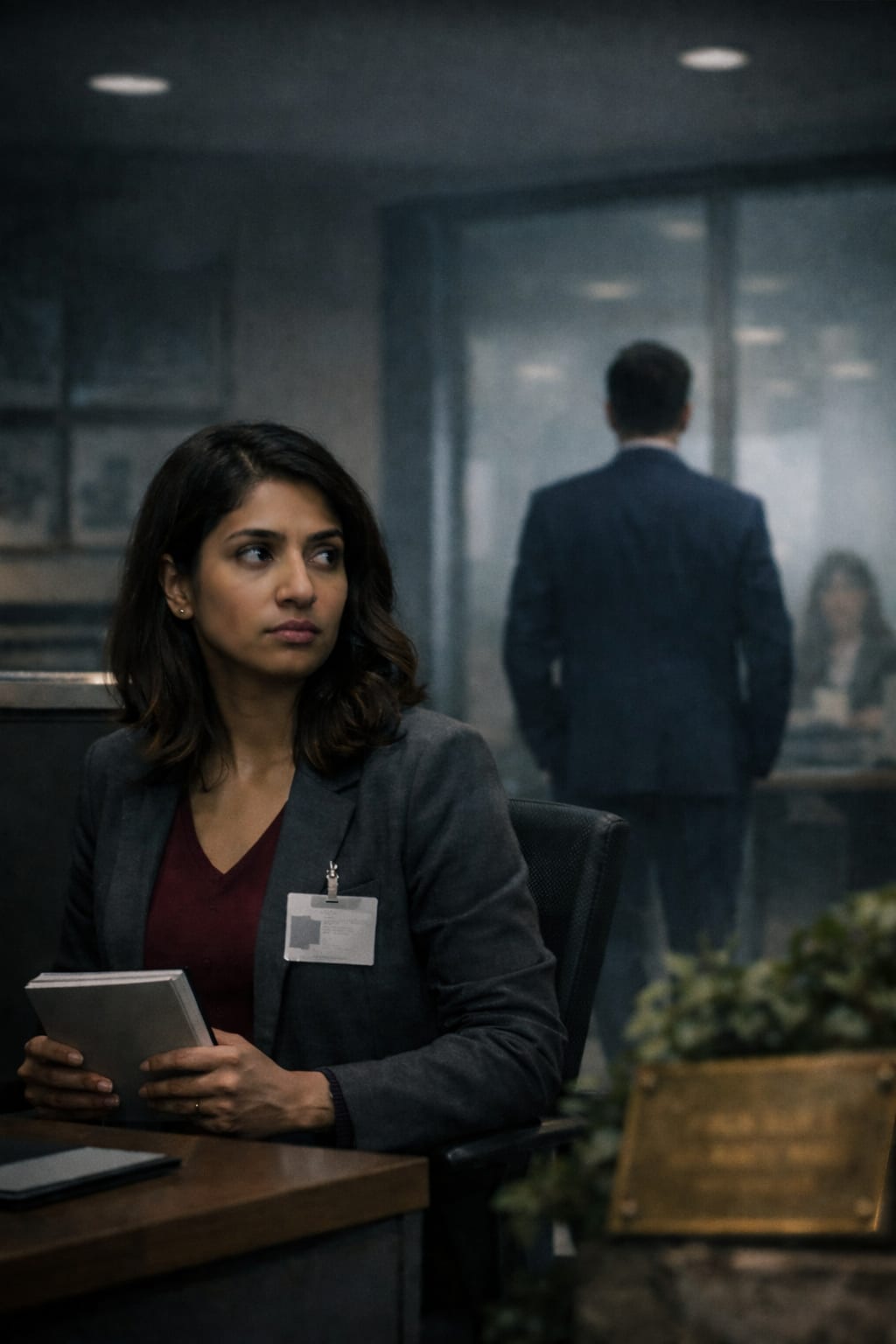
On the first day Mira started at Hargrove & Sons, she learned the building the way you learn a person’s moods—by watching what makes everyone else flinch.
The lobby looked harmless enough. Polished marble. A wall of framed black-and-white photos: men in suspenders standing beside engines, women at drafting tables, a riverboat with HARGROVE painted on the side in block letters. A fountain that didn’t quite sound like water.
The receptionist handed Mira a visitor badge even though Mira had said, twice, “I’m hired.”
“That’s fine,” the receptionist said, smile already moving on. “It’s just for the elevator.”
Mira clipped it on, expecting some kind of magnetized gate. Nothing happened. The elevator doors opened as usual. She stepped inside with two other people—both in the company’s charcoal-gray, both holding their coffees like they were holding something fragile.
A man on the right pressed the button for the ninth floor. The woman beside him pressed nothing at all, just stood with her eyes on the glowing numbers as the doors slid shut.
Mira said, “Hi,” because she had always been the kind of person who filled quiet spaces.
Neither of them said hi back.
Not in a rude way. In a practiced way.
Mira stopped smiling mid-smile. She looked down at the buttons, then up at their faces. Their expressions weren’t unfriendly. They were careful. Like people who had been trained not to touch something hot.
The elevator began to rise.
At the fifth floor, it stopped. The doors opened. A man in a navy suit stepped in, hair still wet as if he’d come in from rain. He didn’t have a badge. Or he had one tucked somewhere invisible. He stood in the center, facing forward.
The charcoal-gray man shifted his coffee from one hand to the other. The woman in gray lowered her eyes.
Mira nodded at the navy suit, reflex more than choice.
The navy suit didn’t nod back. He didn’t look at her, exactly. His gaze passed over her and settled on the panel of buttons, then slid away.
The doors closed.
The air in the elevator changed. Mira couldn’t explain it. It was the same air, the same scent of burnt espresso and aftershave, but it tightened.
The navy suit breathed out slowly through his nose. His shoulders relaxed one millimeter.
Only then did the charcoal-gray man take a sip of coffee.
Only then did the woman in gray blink.
At the seventh floor, the navy suit exited. The doors shut behind him. The woman in gray exhaled hard, like she’d been holding it. She stared at the floor numbers as if they were going to accuse her of something.
Mira waited a beat. Then, quietly: “Is he…?”
The charcoal-gray man’s eyes flicked to her visitor badge. Back to her face.
“You’ll get used to it,” he said, not unkindly.
The elevator climbed. At nine, the doors opened. Mira stepped out into a hallway lined with frosted glass and muted carpet. The woman in gray stayed in the elevator, heading higher.
The charcoal-gray man said, “Don’t worry,” as if Mira had asked a question out loud she didn’t know she’d asked.
He walked away quickly, as if words lingered.
Mira found Human Resources behind a glass door that read PEOPLE OPERATIONS in minimalist letters.
The HR manager, Cora, stood up when Mira entered. Cora’s smile was warm in the way a sweater is warm—useful, intentional, slightly scratchy if you wore it too long.
“Mira. Welcome,” Cora said. “We’re excited.”
Cora gestured for Mira to sit. On the desk were two mugs: one that said WORLD’S BEST BOSS and one that said DON’T TALK TO ME.
Mira sat. Cora slid a packet of forms across the desk.
“We’ll go over the basics,” Cora said. “Payroll, benefits, policies.”
Cora said the words policies with a little extra weight, like it mattered more than payroll.
Mira nodded. She clicked her pen. Cora began: lunch hours, sick time, the usual.
Then Cora paused and flipped a page.
“Here,” she said, tapping a paragraph with her finger. “This is important.”
Mira leaned in. The paragraph was generic: professionalism, respect, confidentiality. Things you could find anywhere.
“What’s important about—” Mira started.
Cora’s finger shifted, covering the sentence Mira had been about to read, as if she’d moved without thinking.
Cora’s smile stayed fixed. “It’s important,” she repeated.
Mira looked at Cora’s finger. Looked at Cora’s face. There was a quiet message there, something between the lines.
Mira nodded. “Okay.”
Cora’s finger moved away, slowly, like lifting a lid from something that might steam.
Cora went on. “We also have a safety drill today at two. You’ll hear the tone.”
“A fire drill?” Mira asked.
Cora’s eyes widened a fraction. “No,” she said, and then she added, gently, “Just a drill.”
As if there were other kinds.
After the paperwork, Cora walked Mira to her desk. The office was a grid of cubicles with low walls, punctuated by glass conference rooms where people stood at whiteboards like they were worshiping equations.
Mira’s team—Data Integrity—sat together in a corner where the lights hummed a little louder.
Her manager, Rafi, popped up from behind a monitor as if he’d been waiting for her arrival in complete stillness.
“Mira! Great. You made it.” He offered his hand. Mira shook it.
Rafi’s grip was damp. Not sweaty, just as if he’d washed his hands a lot.
He pointed to her cubicle. “This is you.”
Mira’s desk was clean: laptop, notepad, company-issued pen. A little plastic plant. Someone had placed a small folded card that said WELCOME in neat handwriting.
Mira smiled despite herself. “This is nice.”
Rafi smiled back, but it didn’t reach his eyes. He leaned closer, voice lowered.
“One thing,” he said. “You’ll notice people here are… particular.”
Mira waited.
Rafi’s gaze darted to the open office beyond them. Then back to Mira.
“If you’re unsure about something,” he said, “ask me. Or ask Cora. Don’t—” He stopped.
Mira prompted, “Don’t what?”
Rafi’s mouth opened. Closed. He swallowed.
“Just ask me,” he repeated, as if the rest of the sentence had been a mistake he’d almost committed.
Mira’s first few hours were onboarding videos and system logins. The company had its own internal messaging platform with channels named things like #wins and #announcements and #quiet-hours.
At 11:58, the whole office rose.
It was so synchronized Mira nearly laughed. Chairs slid back. Mugs were picked up. Phones were checked. People moved toward the break room with the same calm urgency as a school of fish turning.
Mira looked up at Lani, the woman in the cubicle across from hers. Lani had eyeliner sharp enough to cut fruit and a sticky note on her monitor that said LOOK BUSY.
“Lunch?” Mira asked.
Lani’s eyes flicked to the clock, then to Mira, then away. “Sure,” she said, and stood.
In the break room, there was a long table and a row of microwaves. People lined up without speaking much, eyes down, hands busy.
Mira took out her sandwich, feeling like she’d walked into a library where everyone pretended it wasn’t a library.
She sat beside Lani and unwrapped her food.
Across the table, a man with a shaved head and a crooked tie laughed—an actual laugh, a burst that made Mira’s shoulders relax. He was mid-story, hands moving.
“And then,” he said, “my kid looks me dead in the eye and—”
The room went still.
Not frozen. Not dramatic. Just… a collective pause, like a record needle hovering over a groove.
The man’s hands stopped mid-gesture. His mouth remained open on the word dead.
He blinked.
He swallowed the rest of his sentence.
He looked down at his lunch as if it had suddenly required all his attention.
Conversation did not resume.
Not immediately. Not with that man. Not with anyone near him.
People ate. People chewed. People checked their phones. Lani took a slow bite of her salad and stared at her fork like it was fascinating.
Mira waited for the normal awkwardness to pass. It didn’t.
The shaved-head man finished his meal quickly. He stood, threw away his trash with exaggerated care, and left without looking up.
When the door swung shut behind him, the room exhaled as one.
Sound returned. A microwave beeped. Someone’s chair scraped. A woman at the far end began talking again, softly, about weekend errands.
Mira’s sandwich tasted suddenly dry.
She turned to Lani. “What just happened?”
Lani’s eyes stayed on her salad. “Nothing,” she said.
Mira leaned in. “No, really.”
Lani’s fork paused.
Slowly, Lani lifted her gaze to Mira’s face. There was something in it—warning, yes, but also a kind of pity. Like watching someone step toward a hole covered in leaves.
“People here,” Lani said, voice barely above the hum of the fridge, “don’t like certain words.”
Mira waited for the punchline.
Lani didn’t smile. She nodded toward the closed break-room door, as if it might be listening.
“Just… don’t say them,” Lani added.
Mira blinked. “Say what words?”
Lani’s jaw tightened.
She shook her head once, small and sharp, and went back to eating.
At 2:00, the tone sounded.
It wasn’t a fire alarm. It was a long, low note, like a ship horn heard from far away. It vibrated in the bones.
People stood up immediately. No one spoke. They filed into the hallway in silence, walking in a line that didn’t need to be made.
Mira followed Rafi. “Where are we going?”
Rafi didn’t answer.
They moved down the hallway toward the stairwell. Mira noticed a few things in those minutes: how no one ran, how no one looked at their phones, how everyone kept their eyes forward.
The horn continued, steady.
They descended to the ground floor and out a side exit into a fenced courtyard.
Outside, the air was bright and cold. The sky over the city was a flat sheet of white.
People stood spaced out in clusters, all facing the building, hands at their sides or clasped in front of them. Their visitor badges and employee badges caught the light.
The horn stopped.
Silence.
Then a voice crackled over a speaker mounted near the exit door: “All clear.”
As if they’d been holding their breath. The clusters loosened. Some people smiled at each other, weakly. A few laughed too loudly, and then, when they noticed the way the laughter sounded, they stopped.
Rafi finally spoke. “You did great,” he said to Mira, as if she might have done something wrong by accident.
Mira frowned. “It’s just a drill.”
Rafi flinched.
Not visibly. Not dramatically. But his eyes shut for half a second, like he’d braced for impact.
“Right,” he said, too quickly. “Just—yeah.”
He stared at the building’s glass facade, jaw working like he was chewing something he didn’t want to swallow.
Mira felt something cold slide into place in her mind: words. Certain words. Unspoken rules.
Back at her desk, Mira tried to focus on her tasks. The work itself was straightforward—cleaning datasets, flagging inconsistencies, sending reports.
She could do this.
But her attention kept snagging on tiny behaviors.
How people never said certain things. How conversations detoured around invisible potholes. How someone would start a sentence and reroute midstream, like a car avoiding a street they’d been told was closed.
At 4:11, Mira’s email pinged. A calendar invite popped up on her screen: Compliance Check-In – Mandatory.
Rafi appeared at her cubicle wall like a ghost.
“Hey,” he said, too bright. “You got the invite?”
“Yeah,” Mira said. “What is it?”
Rafi’s smile twitched. “Just a quick check. You’ll meet with… with the facilitators.”
“The facilitators,” Mira repeated.
Rafi nodded. His fingers tapped the edge of her cubicle wall in a rhythm that didn’t quite settle.
“Do I need to prepare?” Mira asked.
Rafi’s tapping stopped. “No,” he said. “Just… be normal.”
Mira almost laughed. “I am normal.”
Rafi didn’t laugh. He just looked tired.
The compliance room was on the twelfth floor, in a corridor that felt newer than the rest of the building, like it had been installed after something went wrong.
A woman opened the door before Mira could knock. She wore a beige sweater and no badge. Her hair was tied back so tightly her face looked stretched into perpetual politeness.
“Mira Patel,” she said, as if reading Mira from the air. “Come in.”
The room was bare: table, two chairs, a small speaker in the corner. No windows.
Another facilitator sat already, a man with glasses and a notebook. He smiled without showing teeth.
“Mira,” he said. “How are you finding your first day?”
“Good,” Mira said automatically. “Everyone’s been really helpful.”
The woman in beige nodded, as if pleased by the word helpful.
The man with glasses opened his notebook. “We ask everyone to check in,” he said. “It helps keep things—” He paused. His eyes flicked to the woman. “It helps keep things consistent.”
Mira sat down. Her visitor badge felt suddenly heavy on her chest.
The woman in beige folded her hands. “You’ve worked in other offices before, yes?”
“Yes,” Mira said.
“And you know that every place has its… culture,” the woman said, voice gentle.
Mira nodded.
The man with glasses leaned forward. “Sometimes, new hires struggle because they don’t pick up on certain expectations.”
Mira’s mouth went dry.
“I’m trying,” she said.
The woman in beige smiled. “We know you are.”
A beat passed.
The speaker in the corner emitted a soft click, like it had turned on.
The man with glasses asked, “Tell us about your lunch.”
Mira blinked. “My lunch?”
“Yes,” he said. “The break room.”
Mira pictured the shaved-head man, his laugh cut off like a string snapped.
“I ate a sandwich,” Mira said carefully.
“And did anything unusual happen?” the woman asked.
Mira could feel the rule like a wall. Don’t name it. Don’t step into it.
She said, “It was quiet.”
The woman’s smile widened by a fraction. Approval, maybe.
“Sometimes,” the man with glasses said, “people bring… outside habits inside.”
Mira swallowed. “Like what?”
The woman in beige tilted her head. “Like language,” she said.
Mira’s heartbeat moved into her throat.
The man with glasses flipped a page. “We have a standard here,” he said. “It’s not complicated. Most people follow it without thinking.”
Mira held still. She realized—truly realized—that they were not going to tell her the rule.
They wanted to see if she already knew.
The woman in beige leaned in slightly, voice softer. “You said hello in the elevator this morning.”
Mira’s stomach dropped. “I—”
The man with glasses lifted a hand. “It’s fine,” he said. “It’s common. First-day nerves.”
Mira stared at them. “Is saying hello… not allowed?”
The woman’s eyes softened. “It’s not about hello,” she said.
The man with glasses said, “It’s about what follows.”
Mira’s mind raced through all her conversations. All her words. All the ones that had made people freeze.
Dead.
Drill.
Certain words.
Mira took a careful breath. “I’m not trying to be disrespectful,” she said. “I just… don’t know what I’m supposed to avoid.”
The woman in beige held her gaze, patient as a nurse.
“You’ll learn,” she said.
Mira felt heat rise in her face. “How?”
The man with glasses smiled again, teeth still hidden. “The way everyone learns,” he said. “By paying attention.”
They ended the check-in with a pamphlet that had the company logo on the front and blank pages inside. Not a single word.
“This is for your notes,” the woman said.
Mira left the room with the pamphlet in her hand like a paperweight.
On the elevator down, she stood alone, back against the mirrored wall. When the doors opened at the ninth floor, a navy suit stepped in.
Not the same one as earlier. This one had a different tie. But the posture was the same: centered, forward, still.
Mira stared at the buttons and did not say hello.
The doors closed. The elevator climbed.
The navy suit didn’t press a floor. The elevator continued anyway, as if it already knew.
Mira’s mouth went dry. Her visitor badge felt like it was burning through her shirt.
At the eleventh floor, the navy suit stepped out without looking at her. The doors shut.
Only then did Mira realize she’d been holding her breath.
She stared at her own reflection in the mirrored wall. Her eyes looked bigger than they had that morning.
Back at her desk, Lani was typing with furious concentration. Rafi’s chair was empty.
Mira sat down and opened her blank pamphlet.
She wrote at the top of the first page: WATCH.
Then, beneath it: LISTEN.
Then she stopped, pen hovering.
Because she almost wrote the word that had gotten the man in the break room into trouble.
Dead.
She scratched it out before she finished the “d,” leaving only a crooked line.
At 5:30, as people began packing up, Mira noticed how departures happened. No one said “goodbye.” No one said “see you tomorrow.” They nodded, or lifted a hand, or simply left.
A man walked past her cubicle and tapped the top of her visitor badge once, light as a raindrop. Then he kept walking.
Mira stared after him.
Lani leaned over the cubicle wall. “Don’t take it personally,” she murmured.
“What was that?” Mira whispered back.
Lani shrugged without looking up. “You’re new.”
Mira’s voice dropped even lower. “Lani… what is the rule?”
Lani’s fingers paused on her keyboard. She stared at the screen as if reading something only she could see.
Then she said, very softly, “People used to talk more.”
Mira waited.
Lani’s throat bobbed. She swallowed.
“There was a year,” Lani said, “when they tried this whole ‘open culture’ thing. Transparency. Authenticity.” She made the last word sound like something sour.
“What happened?” Mira asked.
Lani’s eyes flicked around the office. The clusters of people. The glass rooms. The framed photos on the wall of men in suspenders smiling like they’d never heard a horn in their life.
Lani leaned closer, breath warm with mint gum.
“Someone said something,” she whispered.
Mira’s heart beat hard. “What did they say?”
Lani’s gaze locked on Mira’s mouth, not her eyes, like she could physically stop Mira from forming the wrong sound.
“Don’t,” Lani breathed.
Mira shut her lips. Nodded.
Lani’s shoulders lowered, relief sliding through her like water.
“You don’t say it,” Lani said. “Not in the building. Not on the property. Not on the company Wi-Fi. You don’t type it. You don’t joke about it. You don’t use synonyms. You don’t spell it out. You don’t—”
Mira listened, trying to piece together the shape of the forbidden thing from the way Lani circled it.
“What happens if you do?” Mira asked.
Lani’s eyes went far away for a second.
Then she said, “You become a story people swallow halfway through.”
Mira’s stomach tightened. “Like the guy at lunch.”
Lani’s mouth tightened, not quite a yes, not quite a no.
“It’s not punishment,” Lani added quickly, as if that mattered. “It’s just… correction.”
Mira thought of the compliance room, the speaker click, the way they’d remembered her hello.
Correction.
Mira looked at her blank pamphlet again. The scratched-out half-letter.
“What word is it?” Mira whispered.
Lani’s face went pale. “No.”
“I won’t say it,” Mira insisted. “Just tell me.”
Lani’s eyes widened. “Mira.”
Mira waited, hands flat on her desk, showing she wasn’t a threat.
Lani’s lips parted.
For a moment, Mira thought she would finally hear it. The name of the rule. The center of the web.
But Lani stopped. Her gaze snapped past Mira to the aisle.
Rafi stood there, holding his coat. He smiled too hard.
“Hey,” he said, voice bright. “How’s it going?”
Mira looked at him. Then at Lani.
Lani’s expression had shifted back into something neutral and professional so fast it was almost frightening.
“Great,” Lani said. “We were just finishing up.”
Rafi’s eyes flicked to Mira’s pamphlet on the desk. To the scratched-out mark on the page.
His smile didn’t change, but his voice softened. “Mira,” he said, “you don’t need to take notes like that.”
Mira’s skin prickled. “Like what?”
Rafi’s gaze stayed on the pamphlet. “Like you’re studying,” he said. “It makes people nervous.”
Mira shut the pamphlet slowly.
Rafi nodded once, satisfied, then moved on, chatting to someone else in the same bright voice.
When he was gone, Lani released a breath.
“You see?” Lani whispered.
Mira stared at the closed pamphlet. “I didn’t even write anything.”
Lani’s smile was thin. “Exactly.”
That night, Mira went home and stood in her apartment kitchen, staring at her own reflection in the microwave door. She made pasta. She called her mother. She told her, “Work was fine,” because her mother didn’t need this kind of fine.
Later, in bed, she scrolled through the company intranet on her phone. The posts were cheerful: anniversaries, birthdays, charity drives. Photos of people smiling too widely.
There was an archive section with older newsletters. Mira clicked one from five years ago, back when “open culture” had apparently been the theme.
The first page loaded, and right at the top was a headline:
Mira’s thumb froze. Her heart lurched.
The headline had been blurred out with a gray rectangle. So had the first paragraph. And the second.
Every instance of a particular word, Mira realized, had been covered. Not removed. Covered. As if the word still existed underneath and might bleed through if you stared too hard.
Mira’s throat went tight.
She clicked another newsletter.
Same gray rectangles.
She clicked another.
More gray.
It was like watching someone censor a ghost.
Mira set her phone down on the bed and stared at the ceiling.
So the word was not just forbidden now. It had been hunted backward through time, scrubbed from memory, blocked out like a face in a witness protection photo.
She tried to guess it. Her mind offered candidates: fire, lawsuit, union, strike, death.
Death.
The thought landed with a heavy certainty. It fit the flinch in the break room. It fit the compliance tone. It fit the way the building’s photos showed people frozen in black-and-white, immortal and safe.
Mira’s mouth went dry.
She lay there and didn’t say it.
The next morning, she arrived early. She kept her eyes down in the elevator. She nodded without speaking. She watched people’s mouths, the way they reshaped sentences to avoid cliffs.
At 10:17, a printer jammed in the corner. A young guy in a gray polo crouched to fix it, muttering under his breath.
Mira couldn’t hear the words, but she saw the shape of them: frustration, the sharp edge of a curse.
His coworker, a woman with braids, reached out and touched his shoulder gently.
He stopped muttering instantly.
He looked up, face flushed, and nodded once, like he’d been reminded of something sacred.
Mira watched the woman with braids smile, soft and reassuring.
Then the woman glanced toward the ceiling, toward nothing visible, and her smile faded.
She backed away from the printer as if it might explode.
Mira understood then that the rule was bigger than language.
It was attention. It was naming. It was admitting that certain things existed.
At lunch, Mira sat with Lani again. She ate quietly. She listened to the careful topics: streaming shows, weather, traffic. Things that couldn’t summon anything into the room.
Halfway through, a new hire at the far end of the table—maybe from Sales, judging by the shiny shoes—told a story about a near-miss on the highway.
“I thought I was going to—” he began, laughing.
The table went still.
He blinked, as if the silence had slapped him. He glanced around, confusion sharpening into embarrassment.
“I thought I was going to,” he tried again, softer.
A woman beside him reached under the table and squeezed his wrist. The new hire stopped. He swallowed. He picked up his fork and stared at it.
Everyone returned to eating as if nothing had happened.
Mira’s stomach twisted with a strange sympathy. The new hire’s mistake wasn’t that he’d said the word. He hadn’t. He’d approached the cliff.
At 1:59, Mira watched the clock. Her heart sped up as if it remembered the horn. She noticed how everyone in the room subtly shifted, already preparing.
At exactly 2:00, the tone sounded.
People stood. Filed. Silent. Mira went with them, part of the school now. She watched the navy suits in the line, centered and still.
Outside in the courtyard, Mira stood with her hands clasped. Her visitor badge caught the light.
The horn stopped. “All clear,” the speaker said.
People loosened. Smiles came back. Carefully.
As they turned to go back inside, Mira noticed something at the edge of the courtyard: a small plaque bolted to the fence, half-hidden behind a shrub.
Most people walked past it without looking. As if their eyes simply didn’t land there.
Mira’s curiosity tugged at her like a hook.
She waited until the clusters moved ahead. Then she drifted toward the shrub.
The plaque was old bronze, tarnished at the corners. There were scratches across it, like someone had tried to scrape words away with a key.
Mira leaned in.
She could make out letters under the damage, the way you can sometimes make out a message under white-out.
IN MEMORY OF—
Then the next line was gouged deep, obliterated.
But the last line was faintly readable:
…WHO WE DO NOT NAME.
Mira’s throat tightened so hard it hurt.
Behind her, someone cleared their throat.
Mira turned, stepping back from the plaque.
A navy suit stood a few feet away. Not the same one from yesterday. Another. Identical posture, identical stillness, as if the company had grown them in a glass room.
He looked at Mira’s face, then at the plaque, then back at Mira.
His expression wasn’t angry. It was patient. Like he was waiting for her to correct herself.
Mira’s pulse hammered. Her mouth felt full of cotton.
She did the only thing she’d seen people do when they brushed the edge of the forbidden:
She looked down.
She nodded once, small and precise, as if acknowledging a mistake.
Then she stepped away from the plaque and followed the line back toward the door.
The navy suit moved with her, not beside her, not behind her, simply keeping pace at a respectful distance, like a shadow assigned for her safety.
Inside, the building swallowed them. The lights hummed. The carpet muffled footsteps. The framed photos watched with their frozen smiles.
Back at her desk, Mira opened her blank pamphlet again.
She wrote: DON’T NAME.
She stared at the words, then scratched out the second one before she finished the “e.” Too close. Too clear.
She closed the pamphlet.
For the rest of the day, Mira spoke carefully. She said “That’s wild” instead of “That’s scary.” She said “I can’t believe it” instead of anything else. She learned to tell stories that ended before they reached the point.
When someone asked how she was doing, she said, “Good,” because good was safe. When someone said, “See you tomorrow,” by mistake, they laughed too loudly and corrected themselves with a nod.
At 5:45, as she packed her bag, Mira saw the shaved-head man from lunch pass by her cubicle.
He moved quietly, shoulders slightly hunched, like someone who’d once been taller.
Mira wanted to say something—to apologize, to ask if he was okay, to ask what happened to him after he cut off his sentence yesterday.
Instead, she watched him.
He walked to the elevator. He waited. When the doors opened, he stepped inside alone.
Before the doors shut, he glanced back at the office. Not at anyone. Just at the space itself.
He lifted his hand and touched the spot on his chest where a badge would be.
A small tap. A reminder.
Then the doors closed, and he was gone.
Mira sat back down for a moment, bag still on her shoulder.
In the quiet that followed, she understood something she hadn’t on day one: the rule wasn’t there to stop bad luck. It wasn’t superstition.
It was grief engineered into routine.
If you never said it, maybe it never fully happened. If you never named it, maybe it stayed behind the gray rectangles. Maybe it stayed on the other side of the horn. Maybe it stayed outside the building, pressed against the fence like a plaque half-hidden behind a shrub.
Mira stood up. She slipped her visitor badge into her pocket instead of wearing it on her chest.
In the elevator, she did not say hello. She watched the numbers glow. She breathed shallowly until the doors opened at the lobby.
The fountain in the lobby whispered in its almost-water voice.
Mira walked past the framed photos.
At the exit, the security guard nodded at her.
Mira nodded back.
Outside, the city air hit her like truth—cold and loud and full of names. Cars honked. People shouted into phones. Someone on the sidewalk laughed and finished the whole sentence.
Mira stepped into it and let herself breathe the way she couldn’t inside.
She walked away from the building without turning back, careful not to look at the fence, careful not to wonder what word lay under the scratches.
Because she understood now.
And because understanding, here, was the same thing as obeying.
About the Creator
Lawrence Lease
Alaska born and bred, Washington DC is my home. I'm also a freelance writer. Love politics and history.
Keep reading
More stories from Lawrence Lease and writers in Fiction and other communities.
Something Has Already Begun (We Just Don’t Know What Yet)
They didn’t realize it had started until they were already standing inside of it. Not inside a room, not inside a decision — just inside a feeling, the way you sometimes find yourself already halfway down a hill before you remember choosing to walk.
By Lawrence Leaseabout 20 hours ago in Fiction
Choose Your Own Adventure: St Helena Station
*****Preface***** I have been obsessed with Choose Your Own Adventure stories since I was a kid. I credit them with my love of reading and writing. I've been struggling to get my own kids to embrace words the same way I have but they love video games and our occasional Dungeon's and Dragon's game... which gave me an idea. I'll write an interactive story. So far its working; my middle son loves it and can't wait for the next section to come out.
By Sandor Szaboa day ago in Fiction
The Saloon Murders
It’s late in the evening. The cowboys and cowgirls are all in bed. A woman is sitting in the dark again. She is at her desk typing details in a letter. She doesn’t need the light to see what is being typed. She’s got it down to a science. She types it urgently as if it’s a matter between life and death. The typewriter dings with each return. She is frantic and determined to fix what this woman has done to the man she loves. In mid-sentence, the phone rings causing her to jump. She answers it.
By Meredith McLarty7 days ago in Fiction
📢 Raise Your Voice Thread: 02/05/2026
Our “Raise Your Voice Threads” are hosted most alternating Thursdays at 12PM ET to offer creators more avenues to uncover exceptional stories on Vocal. As we are continuously searching for fresh creators and inspiring stories, this thread provides an opportunity to exchange and discuss the stories that have moved and motivated us on Vocal.
By Raise Your Voice by Vocala day ago in Resources


Comments
There are no comments for this story
Be the first to respond and start the conversation.