
"Unraveling the Enigma: The Truth Behind the Bermuda Triangle"
"Navigating Myths, Legends, and Scientific Anomalies"
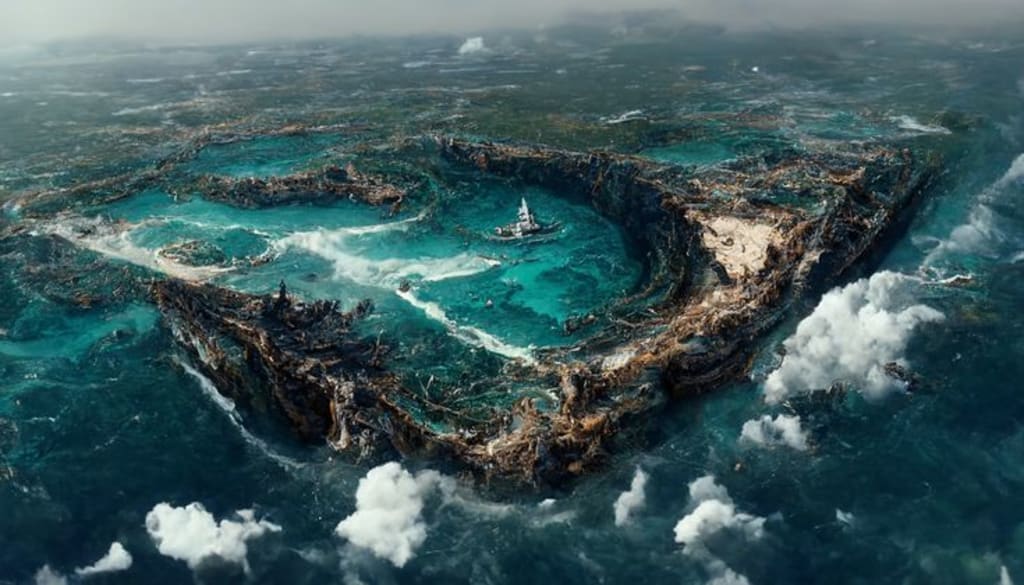
In the vast expanse of the Atlantic Ocean, near the Southeastern coast of the United States, lies a region that has fueled centuries of mystery and speculation – the Bermuda Triangle. Despite being an unofficial designation, this imaginary area of water has gained infamy for the disappearance of more than 50 ships and 20 planes since the mid-19th century.
As a team of daring explorers embarks on a journey to debunk the myths surrounding the Bermuda Triangle, they encounter a myriad of theories, ranging from the legendary lost city of Atlantis to extraterrestrial civilizations. One prevailing myth suggests that Atlantis once thrived in this region, powered by mysterious crystals that emitted energy beams, disrupting electronic devices of passing planes and ships. While intriguing, this theory lacks factual support.
The explorers, armed with scientific knowledge, investigate oddities associated with electronics in the Bermuda Triangle. Astronauts from the International Space Station have observed a weakened Earth's magnetic field in the area, affecting satellites. However, this phenomenon doesn't impact ships and planes directly, debunking some of the fantastical claims surrounding the Bermuda Triangle.
The explorers arrive at the tranquil waters of the Bermuda Triangle, dispelling the notion of an imminent storm. Yet, as they consult their compass, panic ensues when the needle begins to oscillate erratically. Unbeknownst to them, the Bermuda Triangle is one of the rare places where true north and magnetic north align, creating confusion for navigational instruments.
Delving into the historical context, the explorers transport themselves back to the early 20th century, imagining the challenges faced by captains relying on compasses for navigation. They recognize that the Bermuda Triangle's reputation may be rooted in the navigational difficulties faced by seafarers during a time when technology was less forgiving.
Contrary to popular belief, statistical analysis reveals that the Bermuda Triangle does not rank among the top 10 regions for ship disappearances in the Atlantic Ocean. The prevalence of accidents in this area is attributed to its location along a major shipping route, increasing the probability of shipwrecks.
As the explorers venture further, they dismiss theories involving extraterrestrial bases, giant squids, and spacetime rifts, acknowledging the lack of scientific evidence to support these claims. Instead, they consider more plausible explanations, such as methane deposits under the seafloor or the occurrence of rogue waves, which could contribute to ship disappearances.
The narrative then shifts to historical incidents, including the disappearance of the USS Cyclops in 1918 and the Flight 19 incident in 1945, where five planes vanished during a navigation training exercise. These real-life mysteries fuel the Bermuda Triangle legend, leaving unanswered questions and speculation.
In a modern case, the story of pilot Bruce Gnan unfolds, recounting his inexplicable experience of traversing the Bermuda Triangle in a remarkably short time. The explorers grapple with the mysterious circumstances surrounding Bruce's flight, considering atmospheric anomalies, electronic fog, and even the influence of dark energy.
Despite extensive research and exploration, the Bermuda Triangle retains its mystique, leaving some incidents unexplained. As the explorers conclude their journey, they reflect on the intersection of science and legend in this enigmatic region, emphasizing the importance of critical thinking in unraveling the truth behind the Bermuda Triangle.
About the Creator
Keep reading
More stories from Purna Smith and writers in Fiction and other communities.
"Sky bound Tales: From Short Hops to High-Flying Wonders"
In the vast tapestry of air travel, where journeys span continents and skies, the peculiarities of short-haul flights paint a fascinating picture. Take, for instance, the remarkable route of Loganair, connecting the islands of Westray and Papa Westray in Scotland, where a mere 2-mile distance transforms into a thrilling 47-second flight. The Orkney archipelago, with its 70 islands lacking bridges, relies on planes, ferries, and boats to navigate its scattered beauty.
By Purna Smith2 years ago in Humans
Almost
Jazna tells Isaac she’s leaving on a Tuesday morning, while the kitchen is still dim and soft with early light. She waits until the kettle finishes boiling, because she doesn’t want her voice to compete with the noise. Or maybe because she needs those last few seconds to steady herself. “I’m going today,” she says.
By Sara Wilson7 days ago in Fiction


Comments
There are no comments for this story
Be the first to respond and start the conversation.