
Unlearning Who I Thought I Had to Be
A Journey Back to Myself

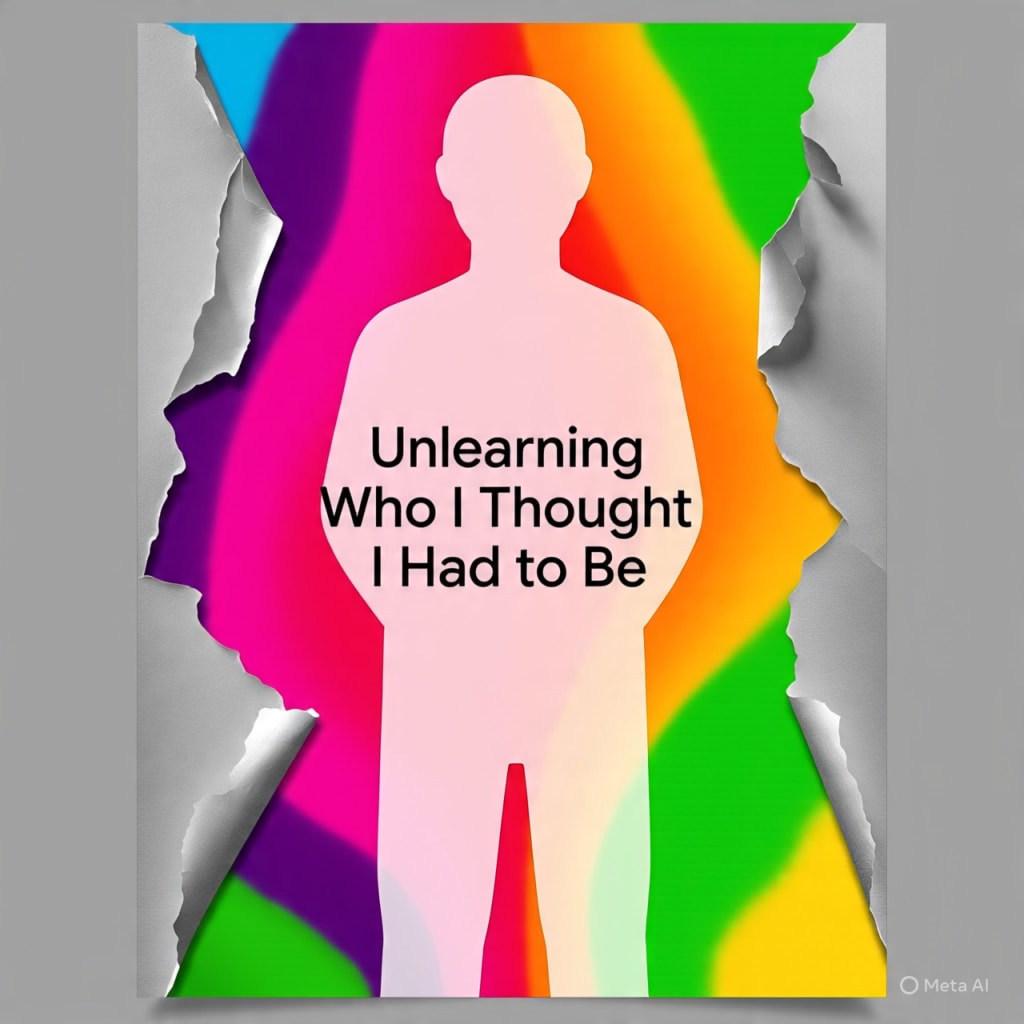
For most of my life, I believed I knew exactly who I was supposed to be. At least, that’s what I told myself. Growing up in a small town, with its quiet streets and sharp opinions, the expectations felt like a heavy cloak draped over my shoulders from the moment I could remember.
“You need to be practical,” my father said, his voice steady as the ticking clock in the living room. “Engineering is a safe career. It’s respectable. It pays the bills.”
My mother nodded along. “And don’t forget to find someone nice to settle down with,” she added with a soft smile that didn’t quite reach her eyes. “Someone who will take care of you, and who you can care for in return.”
The voices of my childhood echoed endlessly in my mind: Be dependable. Be quiet. Be sensible. Be what they expected. I listened, I learned, and I wore their expectations like armor, thinking that if I just fit their mold perfectly, I’d finally be enough.
But beneath the surface, there was a growing restlessness I couldn’t name. A quiet whisper in the back of my mind, asking: What if I don’t want to be what they say?
College was supposed to be my ticket to freedom, a place where I could become the version of myself I was meant to be. But even there, I found myself trapped in the same patterns — studying what was expected, keeping my head down, trying to please everyone.
One late autumn evening, during my third year, I wandered into the campus art gallery almost by accident. The walls were covered in paintings — chaotic splashes of color, abstract forms, and faces that seemed to carry a thousand emotions. I stood in front of a large canvas, the brush strokes wild and free, and suddenly something inside me cracked open.
I realized I had no idea who I truly was beyond the expectations. Who was I beneath the practical student, beneath the good daughter, beneath the invisible cloak I had wrapped around myself for so long?
That night, I started writing — scribbling down thoughts I’d never dared to say aloud. I wrote about my fears, my dreams, the parts of me that felt messy and undefined. For the first time, I wasn’t trying to fit into a shape already carved out for me. I was simply being.
But unlearning who I thought I had to be wasn’t easy.
It was like peeling back layers of paint from an old wall, only to find raw, fragile plaster underneath that could crumble at the slightest touch. Every step forward felt like a battle against years of conditioning, and sometimes I wondered if I’d lose myself entirely in the process.
My family noticed the changes. “You’re acting so different,” my father said one evening when I confessed I wanted to switch majors from engineering to literature. His disappointment was a silent shadow, thick and suffocating.
“You’re throwing away your future,” my mother whispered, almost pleading. “You don’t know what you’re doing.”
I wanted to scream, to explain that I wasn’t throwing anything away — I was finding myself. But the words got stuck, tangled in guilt and love and fear.
The breakthrough came unexpectedly.
I was sitting in a small café, watching the rain fall outside, when an older woman joined my table. She was a writer, a traveler, a woman who had clearly lived many lives in one. We talked for hours — about identity, about fear, about the weight of expectations and the freedom of choice.
She told me, “Unlearning who you thought you had to be isn’t about losing yourself. It’s about discovering the self that was always there, waiting beneath all the noise.”
Her words stayed with me, a balm for my restless soul.
Slowly, I began to rewrite my story.
I dropped the courses that didn’t feel like mine and embraced the ones that sparked my curiosity. I picked up a paintbrush, clumsy at first, but eager to create. I started journaling every day, filling pages with questions, dreams, and confessions.
I surrounded myself with people who saw me — not the version I was supposed to be, but the one I was becoming. Friends who celebrated my quirks, who challenged my doubts, who believed in my potential even when I didn’t.
It wasn’t a smooth journey. There were days when the old voices screamed loudest, when fear clawed at my resolve. But each time, I remembered that woman in the café and the truth she shared.
Years later, standing in a small gallery of my own art, I looked at a piece I had painted the night I finally told my family I was moving to a different city to pursue writing full time. The colors were bright, wild, unapologetic — a reflection of the person I had become.
I realized then that unlearning isn’t a one-time event. It’s a continuous process of peeling back layers, shedding masks, and allowing yourself to be seen — imperfect, evolving, and whole.
I’m still learning, still growing, but now I know the most important lesson: I don’t have to be who I thought I had to be. I get to choose who I want to be, every single day.
The End
About the Creator
Keep reading
More stories from Haris Raheem and writers in Fiction and other communities.
A Letter to the Father Who Left
Dear Dad, I don’t know how to begin this letter. It feels strange even calling you “Dad.” The word feels foreign in my mouth, like a name I was never meant to say. But here I am, writing to you after all these years—years that have shaped me, scarred me, and, strangely enough, strengthened me.
By Haris Raheem7 months ago in Fiction
Pandora’s Burden
“My brother warned me to not accept gifts from the one who commissioned you,” said Epimetheus to the woman clad in silvery raiments standing at the entrance to the temple. Her silver tiara and the silver rings on her fingers and toes glinted in the firelight cast by torches set on either side of the doorway. Lingering in the shadows, beyond the reach of the flames as she was, he could not tell what she held in her hands. At first what appeared to be a box was perhaps a funerary urn, or maybe merely an apple.
By J. Otis Haas3 days ago in Fiction




Comments
There are no comments for this story
Be the first to respond and start the conversation.