

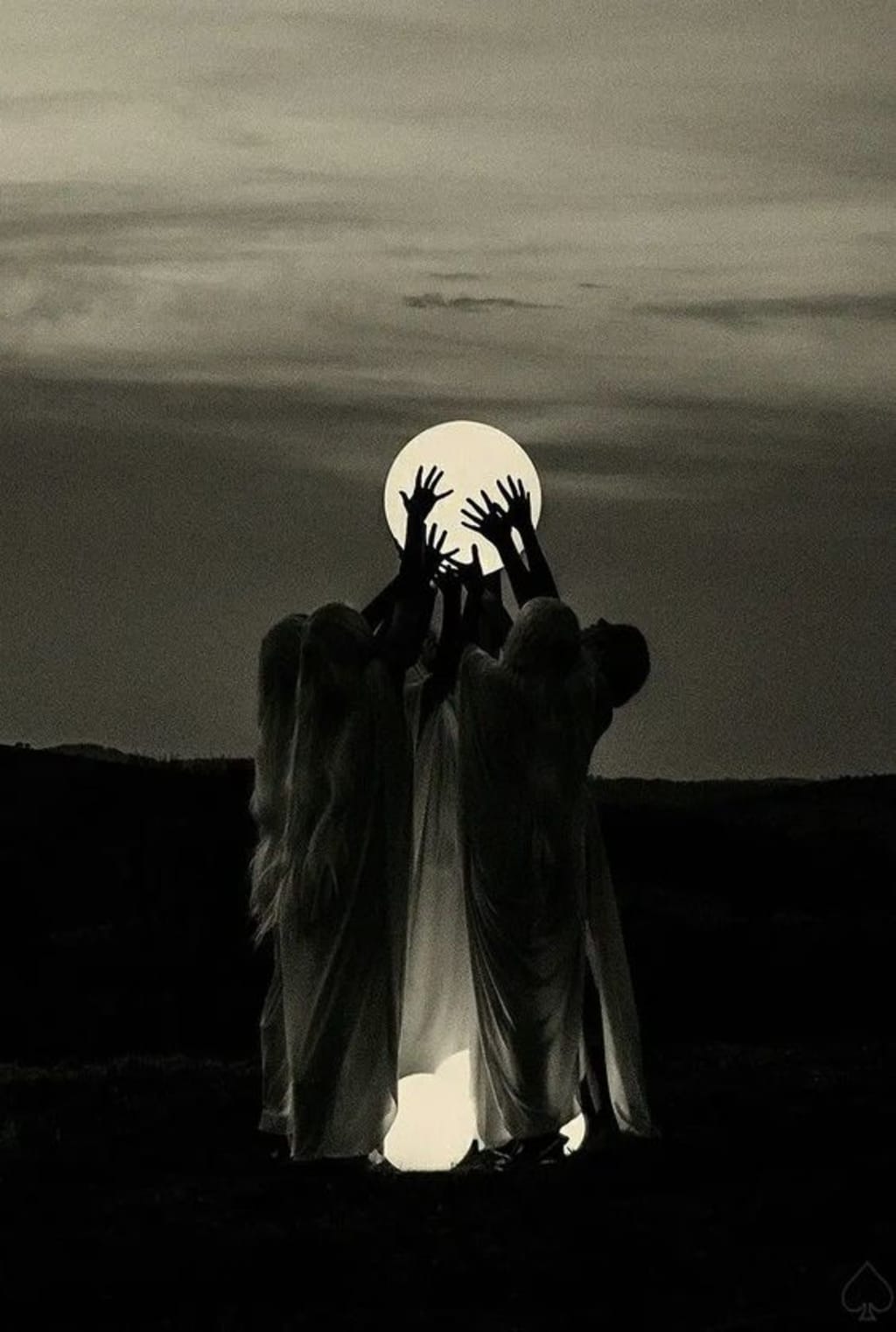
SURGING FORWARD WITH MUDDIED BOOTS, an air of imminence under his black coattails, a tall man approached the portico of a grand estate. Feeble though, in the gloaming. He paused a moment on the gravel path and beheld a frenzied light, and wicked howling emanating from a second storey window in the eastern corner of the house. His pallid face was stricken with apprehension as rain bellowed and gale force winds languished against the man, threatening to fell him like an axe to a tree. He considered leaving, but held fast and gripped the long parcel under his cloak more tightly. He had some difficult business to attend, but business nevertheless.
When dry, and in more comfortable quarters, the man, Sir Malcolm McKenzie, was a handsome fellow. His long locks were black and darling, and hid his sticking ears. His chin was stout and profoundly bearded. He never laughed, but many who knew him well, said the laugh, like his voice, was deep and hearty, and his smile positively radiant. However, it was his gaze, most pleasing, which he possessed. Intense green eyes, with good symmetry and lustre, even in the most horrid circumstances. Of course his character was the most admirable. Come tempest, a most rigid, righteous, bracing man. A vanguard of courage, and a bastion of moral superiority. While at leisure, peaceable, aloof, and of good humour. At that time, in that moment, there had come a tempest.
Once he was close enough, the doors swung open to let Sir Malcolm in, as if sensing his presence, as well as the deluge. The gusting of wind was so powerful, it required both the butler, and a footman, who came skating into the hall, to push the doors closed with all of their might combined.
All the while, Sir Malcolm, soaked to the tongue, raced up marble steps. He stopped, nearly at the mezzanine to open the parcel. He held it awkwardly in the crook of his right arm; then, left-handed, tore the sodden brown paper, and unwound a damp, malachite cloth beneath to reveal a large rifle.
Stood side by side, a pair of house-maids above him gasped, and covered their mouths when they observed the beleaguered Sir Malcolm, armed with a deadly weapon. Yet their mauve and brown blossomy gowns, their pale aprons, even their floppy lace caps, were freshly stained red with blood. As she exclaimed, one of the maids even dropped a large heap of sullied towels and sheets onto the floor. Those, being especially sanguine.
Sir Malcolm looked at the two girls and said firmly “You two may want to go downstairs. I insist that under no circumstances, shall you desire to ever step foot in that room again. This will not be pleasant.”
Immediately, the young women did exactly as the gentleman suggested, and they ran past him with haste, down the stairs, not bothering to pick up the dripping, blood-soaked sheets. They made themselves scarce, and likely cloistered themselves in a dining room.
He turned then to examine the gun and determine if it was up to his exacting standards. It was an older weapon. A finely crafted Baker rifle. It hadn’t been fired in over forty years, yet it was clean, and polished. And no less deadly. He rubbed his thumb along the scrolled brass of the trigger guard, and on the underside of the dark walnut stock. There were no missing parts. Everything seemed to be in order, and it was suitably dry, in Sir Malcolm’s admiring eyes.
He brought the butt of the weapon to the floor, and held it with his knees, then loaded a patch and lead ball into the muzzle, and he did it with a quickness that was second nature to him. Then with the rod, he flash-forced the lead down the barrel; and avoided knocking the pipes when replacing the rod just as fast. Thereafter, like a master of the drum corp twirling drumsticks, he spun the gun about in his left hand, and replaced the stock of the rifle into the cradle of his arm so as to flick back the hammer; prime the lock with pre-measured, fine black powder; and finally close the frizzen. He moved with the swiftness of a honed and hardened soldier ready for battle.
However, no matter how skilled, or accomplished the man, Sir Malcolm could only have been quicker if he weren’t an amputee missing his right forearm. Thus the procedure of loading the rifle took half a minute. Afterwards, the man felt a twinge in his right shoulder. He paused, but only to roll the joint in its socket.
The staircase split in half, to separate the eastern and western wings of Wilderstone Manor. Sir Malcolm continued up the final three stairs on the right. To the East Wing. To the room in question. To the room where a chorus of screams bled into the upstairs corridor.
Once on the upper landing, a loud, golden voice shouted from downstairs, “McKenzie!”
The voice stopped Sir Malcolm, and drew his attention, though he already knew the speaker before he looked.
The butler and the footman had abandoned the front door and were preparing to exeunt from the setting completely, perhaps following the lead of the house-maids whom Sir Malcolm had dismissed.
Standing in the atrium below was another man, in a navy blue coat. Mister Peter Curtis. Neither was he short, nor tall, and not small nor large, but well-proportioned. He was blond, with waves, though presently he had wet, matted hair cropped at the neck. He had sideburns well down to his chin, on a face otherwise clean-shaven; a face immaculately smooth and pale. His cheeks were gaunt and dimpled, nose long and strong, and eyes were wide and blue, and filled with desperation as he looked upward at his friend.
“Peter,” said Sir Malcolm, “go back to Baldgrange. Your recourse here is unnecessary. I can take care of this on my own.”
“I doubt that. Besides, we did not come here to assist, Malcolm. We have come to stop you.”
At this utterance, two women entered the manor, and joined Mister Curtis. One appeared angry, the other, terribly overcome with grief. But still, they bravely strode into the mansion to confront Sir Malcolm. Both as sufficiently wet as the two gentlemen.
First there was Miss Genesee Curtis, Peter’s younger sister, who was easily the most distraught Sir Malcolm had ever seen her, in either his or her life. Her white evening dress appeared torn and mangled at the hem, and soiled by grass and mud, and her own blood. She was cut all over her hands and upon her arms and legs. There was a small gash on her brow, and another upon her temple. It was obvious that tears recently flooded her face, though the streaks could no longer be distinguished from the lashing of rain. Thus a thick brown cloak had been placed upon her shoulders for warmth, and she clutched her brother’s elbow for support. Her teeth chattered, and knees knocked so; it was a wonder how she could be awake and standing, let alone there at all. Miss Curtis, of little height, looked very much like her brother in nearly all respects. Her hair was fair, and likewise was now wet and lacked style, yet it was long enough to reach the small of her back. Her face was thin, soft and delicate, though her skin was brown and dunny. She too had the handsome dimples, the proud nose, and the wide debonair blues that her brother had acquired, though her eyes now glistened and watered.
Contrary to Miss Curtis’s miserable demeanour was the haughty scowl of the ever impertinent Lady Lyra Lyness. And it was difficult to be certain, based on her pursed plump lips, and furled bushy brow, whether she was more or less perturbed than usual. For though her scarlet evening dress was soaked, and her hair piece had blown off her head, and was assuredly ruined, the storm did nothing to affect her negatively. It was, what enraged her, Sir Malcolm’s current action. Lady Lyness was tall and lean, and reasonably handsome. Her neck was long. She had no hair to speak of, but she did have a smooth and shapely head. With a complexion not unlike bronze. Her cheekbones were high, her ears were tiny, and her nose was quaint, and artful. Put together, she looked like the bust of a Nubian queen of old. And her eyes were tawny, wise and worldly. Her voice was rapturous, yet her accent was foreign, and it was obvious that she was not from Cumbria.
Lady Lyness informed Mister Curtis, “We came as fast as was within our power. The other ladies have made themselves sentry, just outside. Nothing else will get in, nothing will get out.” Then she said to Sir Malcolm, “Come downstairs, Sir Malcolm. Put away the rifle. Hear us.”
Mister Curtis added, “For Genesee and myself, Malcolm, take heed! And if not ours, then for Talise’s sake!
“You shan't dissuade me,” replied Sir Malcolm, “Not any of you. My mind is settled.”
Lady Lyness shouted, “There is another way, Malcolm! But this course, with a gun no less, is foolhardy. Nothing good can come of it!”
“In that respect you are certainly wrong, Lady Lyness! Though my deeds shall be evil, I know that, I have made peace with that, good will come of this,” Sir Malcolm hissed. “The means shall be justified by the ends.”
“Your steadfastness is undeniable, and your intentions are noble and resolute, but your judgement is clouded, Sir. This undertaking may possibly be your undoing as a man, and will unquestionably deprive you of your sanity. And should you leave that room alive, by some miracle, after what initially is a pyrrhic victory, at best, will return to haunt you. It will return to haunt us all, and have undoubtedly grown in strength-- an evil fueled in part by our collective bereavement, and its own unnatural enmity and grudge. There will be dire consequences that you cannot begin to comprehend, for which we will all of us, suffer; repercussions that even I cannot foresee, and may very well be impossible to surmount. The ends, as you say, won’t be the end you expect. Sir. Do. Not. Do. This. Trust us.”
Sir Malcolm shook his head and spat back, “Trust you.” He nearly chuckled, however he was far from amused. He regarded the words as if they were poison to him. “I barely know you. You and your sisterhood. The entire time we have been acquainted, you were deceitful. I can say with conviction, without a shadow of a doubt, what I trust most about you, is your capacity and willingness to lie to my face. I am sorry, but no. I cannot put my family in any further jeopardy. I will not risk the welfare or the honour of my family any more than I already have. Nor can I in good conscience stand by and willfully endanger another. I must proceed.”
“Please, Malcolm!” Miss Curtis cried with anguish. She bawled, and mewed, “Don’t do this. I beg you. I know that you love Talise. Please, try it our way. Please.”
Sir Malcolm looked at the young woman sobbing, and his face softened.
“I—” Sir Malcolm’s voice faltered for a moment too. He did not want to hurt Genesee. He did not want to fracture her heart any further than it already had been fractured; and he certainly did not want it to shatter. Her sister Talise, his wife, was dear to her, as Talise was dear to him. Alas, though he did not want to, he knew what he needed to do, and could wait no longer.
“It’s too late, Genesee. I am sorry.”
“Malcolm, stop!” Peter yelled. But this time, Sir Malcolm didn’t stop. He marched on, and disappeared down the hallway, out of sight of Lady Lyness and the Curtises. Although he did hear as someone had begun to chase him up the stairs.
Once in the hallway, time seemed to dilate around Sir Malcolm, and he felt as though his footsteps were sluggish, and uncontrollably so. As were all of his actions, voluntary or otherwise: when he adjusted the rifle cradled in his underarm; when he blinked; when he took a breath; or when his heart beat.
And the haunting screams only continued, and grew steadily louder, echoing the closer he advanced towards it. Louder and of a higher pitch, the sound rang and rumbled in his ears like the whistle of a locomotive. A sound so terrifying, the maroon damask paper began to peel and pucker along the tops and bottoms, and bubble in the middle of the walls as if in the midst of a sudden heat spell; and the timbers behind the paper cracked like bone or sinew; the frames of the paintings lining the hall turned to dust, and the paint of the artworks oozed down like acid; the glass chimneys of the oil lamps burst and skittled through the air towards the man as if there were a breeze, while their cast iron brackets bent and sighed and began to rust over in seconds; and the oak floorboards creaked and warped under foot, and their nails shot up to the ceiling like bullets, it seemed, aiming for the gentleman.
The air grew thick and heavy too. It felt to Sir Malcolm like fording a great river, and he was struggling terribly to advance and not be swept away in a current, and thrown downstairs. However, he did reach the room as he was determined to do. He anchored himself to the door frame with his shoulders, and held firm to the rifle, more than ready to fire.
Here the din of wailing was certainly at its worst, and Sir Malcolm could hear nothing else. As well, a rank and hideous odour penetrated every stratum of the bedroom. Coated every surface of the room therein, a viscous spray of blood, curdled vomit, and all manner of putrefaction. Dirtied discarded clothing and bedding, splinters of broken furniture, and lit, overturned candles and melted wax, littered the room. Somehow, the candlelight was substantial enough to allow the man to glimpse into the dim. What was a small, emaciated creature, filthy and naked, and thrashing about afraid in bed, lay underneath some sinister, immense, amorphous shadow, snarling and ferociously flitting above the bed, and the young woman writhing there.
Though the mass had no eyes or a face, it definitely noticed Sir Malcolm, and it roared with a most unkind malevolence.
About the Creator
Samuel Andrew Milner
There's not much to tell about me. Maybe I should get out more.
Keep reading
More stories from Samuel Andrew Milner and writers in Fiction and other communities.
Black Velvet
Le gâteau. It looked delicious. Or rather he, for he was as masculine in the ways with which dark chocolate had been in him infused, and atop his skin with icing slathered. He was brought into this life however, unknowing of his delicacy, unaware of his handsomeness. He simply had been removed from the kiln where his components were warmed and roused.
By Samuel Andrew Milner3 years ago in Fiction
Flower Bloom 369
FLOWER Bloom 2/25/26 Wednesday By Mariann Carroll Karen had been with Tony for 7 years. Tony started acting strangely after her surgery. He would mow the lawn in the rain and be on his cellphone. He started pushing Karen away. Tony came clean about seeing someone. Karen moved out two months later. Karen moved in with a friend. She felt betrayed.
By Mariann Carroll5 days ago in Fiction




Comments (1)
This passage is full of vivid and descriptive language that makes the scene come alive.👌👌