
Unbreakable Friendship in the Heart of the Jungle
The touching story of a child and an elephant bound together by trust and innocence

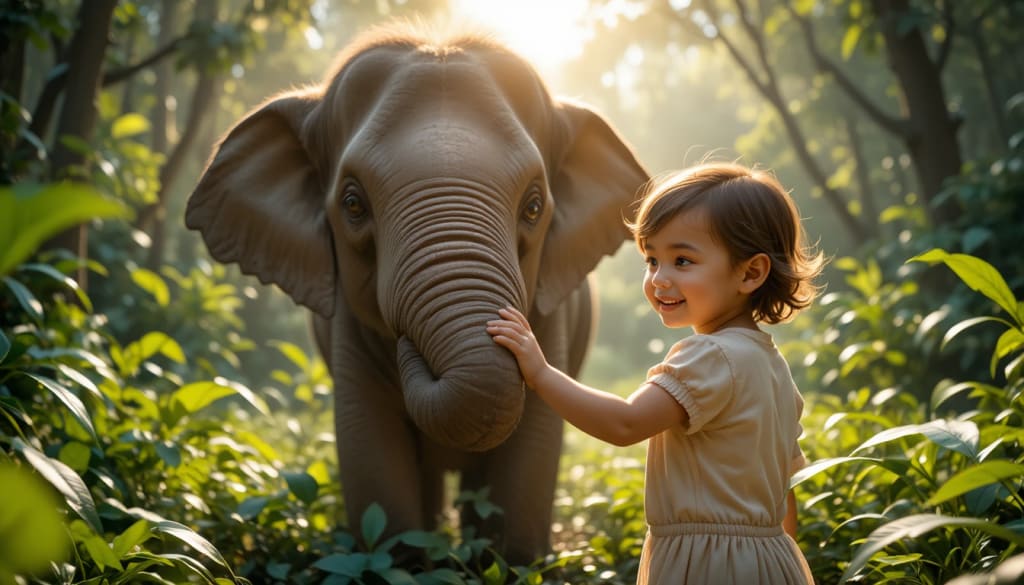
In the eastern part of a wide tropical forest, where tall grasses met thick clusters of trees, a small research camp had been built by wildlife observers. The camp was simple—three tents, a supply shed, and an open area where the workers discussed their daily notes. Among the staff was a young boy named Arin, who had joined the team with his older sister, Lira, a field biologist. Arin was not an official member of the group, but he helped with small tasks such as sorting equipment or carrying messages between workers.
The forest around the camp was known for its elephant population. Most herds kept their distance from humans, crossing old animal paths and visiting water holes scattered across the area. The observers hoped to monitor their movement patterns, feeding habits, and how they interacted with the environment. Arin found the work interesting, even though he did not fully understand the scientific details.
Each morning, the camp woke to the sound of insects and birds. The team checked their maps and planned where they would walk. Arin often stayed behind, but sometimes he followed the group for short distances along the safer routes. He paid attention to the forest floor, recognizing marks that animals left: a broken branch, a wide footprint, or a trail where grass had been pushed aside.
One afternoon, after finishing a small task, Arin wandered to the edge of the nearby clearing. He stayed within the range that Lira had approved, but the trees were thick and the path curved slightly. As he walked, he noticed a patch of fresh footprints in the soft soil. The prints were larger than any he had seen before. They were round, deep, and spaced far apart. He recognized them immediately as elephant tracks—the first ones he had seen so close to camp.
Arin followed the tracks for a few minutes. He walked slowly and listened carefully. The forest was quiet except for the steady hum of insects. When he turned around a large tree trunk, he saw something unexpected: a young elephant standing alone in a shallow dip in the ground. The elephant did not appear injured, but it was smaller than the others Arin had seen from a distance. It was likely a juvenile that had wandered away from its herd.
The elephant noticed Arin almost immediately. It lifted its head slightly, its ears relaxed rather than flared. Arin froze, remembering the instructions he had learned from the observers. He remained still and avoided sudden movement. The elephant did not show signs of distress. Instead, it took one slow step forward, testing the boy’s presence.
Arin stepped back carefully to maintain distance, but he also tried not to signal fear. The elephant stopped again and lowered its trunk, brushing the ground. It was not a threatening gesture. The two of them simply stood there, watching each other from a respectful space.
After a minute, Arin turned slightly so the elephant could walk past if it wished. The elephant responded by taking a few calm steps closer—not enough to alarm him, but enough to show continued interest. Arin remained steady. He did not try to touch it. He simply allowed the moment to pass naturally.
He knew he should return to camp and report what he had found. But before leaving, he took a few mental notes: the elephant’s size, its height compared to nearby branches, the shape of its ears, and the dust on its skin. These details would be useful for Lira and the rest of the team.
Arin slowly stepped backward, giving the elephant a clear view of the path. The elephant watched but did not follow. It lifted its trunk, sniffed the air, then turned away and walked deeper into the forest. Leaves rustled under its feet, and within moments the trees hid its shape.
When Arin returned to camp, he immediately told Lira what he had seen. She asked him for a precise description and noted everything in her field journal. The team decided to investigate early the next morning to see if the elephant was still nearby. They were careful not to disturb it, knowing the herd might be searching for the juvenile.
The next day, the observers followed Arin to the location. The footprints were still visible, though lighter after a night of wind and insects. They found several broken branches that suggested the elephant had moved north. One of the trackers found older prints from a larger herd in the same direction. This was a positive sign—the juvenile had likely rejoined its group.
Over the next several days, Arin continued helping around the camp. He did not attempt to wander farther than allowed, but he remained aware of the forest’s subtle signs. He appreciated how much information could be learned simply by paying attention. The workers often commented on how observant he was for his age.
Weeks passed, and the routine at the camp continued. The researchers gathered data, checked equipment, and documented animal behavior. They sometimes spotted elephants from a safe distance. Arin occasionally wondered if the young elephant he had seen was among them. He could not be sure; many juveniles looked similar. But the idea stayed in his mind as a quiet memory rather than something emotional.
By the end of the season, the team prepared to leave the forest. They packed their equipment, cleaned the site, and ensured no supplies were left behind. Before departing, Arin took one last walk around the edge of the clearing—within the permitted range. He looked at the tree line where he had first seen the elephant and considered how large the forest truly was. Many animals lived their entire lives hidden among the leaves and branches.
Arin returned to the transport vehicle as the team prepared to leave. The forest remained much as it had been—its sounds, its colors, and its paths unchanged by the brief presence of people. As the vehicle moved away from the clearing, Arin looked back once, noting how quickly the trees closed behind them.
The encounter with the young elephant had not been dramatic or emotional, but it had been a clear example of how humans and wildlife could cross paths in a quiet, respectful way. For Arin, it was simply part of learning how to observe the natural world—an experience he would remember as one piece of a much bigger landscape.
About the Creator
Keep reading
More stories from Bilal Mohammadi and writers in Fiction and other communities.
An Unexpected Encounter in the Jungle
The jungle was alive with the soft chorus of insects and the distant calls of hidden creatures. Morning sunlight filtered through the thick canopy, breaking into shimmering golden fragments that danced over the river. The water flowed gently, winding like a silver ribbon between the towering mountains that guarded it on both sides. It was a place untouched by roads or villages, a place where silence had a heartbeat of its own.
By Bilal Mohammadi2 months ago in Fiction
Ludacris and Nelly draw backlash over bookings at MAGA-coded music festival
Ludacris and Nelly headlining a mostly right-wing event is good for them. It’s also great for the genre of hip hop. The two rap veterans have showcased their talents on other stages. Why can’t they perform for mostly MAGA folks and grab that bag?
By Skyler Saunders4 days ago in Beat



Comments
There are no comments for this story
Be the first to respond and start the conversation.