
To the Edge and Back Again: A Drive Through Darkness
What one rainy curbside night taught me about survival

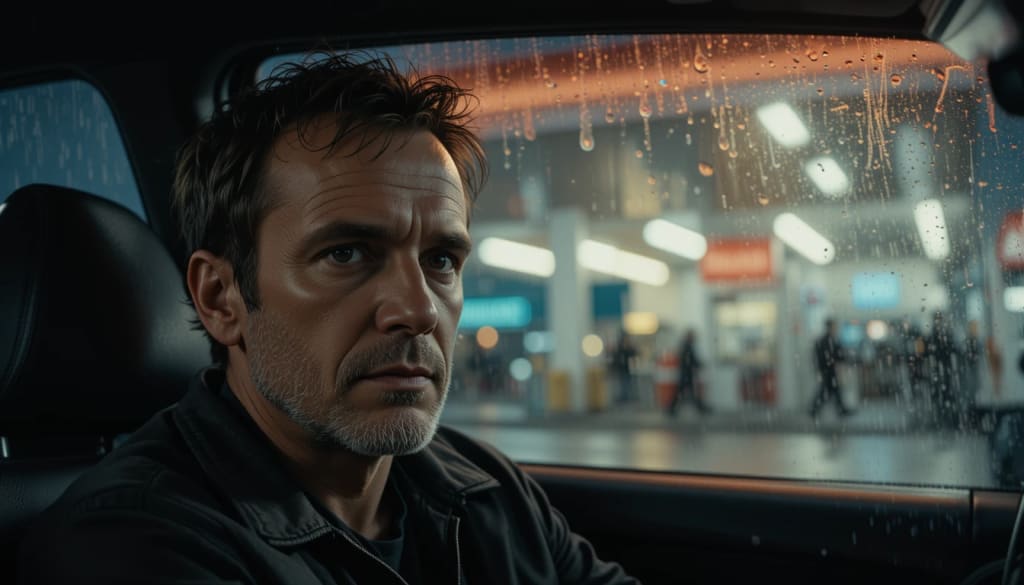
The rain came down in sheets, blurring the world beyond the windshield. Ethan gripped the steering wheel of his old Toyota, the wipers struggling to keep up. It was just past midnight, and the highway stretched ahead, a slick ribbon of asphalt cutting through the Oregon wilderness. At 27, Ethan was a delivery driver, working nights to pay off student loans for a degree he wasn’t using. His life felt like this road—endless, directionless, and shrouded in a storm he couldn’t outrun. Tonight, though, the darkness would teach him something about survival, something he’d carry long after the rain stopped.
Ethan’s shift had started like any other. He’d loaded his car with packages at the warehouse, the air thick with the smell of cardboard and diesel. His phone buzzed with delivery alerts, each one a pin on a map that kept him moving. He liked the solitude of night deliveries, the way the world quieted, leaving only the hum of his engine and the occasional crackle of the radio. But tonight, the storm had rolled in fast, turning quiet streets into rivers and his routine into a gauntlet.
He was an hour from Portland, on a rural route flanked by towering pines, when his phone died. No GPS, no music, just the rain hammering the roof. Ethan cursed under his breath, squinting through the fogged windshield. The dashboard clock read 12:17 a.m. He had three more stops, but the road signs were barely visible, and the weight of the night pressed against him. He felt it then—a familiar tightness in his chest, the kind that had shadowed him since he was a kid. His mother called it anxiety; Ethan called it the dark, a thing that lived inside him, waiting for moments like this to whisper, You’re not enough.
He pulled over at a gas station, its neon sign flickering like a dying star. The lot was empty except for a pickup truck parked crookedly near the pumps. Ethan sat for a moment, the engine idling, trying to shake the dark. He checked his phone again—still dead. His charger was buried somewhere in the backseat, tangled in a mess of jackets and empty coffee cups. He stepped out into the rain, the cold biting his skin, and popped the trunk to grab a flashlight.
That’s when he saw her. A woman, maybe in her forties, stood under the gas station’s awning, her coat soaked, her hair plastered to her face. She was shivering, clutching a paper bag that was starting to disintegrate in the wet. Ethan hesitated. He wasn’t the hero type—too awkward, too tired—but something about her stillness, her quiet desperation, pulled him toward her.
“You okay?” he called, his voice barely carrying over the rain.
She looked up, startled, her eyes wide but guarded. “Car broke down,” she said, nodding toward the pickup. “No signal out here. Been waiting for… I don’t know. Something.”
Ethan glanced at the truck. Its hood was up, but it looked like it hadn’t moved in hours. “You need a ride?” he asked, surprising himself. He wasn’t supposed to take passengers, but the words were out before he could stop them.
She studied him, her gaze sharp, then nodded. “If you’re sure. I’m just trying to get to Salem.”
Ethan’s stomach twisted. Salem was 30 miles out of his way, and his last delivery was due by 2:00 a.m. But the dark was loud tonight, and helping her felt like a way to quiet it. “Hop in,” he said, gesturing to his car.
Her name was Rachel, she told him as they pulled back onto the highway. She was a nurse, working the graveyard shift at a hospital in Salem. Her truck had died halfway through her commute, and she’d been stranded for two hours, too far from anything to walk. “You’re a lifesaver,” she said, her voice soft but steady. “Not many people stop these days.”
Ethan shrugged, keeping his eyes on the road. “I know what it’s like to be stuck.”
They drove in silence for a while, the rain a constant drumbeat. Ethan’s mind churned, replaying the day’s small failures: a late delivery, a customer’s complaint, the way his boss had sighed when he’d asked for a day off. The dark whispered louder, telling him he was wasting his life, that he’d never be more than a guy driving packages through the night.
Rachel broke the silence. “You look like you’re carrying something heavy,” she said, her tone matter-of-fact. “Not the boxes in the back. Something else.”
Ethan’s grip tightened on the wheel. “Just a long night,” he said, dodging.
She didn’t push, but her presence felt like a mirror, reflecting the weight he tried to ignore. He thought of his childhood in Eugene, where his father’s absence left a hole his mother couldn’t fill. He’d been a quiet kid, good at school but bad at believing in himself. College was supposed to change that—a biology degree, a plan to work in conservation—but the loans piled up, and the jobs didn’t come. Now he was here, driving through a storm, wondering where he’d gone wrong.
“You ever feel like you’re running out of time?” he asked, the words slipping out.
Rachel laughed, a sound both bitter and warm. “Every damn day. I’m 43, working nights, living paycheck to paycheck. Thought I’d have it figured out by now.” She paused, then added, “But you keep going. That’s survival. One foot in front of the other, even when it’s dark.”
Her words hit Ethan like a lifeline. He glanced at her, her face lit by the dashboard glow, and saw something he recognized—resilience, hard-won and unpolished. The dark quieted, just a little.
The road curved, and the rain eased, revealing a sky pricked with stars. Ethan’s last delivery was a house on the outskirts of Salem, a small package of books left on a porch. Rachel waited in the car, and when he returned, she was scribbling something on a scrap of paper. “My number,” she said, handing it to him. “In case you’re ever stuck out here. Or just need to talk.”
He took it, his fingers brushing hers. “Thanks,” he said, meaning it.
They reached the hospital at 1:45 a.m. Rachel grabbed her bag, now a soggy mess, and turned to him. “You didn’t have to do this, but you did. That’s not nothing, Ethan.” She smiled, then stepped into the rain, disappearing into the hospital’s glow.
Ethan sat there for a moment, the engine idling. The dark was still there, but it felt smaller, less like a monster and more like a shadow he could outrun. He plugged in his phone, now miraculously alive, and saw a missed call from his mother. He’d call her back tomorrow, he decided. Maybe he’d even visit, tell her about the night he drove a stranger through a storm and found something like hope.
The drive back to Portland was quieter, the rain a soft patter now. Ethan turned on the radio, letting an old rock song fill the car. He thought of Rachel’s words—one foot in front of the other—and realized they were enough for now. He didn’t need to have it all figured out. Survival wasn’t about grand plans or big wins; it was about showing up, even when the dark was loud.
When he got home, the clock read 3:22 a.m. His apartment was a mess—dishes in the sink, laundry on the floor—but it felt less like a cage. He pulled out Rachel’s number and taped it to his fridge, a reminder of the night he’d gone to the edge and come back. Then he opened his laptop, something he hadn’t done in months, and started typing. Not a resume, not a plan, but a story—about a rainy night, a stranger, and the moment he decided to keep going.
The next day, Ethan woke to sunlight streaming through his window. He made coffee, slow and deliberate, and sat on his balcony, watching the city hum. His shift didn’t start until dusk, and for the first time in a while, he didn’t dread it. He thought of posting about the night on X, but decided against it. Some stories were better kept close, like a map for the road ahead.
He drove that evening with the windows down, the air crisp and clean. The dark was still there, whispering, but Ethan was listening to something else now—a quieter voice, one that said he was enough, just as he was. The highway stretched before him, and for once, it didn’t feel endless. It felt like a beginning.
About the Creator
Shohel Rana
As a professional article writer for Vocal Media, I craft engaging, high-quality content tailored to diverse audiences. My expertise ensures well-researched, compelling articles that inform, inspire, and captivate readers effectively.
Keep reading
More stories from Shohel Rana and writers in Fiction and other communities.
Fear, Alone: The Quiet Words That Haunt Us
The morning was soft, the kind of dawn that draped the world in a hush, as if the sun itself was hesitant to rise. Clara sat on the edge of her bed, her bare feet grazing the cold hardwood floor. Her apartment was small, a one-bedroom in a quiet corner of Portland, where the walls were thin enough to hear her neighbor’s coffee maker hiss each morning. At 29, Clara was a poet, or at least she had been, before the words stopped coming. Now, she was a barista, a listener, a keeper of secrets—her own and others’. The quiet words, fear and alone, lived in her chest, heavy as stones, whispering truths she wasn’t ready to face.
By Shohel Rana8 months ago in Fiction



Comments
There are no comments for this story
Be the first to respond and start the conversation.